
How Many Types of CNC Machine Does a Job Shop Really Need?
Six machine families cover almost every metal and plastic part. Each one is defined by how it removes material, how many axes move at once, and how big the work envelope is. Read this and you can match a part to the right machine before you ask for a quote.
Key takeaways
How Many Types of CNC Machine Are There in Practice?
Ask ten machinists and you will get ten counts, because the answer depends on whether you split by spindle orientation, by axis count, or by material removal method. For quoting purposes, six types of CNC machine cover almost everything: CNC milling, CNC turning, mill-turn, EDM, waterjet, and additive or hybrid machines. Every one of them is a cutting tool or an electrode moving under programmed control. The differences are in what moves, what stays still, and how many directions the motion can take.
A CNC mill holds the workpiece still and spins a rotary cutter. A CNC lathe does the opposite: the workpiece spins and the tool stays put. That single difference decides most routing. If your part is a shaft, a bushing, a fitting, or anything with a centerline, it belongs on a lathe. If it has flat faces, pockets, ribs, or bolt patterns on more than one side, it belongs on a mill.
Axis count is the second filter. Three axes means X, Y and Z move in straight lines. Add a fourth and the work can rotate around one axis. Add a fifth and the tool can tilt, which lets a stub cutter reach into deep pockets with short flute length. More axes reduce the number of times someone has to unclamp the part. That matters because every re-fixture adds position error and hours.
GreatLight runs 127 high-precision CNC machines across three plants in Dongguan and Singapore, including 16 simultaneous 5-axis machining centers, 12 four-axis mills, 27 three-axis machines and 16 mill-turn centers. We hold ±0.005 mm on production parts and inspect 100% of them before shipment. That range is why we rarely turn a job away for being the wrong shape.
CNC Milling: 3-Axis, 4-Axis and 5-Axis
A 3-axis mill is the workhorse. The table moves in X and Y, the spindle moves in Z, and the cutter comes down from one direction. It is fast, rigid and cheap to run. Use it for plates, brackets, housings with a single open face, and any part you can describe as a block with features on top. Typical work envelopes on our 3-axis machines run 750 × 1,150 × 550 mm and 600 × 600 × 600 mm.
The limit shows up when a feature sits on a side wall. Now you need a second setup, which means a second fixture, a second datum, and a fresh chance to be 0.02 mm out. A 4-axis mill adds a rotary table. With a Ø400 mm rotary table, we can index the part to three or four faces without unclamping, and cut continuous contours on a cylindrical surface. It is the right call for long parts with features around the perimeter.
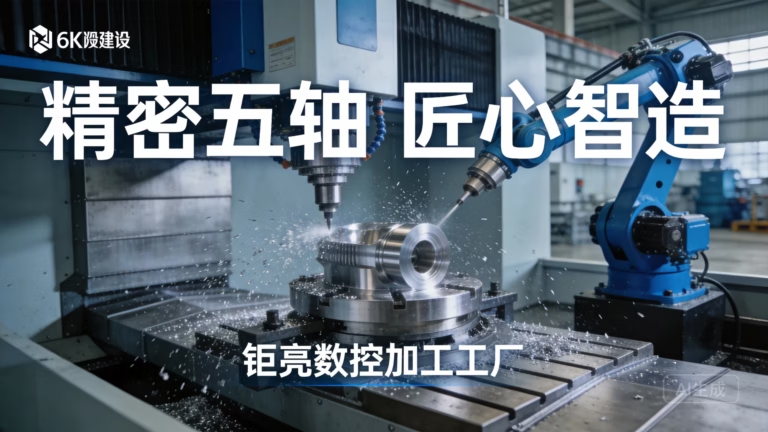
A 5-axis machine tilts the tool as well as the table. Two rotary axes let the cutter approach at an angle, so a short, stiff tool can machine a deep cavity that a long tool could only reach with chatter. This is how you hold ±0.005 mm on a tall thin wall. It also lets one setup cover five faces, which cuts fixture cost and lead time. On a 16-machine 5-axis fleet, we machine impellers, medical housings and engine components that would need four setups on a 3-axis mill.
5-axis is not automatically better. Programming takes longer, cycle times can be higher on simple parts, and the machine hour rate is higher. If your part fits in a vise and has features on one face, a 3-axis mill will be cheaper and just as accurate. Choose 5-axis when the geometry demands it: undercuts, compound angles, deep pockets, or tight true-position callouts across several faces.
CNC Turning and Mill-Turn Centers
A CNC lathe spins the workpiece against a stationary tool. This makes it the fastest way to produce cylindrical parts: shafts, pins, spacers, adapters, valve bodies and threaded fittings. Turning is naturally good at holding diameter tolerance and concentricity because the part rotates on its own centerline. Surface finish on a turned OD is usually easier to control than on a milled face.
Live tooling changes the picture. A lathe with driven tools can drill an off-axis hole or mill a flat on the side of a shaft without moving the part. That saves a second operation and a second tolerance stack. If your part is mostly round but has a few cross features, this is often the cheapest route.
A mill-turn center goes further. It combines a turning spindle with a milling spindle, so the part can be turned, then milled, drilled and tapped in the same cycle. Off-center holes, flats and slots land in one setup. The benefit is positional accuracy between the turned diameter and the milled feature, which is exactly where multi-setup processes lose tolerance. We run 16 mill-turn centers for hydraulic manifolds, motor housings and sensor bodies.
Turning has one clear boundary. Long, thin parts deflect under cutting force, so you need a steady rest or a Swiss-type machine with a guide bushing. Square and rectangular parts with no centerline do not belong on a lathe at all. When in doubt, look at the drawing: if there is a dominant axis of revolution, turning wins.
EDM, Waterjet and Additive: When a Cutter Cannot Do It
EDM removes material with controlled electrical sparks between an electrode and a conductive workpiece, submerged in dielectric fluid. Nothing touches the part, so hardness does not matter. We use it for hardened tool steel, 440C, and internal corners sharper than any end mill can leave. Wire EDM cuts a straight profile through a plate with a kerf around 0.3 mm and holds ±0.005 mm on thickness up to a few hundred millimeters. Sinker EDM burns a shaped cavity with a formed electrode.
The trade-off is speed and material. EDM only works on conductive material, so aluminum and steel are fine but plastics are not. It is slow compared with milling, and the recast layer left on the surface needs a finishing pass if the part sees fatigue. Use EDM for a die insert, a hardened punch, or a slot with a 0.2 mm inside radius. Do not use it to clear a large pocket.
Waterjet cuts with an abrasive stream and no heat. It is the choice for thick plate, for materials that crack under thermal load, and for parts where you want a single flat profile with minimal fixturing. It is not a precision finishing process in the same class as milling.
Additive and hybrid machines sit at the other end. A metal printer builds near-net shape, then a milling head finishes the critical faces without re-fixturing. This suits conformal cooling channels and lattice structures that no subtractive tool can reach. For most production parts, though, subtractive machining is still faster and cheaper once you pass a few dozen units.
How to Route a Part to the Right Machine
Run these six checks in order before you send an RFQ.
- 11. Read the geometry for a dominant axisIf the part is a solid of revolution, start with turning. If it is a block with features on multiple faces, start with milling. Write down the number of distinct faces that carry toleranced features.
- 22. Count the setups on 3 axesOne face means a 3-axis mill with soft jaws. Two or three faces means a 4-axis mill with a rotary table, or a tombstone fixture. Four or more faces, or any compound angle, pushes you to 5-axis.
- 33. Check the size against the work envelopeCompare the part to 4,000 × 400 × 150 mm for our largest travel, 750 × 1,150 × 550 mm for medium, and 500 × 500 × 450 mm for compact machines. Oversize parts need splitting, welding, or a different process.
- 44. Match the material to the processAluminum, stainless 303/304/316, 17-4PH and titanium TC4 all cut well. Hardened tool steel and 440C go to EDM. Plastics such as POM, PEEK and PC need sharp tooling and air blast rather than flood coolant.
- 55. Set the tolerance floor±0.005 mm is achievable on critical features with the right setup, but do not call it on every dimension. Reserve tight tolerance for the two or three features that actually control function, and leave the rest at ±0.1 mm to save cost.
- 66. Choose the finish before quotingAs-machined runs Ra 1.6–3.2 μm, a high-quality finish runs Ra 0.8–1.6 μm, and a fine finish runs Ra 0.2–0.8 μm. Fine finishes need slower feeds and often a separate pass, which adds cycle time.
- 77. Decide the quantity and fixture planOne prototype can be cut from a vise or soft jaws. Above roughly 50 parts, a dedicated fixture pays for itself in setup time. We run from a single prototype to 10,000+ part runs with no minimum order quantity.
- 88. Send the model, drawing and finish callout togetherA STEP file plus a 2D drawing with datums and GD&T removes the guesswork. We return a quotation and free DFM analysis within 12 hours, and production can start within 24 hours.
Types of CNC Machine Compared
Use this to shortlist before you talk to a shop.
| Machine type | Best for | Typical tolerance | Watch out for |
|---|---|---|---|
| 3-axis mill | Plates, brackets, single-face pockets | ±0.01 mm | Side features need extra setups |
| 4-axis mill | Long parts, features around the perimeter | ±0.01 mm | Rotary table eats work envelope |
| 5-axis mill | Undercuts, compound angles, deep cavities | ±0.005 mm | Higher hourly rate, longer programming |
| CNC lathe | Shafts, pins, threaded fittings | ±0.005 mm on diameter | Thin parts deflect without a steady rest |
| Mill-turn center | Round parts with off-axis holes and flats | ±0.005 mm | Setup and programming are more complex |
| Wire EDM | Hardened steel, sharp internal corners | ±0.005 mm | Conductive material only, slow on volume |
| Waterjet | Thick plate, heat-sensitive material | ±0.1 mm | Not a fine-finishing process |
| Additive / hybrid | Conformal channels, lattices, prototypes | ±0.1 mm as built | Finishing pass still needed on critical faces |
The Practical Rule
Start with geometry, not with machine prestige. Round part goes to a lathe. Block with one open face goes to a 3-axis mill. Features on four or five faces, or any undercut, go to 5-axis. Hardened steel goes to EDM. Get that first call right and the tolerance, finish and lead time follow.
Frequently Asked Questions
Does more axes always mean a better part?
No. Axis count buys you reach and fewer setups, not accuracy by itself. A well-fixtured 3-axis mill holds ±0.01 mm all day on a simple bracket.
A 5-axis machine earns its rate when the geometry has undercuts, compound angles, or toleranced features on four or five faces. On a flat plate it just costs more per hour.
Which type of CNC machine is best for prototypes?
For most prototypes, 3-axis milling plus turning covers the geometry. If the prototype has organic curves or deep cavities, 5-axis saves days of fixture work.
For a metal prototype with internal channels, additive plus a finishing pass on a mill is often faster than a long series of setups. We produce prototypes from one piece with no minimum order quantity.
Can one machine make a part start to finish?
A mill-turn center comes closest. It turns the outside diameter, then mills and drills off-axis features without releasing the part.
Parts with features on six faces still need a second operation, usually on a 5-axis mill or a fixture that presents the remaining faces.
What tolerance should I put on the drawing?
Put tight tolerance only where it matters. General dimensions at ±0.1 mm and critical fits at ±0.005 mm keep the process economical.
If every dimension is tight, the machinist has to slow the feed and add inspection steps, which raises cost without improving function.
How do you choose the surface finish?
Start from function. A sliding seal face usually needs Ra 0.2–0.8 μm. A mounting face is fine at Ra 1.6–3.2 μm as machined.
Finishes beyond Ra 0.2 μm are possible but push cycle time up, and on aluminum they often need a post-process such as polishing or anodizing.
What certifications apply to machined parts?
GreatLight holds ISO 9001:2015, IATF 16949:2016, ISO 13485:2016 and ISO 27001:2022. That covers general industrial, automotive, medical device and information security requirements.
We inspect 100% of parts before shipment and can supply inspection reports on request. Uploads stay confidential, and an NDA is available.
Send Your Drawing, Get a Routing Plan
Upload a STEP file and drawing. We review the geometry, confirm the machine type, and return a quotation with free DFM analysis within 12 hours.
12-hour quote±0.005 mm100% inspectionNo minimum order quantity
More Machining Notes
We publish setup notes, tooling trials and inspection data from the factory floor.











