
Lava CNC 500: 7 Essential Features to Boost Your Machining Efficiency
A feature-by-feature look at what actually shortens cycle time and holds tolerance on a 5-axis machining center. Written for manufacturing engineers and sourcing staff who have to judge whether a machine fits their part family.
In this article
- 1
- 2
- 3
- 4
- 5
- 6
Simultaneous 5-axis motion to boost your machining efficiency
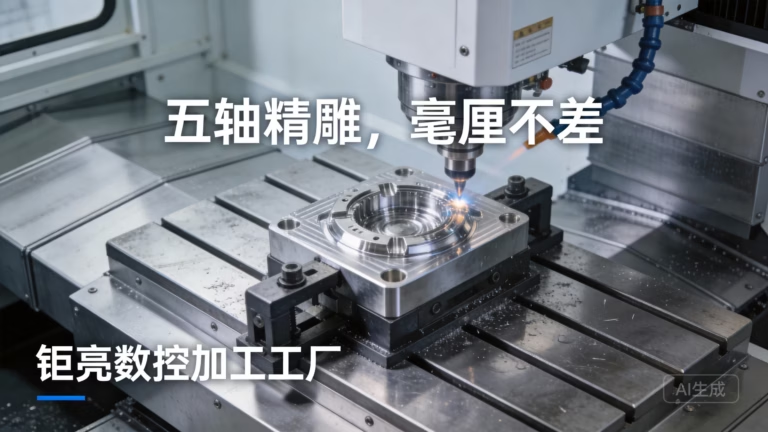
The biggest cost in a machined part is rarely the metal. It is the number of times the part gets clamped, touched, and re-datumed. A true simultaneous 5-axis machine moves all five axes at once, so the tool can follow a continuous path across a curved surface without stopping to index. The Lava CNC 500 is built around that idea.
On a 3+2 machine the table tilts to a fixed angle, locks, and then cuts. That works for prismatic parts with flat faces. It fails on impellers, turbine blades, deep pockets with drafted walls, and any undercut that a straight tool cannot reach. Those geometries force a second or third setup, and every setup adds stack-up error.
Cutting in one clamping removes the setup tax. It also removes the re-fixturing error that shows up as a mismatch between two machined faces. For a housing with bores on five sides, that difference can decide whether the part assembles at all.
There is a limit. Simultaneous motion only pays off when the part actually has contoured geometry. A flat bracket with six drilled holes runs faster on a 3-axis machine, and cheaper. Match the machine to the part, not to the brochure.
- 1Good fitImpellers, blisks, medical implants, mold cores with drafted walls
- 2Poor fitFlat plates, simple brackets, parts with only one machined face
- 3Setup savedTypically two to four fixture changes per complex part
Spindle speed, thermal growth, and what tolerance really means
Spindle speed is the easiest number to sell and the hardest to use well. A high-speed spindle shortens cycle time only when the tool, the holder, and the CAM path are matched to it. Run a long reach tool at 20,000 rpm and chatter will force you back down to 8,000 rpm anyway. The gain is real, but it comes from the whole system.
Heat is the quieter problem. A spindle grows as it warms, ballscrews stretch, and the frame moves. Over a four hour run that drift can exceed the tolerance band on a tight bore. Thermal compensation models that growth and offsets the axes in real time. It does not make the machine rigid. It makes the machine predictable.
Rigid construction matters for the same reason. Cast iron and polymer concrete damp vibration, which lets you take a deeper cut at the same surface finish. A flexible machine forces light passes and long cycle times. Stiffness and damping are the two properties that decide how hard you can push.
In practice, GreatLight holds ±0.005 mm on 5-axis work and inspects 100% of parts before shipment. That number is a process result, not a machine spec. It depends on the fixture, the thermal state, and the probing routine as much as the iron.
- 1Thermal driftWorst in the first two hours after a cold start
- 2CompensationOffsets axes from a temperature model, not from a probe
- 3DampingDecides depth of cut at a given surface finish
Automation, chip management, and CAM integration
A spindle that stops is the most expensive spindle in the shop. Chip evacuation is the usual culprit. Aluminum builds a bird nest around the tool, titanium welds to the flutes, and cast iron turns into sludge at the bottom of a pocket. Through-spindle coolant and a chip conveyor are not accessories. They are the difference between an unattended run and a stopped machine.
Automation closes the loop. A pallet pool or a robot loader lets the machine cut while the operator sets the next job. That is where high-mix, low-volume work gets its margin. The machine does not get faster. It just stops sitting idle between jobs.
CAM integration decides how fast a new part reaches the spindle. Post-processors that match the machine kinematics cut programming time and reduce the risk of a crash on the first run. Adaptive toolpaths that control chip load let you use more of the cutter flute length instead of nibbling at the tip.
None of this is free. Automation adds setup complexity, and adaptive paths need a rigid machine to pay off. If your batch size is three parts per month, manual loading is still the right answer. If it is three hundred, the math changes.
- 1CoolantThrough-spindle for deep pockets and drilling
- 2Chip removalConveyor plus air blast for aluminum
- 3Adaptive pathsConstant chip load, fewer tool breaks
Probing, in-process inspection, and the rotary table
Probing catches errors before they become scrap. A spindle probe locates the stock, sets the work offset, and checks a critical feature after the cut. If the bore is drifting out of tolerance, the machine knows before the part leaves the fixture. You can correct the offset and keep cutting.
The alternative is finding out at final inspection, when the part is already off the machine and the setup is gone. Rework at that stage costs more than the original cut. In-process checks are cheap insurance on tight features, and they generate a record you can hand to the customer.
The rotary table and tilting head are what make the undercut possible. A Ø400 mm table with a direct-drive or high-ratio worm gear holds angular position under cutting load. Backlash here shows up as a step between two passes on the same surface, which is hard to polish out.
Angular accuracy matters most on parts with features on multiple sides, like a valve body or a manifold. The table has to return to the same angle every time, or the bores will not line up. That repeatability, not the travel, is what separates a usable 5-axis machine from a demo.
- 1Probe useStock location, offset setting, in-process size check
- 2Rotary tableØ400 mm, holds angle under load
- 3BacklashShows as a step between adjacent passes
Boundary conditions: when these features do not pay
Every feature on this list costs money. A high-speed spindle, thermal compensation, and a pallet pool add capital cost and maintenance. They only pay back when the part mix justifies them. A shop running simple turned parts should not buy a 5-axis center, and a shop running complex contoured parts should not run them on a 3-axis machine with four setups.
The honest split is by geometry and volume. Contoured surfaces, undercuts, and features on more than two faces favor simultaneous 5-axis. Flat parts with holes favor 3-axis. High mix with small batches favors probing and good CAM. High volume favors automation.
There is also a skills cost. Five-axis programming and setup need experience. An unskilled operator on a 5-axis machine will crash it more often than a skilled operator on a 3-axis machine. The machine does not remove the need for process engineering. It raises the ceiling.
That is why we treat the machine as one part of the chain. Tooling strategy, fixture design, and inspection planning decide whether those seven features turn into lower cost per part or just a bigger depreciation line.
- 1Favors 5-axisContoured surfaces, undercuts, 3+ faces
- 2Favors 3-axisFlat parts, single face, simple holes
- 3Favors automationSteady volume, repeat part family
Which machine configuration fits your part
Match geometry and volume to the right setup, not to the newest machine.
| Part characteristic | 3-axis | 5-axis simultaneous | Why |
|---|---|---|---|
| Flat plate, holes on one face | Best fit | Overkill | No contour, no undercut |
| Impeller or blade | Not viable | Best fit | Continuous curved surface |
| Housing with bores on 4 sides | Multiple setups | Best fit | One clamping, less stack-up |
| Deep pocket, drafted walls | Long reach tools | Best fit | Tilting head reaches walls |
| Prototype, 1–5 parts | Lower cost | Use when geometry needs it | Setup time dominates |
| Production, 500+ parts | Simple parts only | With pallet pool | Automation pays back |
| Tolerance tighter than ±0.01 mm | Hard to hold | With probing and thermal comp | Drift and re-clamp error |
| Simple turned shaft | Mill-turn or lathe | Not needed | Axis count adds nothing |
The verdict: match the feature to the part
If your parts have contoured surfaces or features on three or more faces, a simultaneous 5-axis machine with probing and thermal compensation will cut your cost per part. If they are flat with simple holes, a 3-axis machine will beat it on price every time.
Questions engineers ask
Does a high-speed spindle always shorten cycle time?
No. It only helps when the tool, holder, and CAM path are matched to the higher speed. A long reach tool will chatter and force you back to a lower rpm.
The gain comes from the whole system, not from the spindle rating alone.
How does thermal compensation actually work?
Sensors track temperature at key points on the spindle and frame. A model converts that into a predicted growth, and the control offsets the axes to cancel it.
It does not make the machine stiffer. It makes the position predictable over a long run.
Is in-process probing worth it on short runs?
On a one-off part, probably not. On a tight feature where rework is expensive, yes.
The real value is catching drift before the part leaves the fixture, when you can still correct the offset.
What causes backlash errors on a rotary table?
Wear in the worm gear or a loose preload. It shows up as a visible step between two adjacent passes on the same surface.
Direct-drive tables avoid the issue but cost more and have less torque at low speed.
Can a 3-axis machine hold ±0.005 mm?
On a single face with a stable thermal state, sometimes. The problem is the second and third setup.
Each re-clamp adds stack-up error. That is usually what pushes a part out of tolerance, not the machine itself.
When should a shop skip 5-axis entirely?
When the part family is flat, prismatic, and needs one or two faces machined. A 3-axis machine will be faster to set up and cheaper to run.
Buying 5-axis for that work adds cost without removing any setups.
Send us your part and we will tell you the right process
Upload a drawing or STEP file and we will return a quotation with a free DFM analysis within 12 hours.
12-hour quote100% inspectionNDA on requestNo minimum order quantity
More machining notes
We publish setup notes, tooling trials and inspection data from the factory floor.











