
Lights Off CNC 24 7: How Unattended Machining Actually Works
Lights off cnc 24 7 is a manufacturing condition, not a machine feature. This page explains what has to be in place before a spindle can run with the lights off, what the process can and cannot hold, and how to tell whether your part belongs in an unattended cell. It is written for engineers and buyers who have to decide, not for a brochure.
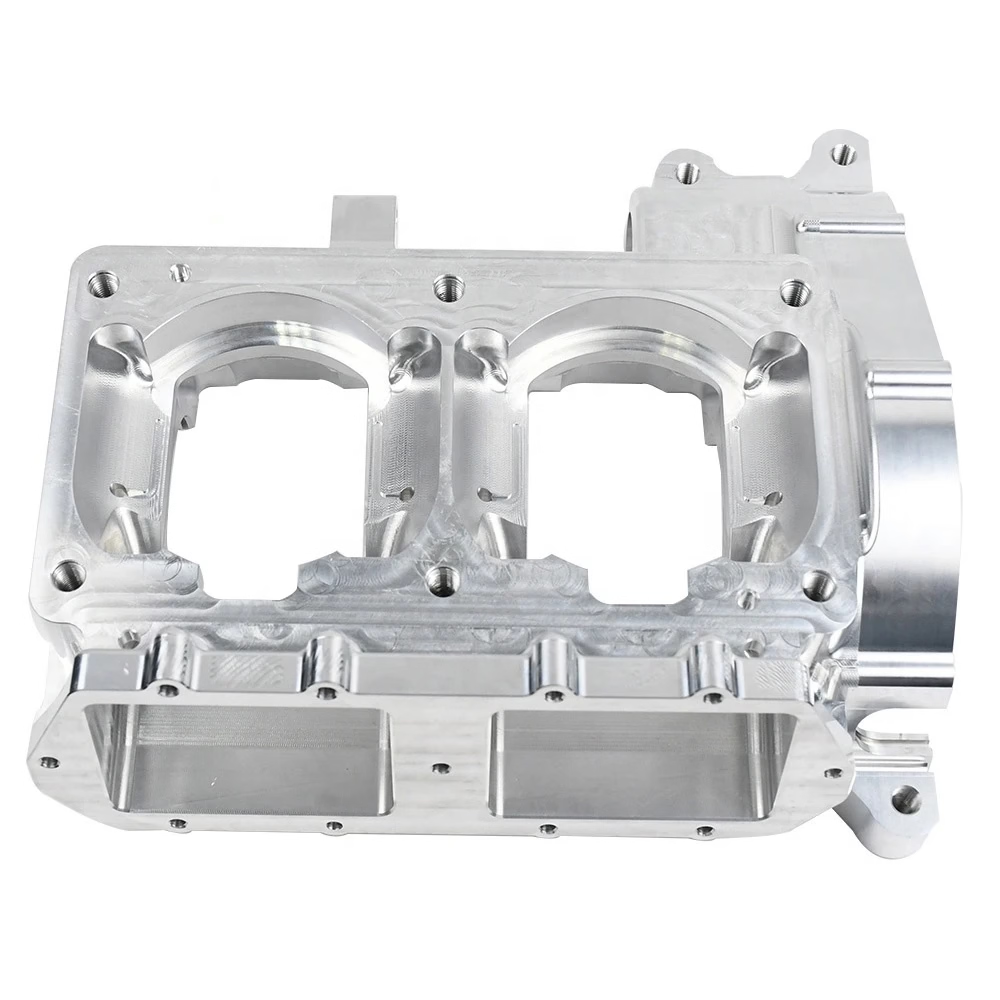
What lights off cnc 24 7 really means
Lights off cnc 24 7 is a manufacturing condition, not a machine feature. The spindle keeps cutting while the shop floor is dark and empty, and the parts that come off the pallet the next morning still meet print. Nothing about the cutting itself is new. What changes is who is watching, and that single change drives every other decision.
Unattended running is a spectrum. At one end sits a single machine with a bar feeder and a parts catcher, running one simple steel shaft overnight. At the other end sits a pallet pool feeding several five-axis centers, with in-process probing and a tool-life system that swaps cutters before they wear out. Both get called lights out. They carry very different risk.
The useful question is not whether a shop can run unattended. Almost any shop can, once. The question is how long it can run before something drifts and nobody notices. That interval sets the real batch size, the pallet count, and the level of monitoring you need to buy.
- 1Unattended means no operator at the spindleLoading, gauging, and tool changes happen without a person.
- 2It is a duration problemThe limit is how long the process stays stable, not how fast it cuts.
- 3It changes risk, not capabilityThe same machine holds the same tolerance either way.
The four systems that make it possible
First comes workholding and part transfer. A pallet pool, a bar feeder, or a robot has to load the next blank without human hands and without losing the datum. Repeatability of the fixture, not the machine, usually sets the floor on what you can hold. A vise that closes to ±0.02 mm cannot support a ±0.005 mm feature.
Second comes tool life. A cutter that lasts 40 minutes and a cycle that takes 38 minutes is a coin flip. Shops that run overnight either use conservative feeds and speeds or count cutting minutes per tool and swap on schedule. Tool breakage detection matters more than tool wear, because a broken 6 mm end mill can scrap an entire pallet before the morning shift arrives.
Third comes in-process verification. A spindle probe or a laser tool setter lets the machine check a critical feature or a tool length between parts. If the check fails, the machine stops or skips that position instead of continuing to cut bad parts. This is the single biggest difference between unattended running that works and unattended running that produces a scrap bin.
Fourth comes chip and coolant management. Long runs generate volume. If chips pile up around the fixture or the coolant concentration drifts, the process degrades slowly and quietly. Through-spindle coolant, chip conveyors, and a coolant chiller keep the thermal state stable enough for a long unattended run.
- 1Fixture repeatability sets the floor±0.02 mm clamping cannot hold a ±0.005 mm feature.
- 2Tool breakage detection is essentialOne broken cutter can scrap a full pallet.
- 3Probe between partsVerify a critical feature, then keep cutting or stop.
Why five-axis work suits lights out running
Five-axis machining removes setups, and setups are where unattended running breaks. Every time a part has to be flipped and re-datumed by hand, a person has to be present. A part that comes off a five-axis table complete in one clamping can run from blank to finished without anyone opening the door.
The trade is stiffness. A trunnion or a rotary table adds overhang, so roughing cuts have to be lighter than on a three-axis machine. The usual answer is more passes at higher spindle speed, with a smaller radial engagement. That raises cycle time per part, but the machine runs while nobody is there, so the arithmetic still works.
On our 16 simultaneous five-axis centers, the parts that run best overnight have three traits: a feature that would need two or three setups on a three-axis machine, a material that breaks chips cleanly, and a critical dimension that a probe can verify in the cut. Aerospace brackets, engine housings, and medical instrument bodies fit this profile.
- 1Fewer setups, longer unattended windowOne clamping means one loading event per part.
- 2Lighter roughing, more passesRotary overhang costs stiffness.
- 3Probe the datum, not just the featureCatch a shift before the whole pallet is cut.
Where unattended machining stops working
Unattended running fails when the process depends on human judgment. If a part needs a visual call on a burr, a feel check on a thread, or a decision about a blend radius, somebody has to be there. Automating that judgment costs more than the labor it saves unless the volume is high and the feature is stable.
Material behavior sets another boundary. Some aluminium alloys and most titanium grades work-harden and generate heat in a way that punishes long runs with no operator. Inconel and magnesium AZ31B need specific coolant and chip strategies that many shops cannot sustain overnight. Thin-wall parts move as the material is removed, and the movement is not always repeatable.
Tool cost is the third limit. Running a 3 mm cutter at conservative parameters for eight hours uses a lot of tools. If the part needs many small tools, the tooling bill per night can exceed the labor saved. Shops should price the run honestly before committing to a lights out schedule.
- 1Judgment calls do not automate cheaplyBurrs and blends still need eyes.
- 2Heat-sensitive alloys punish long runsTitanium and Inconel need active coolant control.
- 3Count the tool billSmall cutters wear out fast overnight.
How to verify a run you did not watch
Measurement is the only way to trust a run that happened in the dark. The first part off the pallet should be checked against the drawing, and the last part should be checked too. If the first and last agree, the middle is likely sound. If they drift, the process is not stable enough for the batch size you chose.
In-process probing adds a second layer. A spindle probe that touches a datum every few parts catches a fixture shift before it becomes a scrap pallet. Laser tool setters catch a chipped cutter before it cuts a whole batch at the wrong diameter. Both are cheap compared to the cost of discovering a problem at final inspection.
Reports matter as much as the numbers. We inspect 100% of parts before shipment and can send dimensional reports on request. For unattended work, the report should show which features were checked in-process and which were checked after the run, so the buyer knows what was actually verified.
- 1Check first and last partsDrift between them sets the safe batch size.
- 2Probe datums between partsCatch a fixture shift early.
- 3Ask for the inspection mapKnow which features were verified in-process.
Is your part a fit for unattended running?
Match the part to the process before you match the machine.
| Part characteristic | Good fit | Poor fit |
|---|---|---|
| Cycle time | 10–120 min per part | Under 3 min per part |
| Feature tolerance | ±0.005 mm with probing | Loose tolerances, no gauging |
| Chip behavior | Short chips, conveyor clears | Stringy chips that wrap the tool |
| Setup count | One or two orientations | Five orientations, hand deburring |
| Material | 6061, 304, 4140, 17-4PH | Gummy plastics, pure copper |
| Volume | 200 to 10,000+ pieces | One-off, design still moving |
| Burr risk | Deburr in cycle | Manual deburr after every part |
| Thermal load | Stable coolant temperature | Long roughing with no chiller |
The verdict
Run unattended when the part has few setups, breaks chips cleanly, and has a feature a probe can verify. Keep an operator on the floor when the part needs hand deburring, a visual blend call, or a material that will not run stable for hours.
Questions engineers ask next
How long can a machine actually run unattended?
It depends on tool life and chip volume, not on the control. A stable aluminium job with a conveyor and a tool-life schedule can run a full night shift. A titanium job with small cutters may only hold two hours before a tool needs attention. The honest answer comes from a test run on your part.
Does unattended machining cost less per part?
Machine time is the same as attended running. The saving comes from not paying an operator for those hours, minus the cost of extra tooling, probing, and the risk of a scrapped pallet. At low volume the saving is small. At a few thousand pieces a year it usually pays.
Can tolerances of ±0.005 mm be held overnight?
Yes, if the fixture is repeatable, the coolant temperature is stable, and the machine probes a datum between parts. Thermal drift is the main risk. A shop that runs a coolant chiller and checks the first and last part of the run can hold that tolerance unattended.
What about lights out for one-off prototypes?
It rarely makes sense. Programming, fixturing, and proving out a new part all need an operator on the floor. The unattended window opens once the process is proven and the same setup repeats. Prototyping and unattended production are different jobs.
Which materials run best with nobody watching?
6061, 6082, 7075, 304 and 316 stainless, 4140, and 17-4PH are common picks. They break chips predictably and hold dimension. Titanium TC4, Inconel, and magnesium AZ31B can run unattended, but they need tighter coolant and chip control than most overnight schedules allow.
How does a shop decide the batch size for a night run?
Start from the shortest tool life in the program, then subtract the time needed for the first-part check. If a cutter lasts 90 minutes and the check takes 10, you have about 80 minutes of safe cutting per tool. Multiply by the number of tools with reliable life and you get the safe window.
Send us your part and we will tell you if it runs lights out
Upload a drawing and we return a quotation with a free DFM analysis within 12 hours, including a straight answer on whether the part suits unattended running.
12-hour quote100% inspectionNDA on request
More from the shop floor
We publish setup notes, tooling trials and inspection data from the factory floor.











