
Medical CNC Machining Service: 7 Proven Checks Before You Release a PO
This guide is for design engineers and sourcing managers choosing a medical cnc machining service for instrument bodies, implant trials, housings and fluid-path parts. Read it to compare suppliers on tolerance, qualification paperwork, material traceability, lead time and order quantity, and to spot the answers that should make you walk away.
In this article
- 1
- 2
- 3
- 4
- 5
- 6
- 7
- 8
Key takeaways
What to compare across medical CNC suppliers
Use this as a checklist during the first call. The right column is what a workable answer sounds like.
| What you ask | Weak answer | Workable answer |
|---|---|---|
| Achievable tolerance | ±0.001 mm, no conditions | ±0.005 mm on critical features, stated per feature |
| Quality system | We follow ISO, certificate later | ISO 13485:2016 certificate with current scope |
| Material traceability | Standard stock, no records | Mill cert and heat number linked to the lot |
| Minimum order | 5,000 pieces to start | One prototype to 10,000+ part runs |
| Quote turnaround | Two weeks after NDA | Quotation and DFM analysis within 12 hours |
| Inspection coverage | Sample check on request | 100% inspection before shipment, reports on request |
| Delivery history | We always ship on time | Historical late-delivery probability below 2% |
The short version
Pick the supplier that answers tolerance, traceability and inspection questions with specifics on the first call. Certificates and low minimums matter, but specific answers are what separate a medical cnc machining service from a general machine shop.
Which parts belong in a medical cnc machining service
CNC machining earns its place on medical parts that need tight features, hard materials or low volume. Surgical instrument bodies, orthopedic trial components, dental abutments, pump housings, valve blocks and catheter connector bodies all fit. Titanium, 17-4PH stainless and PEEK are common here because they hold up to sterilization and body contact.
The process loses ground when the part is a simple flat cover with no critical fit, or when you need 50,000 identical small parts every month. Die casting or injection molding will undercut machining once the geometry settles. Machining is strongest between the first prototype and the point where tooling pays for itself.
One more boundary: internal channels and organic lattice shapes. A 5-axis machine can reach many of them, but if the channel bends beyond tool reach, the part belongs in additive manufacturing and then gets finish-machined. Deciding this early saves a redesign later.
Tolerance and surface finish that hold up in review
±0.005 mm (±0.0002 in) is the working number for a capable medical cnc machining service. It is not a blanket tolerance for every dimension on the drawing. Apply it to the features that control fit and function, and let the rest sit at general tolerances. A drawing with ±0.005 mm on all forty dimensions costs more and buys nothing.
Surface finish matters where the part touches tissue, seals against an O-ring, or slides. As-machined surfaces sit around Ra 1.6–3.2 μm. A controlled cut brings that to Ra 0.8–1.6 μm. Fine finishing reaches Ra 0.2–0.8 μm on sealing faces and bearing bores, usually with a second operation.
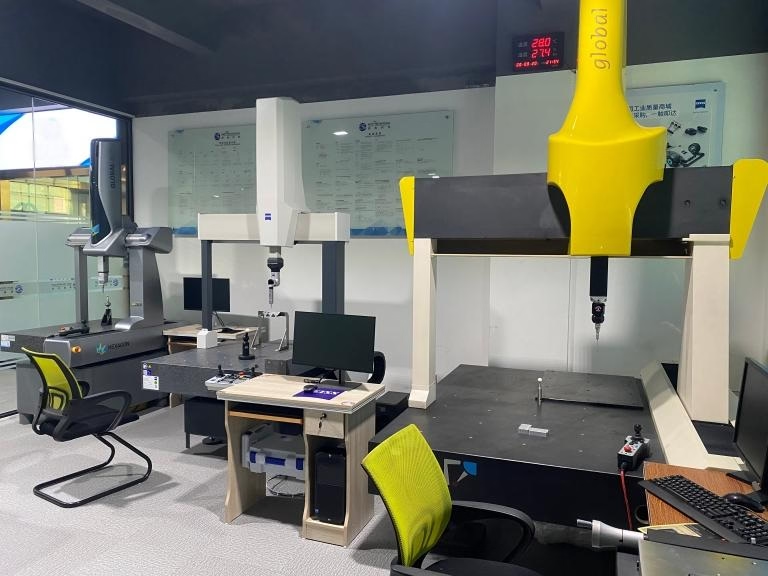
Ask how the number is verified. A tolerance claim without a measurement plan is a promise. The answer you want names the instrument: CMM for position and profile, micrometers and bore gauges for diameters, surface roughness tester for Ra. Then ask when the measurement happens, in-process or only at final inspection.
Certification and paperwork for medical work
ISO 13485:2016 is the certification that separates medical suppliers from general machine shops. It covers design transfer, process validation, traceability and corrective action in the way device auditors expect. ISO 9001:2015 alone is a quality system, not a medical one. GreatLight holds both, plus IATF 16949:2016 and ISO 27001:2022.
ISO 27001:2022 matters more than buyers expect. Your CAD files, drawings and revision history are sensitive. A supplier with a documented information security system can show you how files are stored, who can open them, and when access is revoked. That is separate from signing an NDA, and you should have both.
For implant-adjacent parts, ask about process validation and clean handling. Where the part is machined, how it is deburred, how it is cleaned, and how it is packed all leave evidence. If the supplier cannot describe the sequence, the certificate is doing no work.
Material selection and traceability
Medical work leans on a narrow material set. Stainless 316L and 17-4PH cover instruments and housings. Titanium TC4 (Ti-6Al-4V) and TA2 cover implant trials and bone-contact parts. PEEK, POM and PC cover insulators and fluid-path components. Inconel appears in high-temperature sterilization hardware.
Traceability is the part buyers underestimate. For a device file you may need the mill certificate, heat number and melt lot tied to the exact parts you received. Ask how the shop links a delivered part back to a material lot. The answer should involve a route card or traveler with the lot number written on it, not a verbal promise.
Material substitution is the other trap. If 316L is out of stock, a shop that quietly ships 304 has broken your specification. Ask what happens when the specified grade is unavailable. The correct answer is a phone call and a written deviation request, not a substitution.
Lead time, order quantity and quotescope
Medical development runs in small batches. A supplier with no minimum order quantity lets you order one prototype, test it, then order ten, then a hundred. A shop that quotes 5,000-piece minimums is telling you it does not want development work, and the relationship will break at the next revision.
On timing, the useful numbers are quote and DFM feedback within 12 hours, production start within 24 hours, and parts shipping in 3–5 days. Those are capacity statements, not delivery guarantees. Treat them as a signal about how the shop schedules small jobs alongside production runs.
Compare quotes on the same basis. A price without a stated tolerance, finish, inspection level and material grade is not comparable. Ask each supplier to quote the drawing revision, the material grade and the inspection report you want. Then the numbers mean something.
7 steps to qualify a medical CNC supplier
Work through these in order. Steps 1 to 3 filter the list fast; steps 4 to 7 decide who gets the production order.
- 1Send one representative partPick the part with the tightest feature and the hardest material, not the easiest one. A shop that handles the hard part will handle the rest.
- 2Request DFM feedback with the quoteYou want comments on wall thickness, tool reach, datum strategy and any feature that will need a second operation. Silence here is a warning.
- 3Ask for the certificate scopeRequest the ISO 13485:2016 certificate and check the scope covers the process you are buying, not just the company name.
- 4Test the tolerance claim on a featureName one critical dimension and ask which machine holds it, which fixture is used, and how it is measured. Vague answers mean the number is marketing.
- 5Confirm traceability down to the lotAsk for a sample traveler showing how the heat number follows the part from incoming inspection to packing.
- 6Run a prototype before committingOrder one to five pieces. Inspect them yourself, then compare the inspection report against your measurements.
- 7Agree the inspection level in writingState whether you need 100% inspection, first article report, or material certs with each shipment. Put it in the PO, not in an email thread.
Questions buyers ask before awarding the order
Can a medical cnc machining service work from my 3D model only?
Yes, but send the 2D drawing for any feature with a tolerance, datum or surface callout. A model without a drawing leaves the tolerance open, and the shop will quote a default.
Also include the material grade, finish and inspection requirement. Those three items change the price more than the geometry does.
What order quantity makes sense for a first run?
Start with one to five pieces for fit and function, then move to ten or twenty-five once the design freezes. Machining does not need tooling, so there is no penalty for starting small.
A supplier with no minimum order quantity supports this pattern directly. If a shop pushes you toward a large first batch, ask what changes at higher volume.
How do I know the ±0.005 mm claim is real?
Ask for the measurement method and the machine. A CMM report on the critical features, with the datum scheme stated, is the evidence. A single caliper reading is not.
If the part has a bore or a sealing face, ask for the roundness or roughness value as well. Diameter alone does not describe a seal.
Do I need an NDA before sending drawings?
For anything with a device application, yes. An NDA plus a supplier with ISO 27001:2022 information security controls covers both the legal and the practical side.
Keep the NDA and the file transfer separate. The NDA protects the disclosure; the security system protects the files after they arrive.
What finishes are available on medical machined parts?
Common choices are bead blasting, tumbling, brushing and polishing for stainless and titanium, plus passivation where corrosion resistance matters. Anodizing covers aluminum housings in clear, color or hardcoat.
Laser marking works for UDI-style identification, with a minimum character height of 1.5 mm. Confirm the marking method before the finish, because some finishes change surface contrast.
How early should I involve the machine shop?
As soon as the concept geometry exists. Early DFM input on wall thickness, tool access and datum choice prevents a redesign after tooling or test fixtures are built.
Send the model, the target tolerance and the annual volume. The shop can then tell you whether machining, casting or printing fits the quantity.
Send one part and test the answers
Upload your drawing. We return a quotation and free DFM analysis within 12 hours, with the tolerance, material grade and inspection level stated in writing.
12-hour quote100% inspectionNo MOQNDA on request
More from the shop floor
We publish setup notes, tooling trials and inspection data from the factory floor.











