GreatLight CNC Machining Factory logo
CNC Machining
Rapid Prototyping
Materials
Industries
News
About GL

Get Instant Quote

Supply chain planning for machined parts

Mitigating Supply Chain Risk with Dual Sourcing

Splitting a critical part between two qualified suppliers sounds simple. The hard part is making both sources produce the same drawing. We run dual sourcing when the volume and the risk both justify it.

12-hour quote with DFMNo minimum order quantity±0.005 mm tolerance3–5 day shippingISO 9001 / IATF 16949NDA on request
GreatLight Metal new factory building
15 yearsMachining since 2011
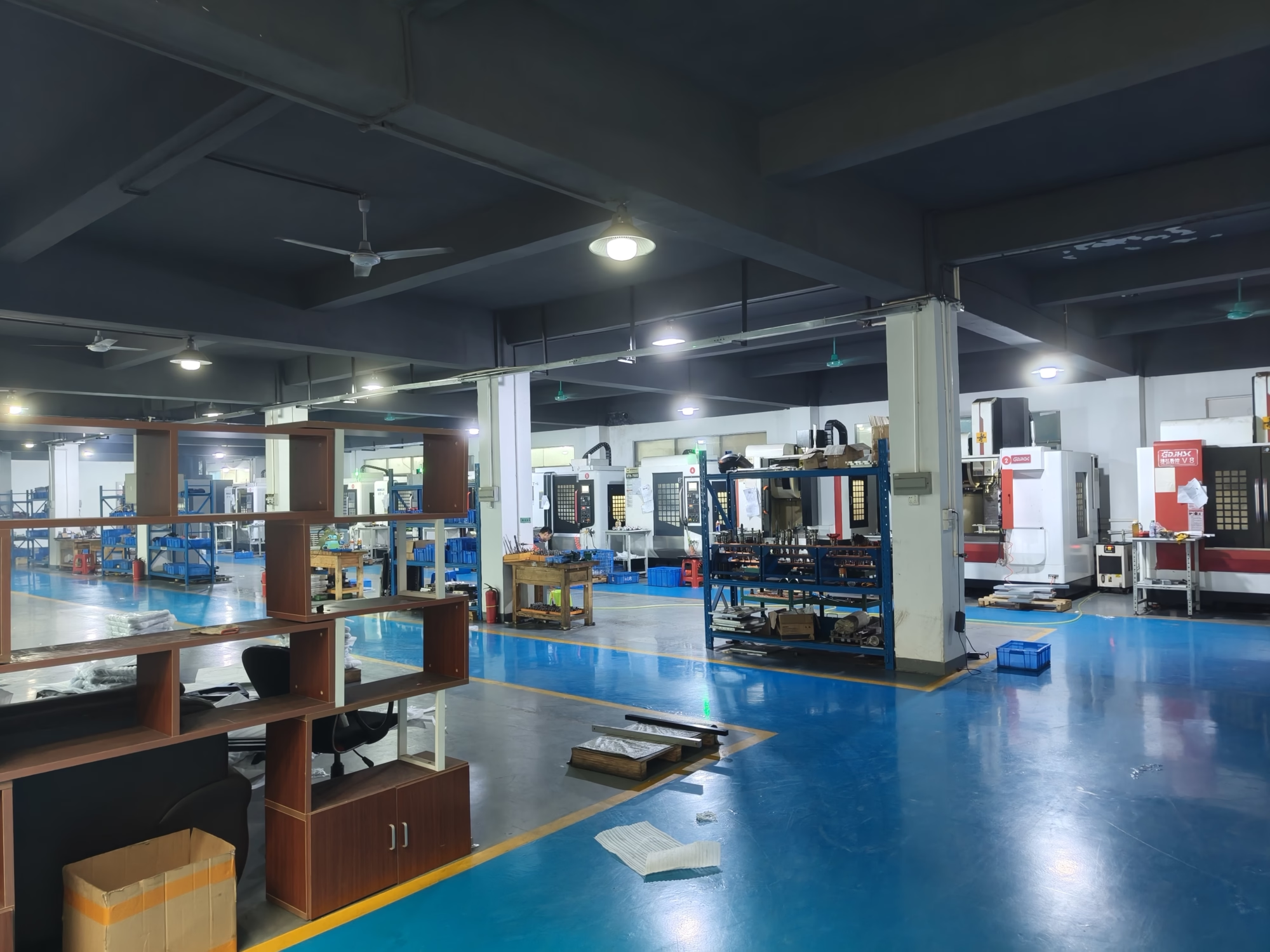
127High-precision CNC machines
3Wholly-owned plants
<2%Historical late-delivery rate
Where single sourcing breaks

Four failures a second source would have caught

Dual sourcing is not insurance against everything. It targets a specific set of failures.

01

The supplier stops answering

A small shop takes on a bigger customer, loses a machinist, or gets bought out. Your open PO sits in a queue you cannot see. By the time you learn the truth, the assembly date has already passed and the only fix is air freight or a line stop.

02

One machine goes down and takes your part with it

A 5-axis spindle needs a rebuild. The part only runs on that one machine because nobody wrote a second process. Two to six weeks of capacity disappears, and no amount of expediting brings it back.

03

Raw material is the real bottleneck

The machining is fine. The 17-4PH bar or the 7075 plate is not. A mill allocation, a heat-treat queue, or a plating line shutdown holds up a part that was otherwise ready to ship.

04

You cannot see the risk until it lands

Most buyers learn about single-source exposure during an audit or a line-down meeting. By then the mitigation is expensive. A cost and capacity review done early is far cheaper than a recovery plan.

The method

How we split a part without splitting the quality

Two sources only work when both build to the same controlled process.

CNC Lathe Technical Specifications Terminology
Step one

Qualify the second source before you need it

A backup supplier discovered during a crisis is not a backup. It is a new project with a new first article, a new fixture, and a new set of questions. That takes weeks you do not have.

So the second source gets qualified while volume is normal: same drawing, same material certs, same inspection plan. First article parts from both sources are measured against the same critical dimensions. If the two processes disagree, we change the process, not the print.

  • 1
    Same revisionDrawing, GD&T and material spec frozen for both sources
  • 2
    Paired first articlesCritical dimensions compared side by side before release
  • 3
    Separate fixturesEach site holds its own workholding so neither depends on the other

Get Instant Quote

CNC Machining Services Online
Step two

Split the volume, not the responsibility

A common mistake is to give 50% to each supplier and treat them as equals. In practice one site should carry the process knowledge and the other should carry surge capacity. The lead site owns the program; the second site ramps when demand moves.

Typical split is 70/30 or 80/20, with the smaller share kept live by a minimum monthly quantity. That keeps the second source warm without paying for idle capacity. When the lead site slips, the second site is already making the same part on the same revision.

  • 1
    70/30 or 80/20Keeps the second source running without doubling cost
  • 2
    Minimum monthly quantityPrevents the backup line from going cold
  • 3
    One ownerA single program engineer answers for both sites

Talk to an Engineer

Decision guide

When a second source pays for itself

Use this to decide per part number, not per company. Most programs land in the middle column.

Part or program profileSingle source is fineDual source is worth it
Annual volumeUnder 200 pieces1,000 pieces or more
Line-down impactPrototype or sparesFeeds a running assembly line
Tooling costHigh fixture or die costLow fixture, standard workholding
Material riskStocked domestic alloyLong-lead or allocated alloy
Drawing stabilityStill changing every buildFrozen revision, ECO controlled
Qualification effortSimple 3-axis geometry5-axis or tight tolerance features
Changeover costFull day of setupUnder 2 hours of setup
What we machine

Processes we can run at more than one site

Every process below can be quoted from a single plant or split across sites when the volume justifies it.

01

5 Axis CNC Machining

16 simultaneous 5-axis centers. Complex geometry, undercuts and compound angles in one setup, which keeps datum stack-up low and makes a second source easier to qualify.

02

4 Axis CNC Machining

12 four-axis mills for prismatic parts with features on multiple faces. Good fit for splitting volume because setup is short and repeatable.

03

3 Axis CNC Machining

27 three-axis machines. The easiest process to duplicate at a second site: standard vises, standard fixtures, predictable cycle times.

04

CNC Milling & Turning

16 mill-turn centers handle turned parts with milled features. One chucking means one source of concentricity, which simplifies cross-site comparison.

05

Rapid Prototyping

Bridge parts for line-down situations and design checks. Useful when you need something in hand before the production source is qualified.

06

Part Surface Finishing

Anodizing, plating, powder coating, black oxide, blasting and laser marking. Finishing is often the second bottleneck, so we plan it as a separate capacity line.


Capability ranges

What both sources can hold

Same tolerance and inspection standard applies to the lead site and the backup site.

ItemRange or standardNotes
General tolerance±0.005 mm±0.0002 in
Fine surface finishRa 0.2–0.8 μmOn request
Standard finishRa 0.8–1.6 μmDefault production finish
As-machined finishRa 1.6–3.2 μmNon-critical faces
Maximum part size4,000 mm4,000 × 400 × 150 mm travel
Rotary tableØ400 mmFor mill-turn work
Inspection100% before shipmentReports on request
MaterialsAluminium, stainless, steel, copper, titaniumPlus engineering plastics
Why GreatLight

What makes a second source actually work

The numbers below are the ones that decide whether a split program holds tolerance across two sites.

15Y

Machining since 2011

We have run split production for long enough to know which parts tolerate it and which do not. That judgment is the useful part.

127

CNC machines across 3 plants

Capacity spread over three wholly-owned plants in Dongguan and Singapore, so a spindle rebuild does not stop a program.

±0.005 mm

Tolerance held at both sites

Both sources are measured against the same critical dimensions. If one drifts, we fix the process before shipping.

99.99%

Qualification rate

First article and production parts released against the same inspection plan, whether they come from plant one or plant three.

12 h

Quote and DFM analysis

Send a drawing and get a quotation plus manufacturability notes within 12 hours, including a view on whether splitting makes sense.

3–5 d

Shipping after release

Parts ship in 3–5 days once production starts. Production can begin within 24 hours of a released order.

7,600 m²Manufacturing space
150Technicians
16Simultaneous 5-axis centers
4,000 mmMaximum processing size
Industry requirements

What regulated industries ask for, and what we deliver

Leader in Cnc Machining Service China

Aerospace brackets and housings

Programs need traceable material, documented inspection and a source that survives an audit. We hold the process on both sites and report critical dimensions per lot.

  • ±0.005 mm
  • 100% inspection
  • ISO 9001:2015
6011

Automotive and EV fixtures

Line-side fixtures cannot arrive late. Volume is split so a tooling failure at one plant does not stop the assembly line at the customer.

  • IATF 16949:2016
  • 3–5 day shipping
  • <2% late rate
oplus_262178

Medical instrument components

Cleanliness, documented material certs and a stable revision are the requirements. Two qualified sources reduce the risk of a single plant going quiet.

  • ISO 13485:2016
  • Material certs
  • Revision control
CNC Machining Services Comparison 2026 Fictiv vs Xometry vs GreatLight

Robotics and automation frames

Large aluminium frames and plates with long lead times on material. Splitting the machining and holding a material buffer at each site keeps the build on schedule.

  • 4,000 mm travel
  • Aluminium 6061 / 7075
  • No MOQ
FAQs

Questions engineers ask before splitting a part

How do I decide which part numbers to dual source?

Start with parts that feed a running line and have a low changeover cost. Annual volume above 1,000 pieces is a reasonable threshold because the second qualification effort is amortized.

Leave prototypes, one-off spares and parts with heavy dedicated tooling on a single source. Qualifying a second site for those costs more than the risk it removes.

Does dual sourcing mean the two suppliers will produce slightly different parts?

Not if the process is controlled. Both sites work from the same frozen drawing revision and the same inspection plan. Critical dimensions are compared on first articles before the second source is released.

Where the two sites differ is in workholding and machine selection. Those are allowed to differ. The measured output is not.

What split ratio should I use?

Most programs work well at 70/30 or 80/20. The lead site keeps the process knowledge and the main volume. The second site holds surge capacity and a minimum monthly quantity so the line does not go cold.

A straight 50/50 split doubles the management effort for the same total output and makes it harder to tell which site owns a quality issue.

Does splitting volume raise the piece price?

Usually yes, by a small amount, because setup and inspection are duplicated across sites. The size of the increase depends on how much setup the part needs.

Parts with under two hours of setup absorb the split well. Parts that need a full day of fixture work do not, and we will say so in the quote.

How long does it take to qualify a second source?

For a part we already run, the second site needs a first article build and inspection. Quotation and DFM analysis come back within 12 hours, and production can start within 24 hours of release.

The first article itself is the long step, because it has to be measured and compared, not just made.

Can you keep the two sites independent if one has a problem?

Yes. Each site holds its own fixtures, its own CAM programs and its own material buffer. Neither depends on the other for tooling or stock.

A spindle failure or a material delay at one plant does not interrupt the other. That independence is the whole point of the arrangement.

Which certifications cover the second source?

The same quality system applies across our plants: ISO 9001:2015, IATF 16949:2016, ISO 13485:2016 and ISO 27001:2022.

Inspection follows the same sequence everywhere: raw material check, in-process monitoring, and final inspection before shipment. Reports are available on request.

What if the volume is too low to justify two sources?

Then we run a single source and reduce risk another way: keep a finished-goods buffer, hold raw material, or qualify a second process on the same machine family.

Dual sourcing is a tool, not a policy. We use it where it removes real exposure and skip it where it only adds paperwork.

Send a drawing and get a straight answer on sourcing

We will tell you whether your part benefits from a second source, what the split would cost, and what the qualification step looks like.

12-hour quote with DFM100% inspection before shipmentNo minimum order quantityNDA on request

Trusted by engineers and manufacturers worldwide

Tesla Ford Motor Company BYD Auto Denso Magna International Boeing Airbus Medtronic KUKA FANUC