
St Pauls CNC Machining: How to Choose a Shop Without Guesswork
A buying guide for engineers and sourcing staff in St. Paul, Minnesota. It covers the six points worth checking before you release a PO: tolerance, lead time, order size, certifications, quoting detail, and documentation.
In this article
- 1
- 2
- 3
- 4
- 5
- 6
- 7
- 8
Six things that decide whether a quote is usable
What to check, what a good answer looks like
Use the left column as your checklist. The middle column is the answer that should raise no flag; the right column is what to push back on.
| Check | Reasonable answer | Push back when |
|---|---|---|
| Tolerance | Tied to named features, ±0.005 mm where needed | One blanket number on the whole drawing |
| Lead time | Quote in 12 hours, parts in 3–5 days | Vague 'a few weeks' with no milestone |
| Order size | No MOQ, one piece to 10,000+ | Minimum buy that blocks the prototype |
| Certifications | ISO 9001, IATF 16949, ISO 13485, ISO 27001 | Claimed but not listed on request |
| Quoting detail | DFM notes with the price | Price only, no process comments |
| Documentation | Inspection reports on request | Material certs refused |
| Finishing | Anodizing, plating, powder coat in house or managed | You are told to find your own finisher |
| Confidentiality | NDA available, secure uploads | Files sent over plain email |
The short version
Choose the shop that answers your DFM questions before you ask, ties tolerance to real features, and quotes lead time in phases. Everything else is price.
Tolerance: buy it where the part needs it
Most RFQs from St. Paul arrive with a title block that says something like ±0.13 mm and three or four features called out tighter. That is normal. The problem starts when a shop answers with a single global number and no comment on which features drive cost. A ±0.005 mm bore and a ±0.005 mm overall length are not the same purchase.
On a 5-axis center, position tolerance depends on how many setups the part needs. One setup holds datums together and removes stack-up. If your part has features on four or five faces, a 3-axis shop will move it between vises three times, and each move adds error you then pay to inspect. Ask how many setups the quote assumes. If the answer is vague, the price is a guess.
Surface finish follows the same logic. Ra 1.6–3.2 μm as-machined is fine for brackets and housings. Sealing faces and bearing bores usually want Ra 0.8–1.6 μm, and optical or sliding surfaces can need Ra 0.2–0.8 μm, which means a separate finishing pass and slower feed. Put the finish callout on the face where it matters, not on the whole drawing.
- 1Call out datumsA GD&T frame without a clear datum leaves inspection open to interpretation.
- 2Limit tight tolerancesEvery tight feature adds a deburr, a check, or a second op.
- 3Say what the part doesA sealing face and a cosmetic face get different treatment.
Lead time and quoting: read the schedule, not the promise
A lead-time quote is a scheduling statement. When a shop says quotation and free DFM analysis within 12 hours, then production can start within 24 hours, then parts ship in 3–5 days, it is describing three separate bottlenecks it has already solved. When a shop says two to three weeks with no breakdown, you cannot tell whether the delay is engineering, material, or machine time.
Material is the usual hidden delay. Aluminum 6061 and 7075 plate is common; Inconel and Ti-6Al-4V are not. On a titanium bracket, the wait is often the mill certificate, not the spindle. Ask whether the quote assumes material on the floor or material on order. The two answers often differ by a week.
Historical late-delivery probability below 2% is a useful number because it is measured, not promised. Ask any supplier how it tracks on-time delivery and what counts as late. A shop that cannot answer is a shop that does not measure.
- 1Separate the phasesQuote, material, machining, finishing, and shipping each have their own clock.
- 2Ask about material stockExotic alloys and thick plate are the usual cause of a slipped date.
Order size, setup cost, and where prototypes get expensive
Setup dominates the cost of a one-off part. Fixturing, first-article inspection, and programming do not shrink when the quantity is one. This is why a shop with no minimum order quantity is usually cheaper at prototype stage than a shop with a 50-piece minimum, even if the unit rate looks higher.
The break point between prototype and production is usually somewhere between 20 and 100 pieces, depending on how much of the cycle is fixturing versus cutting. Below that, soft jaws and probing get you there. Above it, dedicated fixtures and, for castings, tooling start to pay back. If your program is heading to 10,000+ parts, ask when the shop would move from milled to cast or forged blanks. A supplier that only sells machining will not raise this.
Also count finishing. Anodizing, electroless nickel, powder coating, and laser marking are separate operations with their own minimum batch charges. Marking has a practical floor: minimum character height 1.5 mm. If your part number needs to be readable after hardcoat, plan the space before the drawing is frozen.
- 1Quote two quantitiesAsk for 1 piece and 100 pieces. The ratio tells you where setup sits.
- 2Check the marking planLaser marking under 1.5 mm character height is unreliable.
Certifications and documentation: match them to your industry
Certifications only matter when they match the program. ISO 9001:2015 covers general industrial work and most prototyping. IATF 16949:2016 is what automotive and EV customers ask for, and it changes how PPAP and traceability are handled. ISO 13485:2016 covers medical devices, where process validation and records are the point. ISO 27001:2022 is about information security, which matters when your drawings are the IP.
Ask for the certificate scope, not just the logo. A shop can hold ISO 9001 for one process and subcontract another. If your part is anodized or plated, find out who does it and under what quality system. The same goes for heat treatment and, on cast parts, for the foundry.
Documentation is the other half. 100% inspection before shipment, with raw material check, in-process monitoring, and final inspection, is a process description. Inspection reports on request is the deliverable. On a first article, ask for dimensional results on the called-out features plus material certificates. On regulated work, expect to pay for the report, not for the part twice.
- 1Get the scopeA certificate that excludes the process you need is not a certificate.
- 2Trace subcontracted stepsFinishing and heat treatment carry their own quality risk.
Which process fits the part, and when machining is the wrong answer
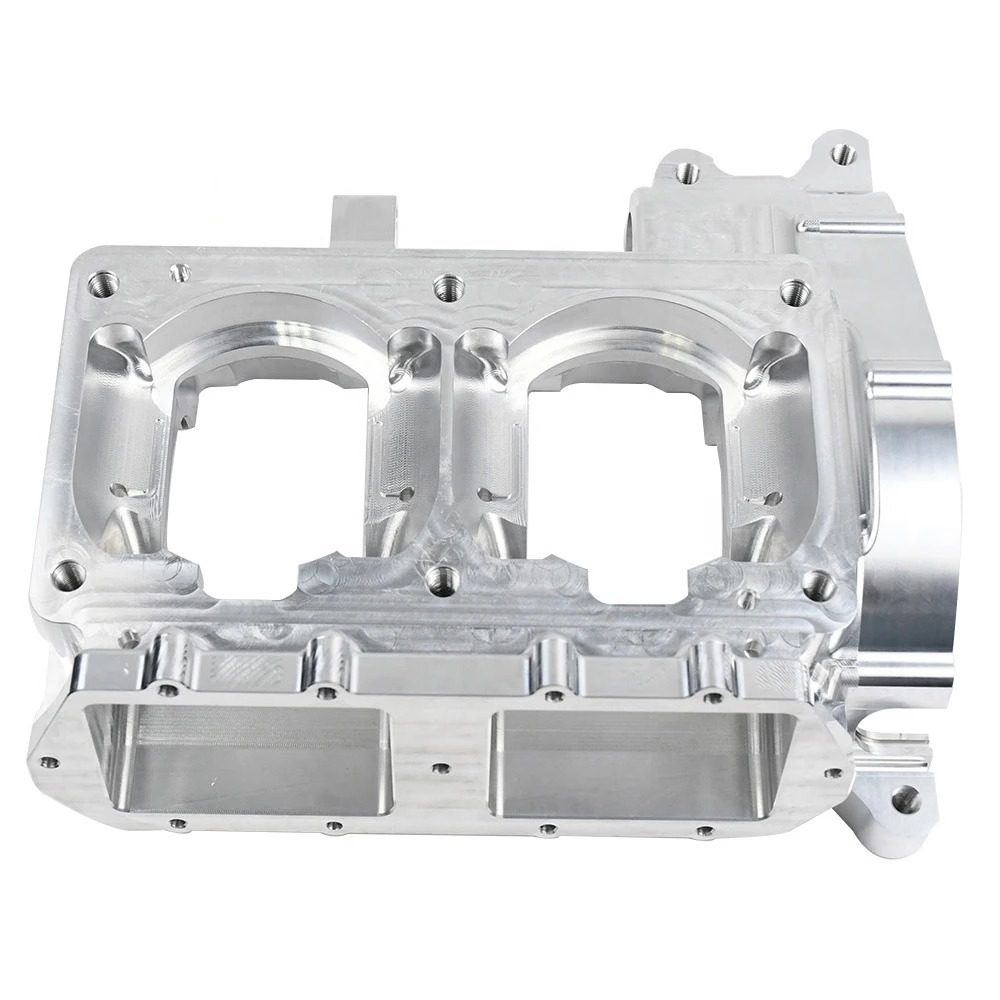
Machining is the right call for tight tolerances, low to medium volume, and geometry that would need expensive tooling as a casting. A 5-axis center handles undercuts, deep pockets, and features on five faces in one setup, which is why complex brackets and housings are usually milled first and cast later, if ever.
Machining is the wrong call when the part is a large thin-wall shell in the thousands, or when the geometry is mostly cosmetic and a mold would pay for itself in a few months. In those cases, die casting or vacuum casting for low-volume urethane parts beats milling on cost. Sheet metal is the better answer for enclosures and brackets with constant wall thickness. A shop that offers all of these can tell you which one to pick instead of quoting whichever machine is free.
Material choice narrows the field too. Aluminum 6061-T6 and 7075 machine fast and hold tolerance well. Stainless 316L and 17-4PH work harden and need slower speeds and rigid setups. Titanium TC4 and Inconel need more spindle time and more tool changes, so the price per part rises faster than the weight falls. If a design can use 6061 instead of titanium, the saving is usually larger than any tolerance relaxation.
- 1Mill first, cast laterPrototype in aluminum, validate, then move to tooling once volume justifies it.
- 2Pick material for the processHard alloys cost spindle time before they cost material.
Step by step: how to vet a supplier in one week
This is the sequence we suggest for a new program, whether you send the RFQ to one shop or five.
- 1Send a complete data pack3D STEP file, 2D drawing with datums and finish callouts, material spec, quantity, and target date. Missing finish callouts are the most common cause of a revised quote.
- 2Require DFM notes with the priceAsk for comments on wall thickness, tool reach, and any feature that will need a second setup. A quote without notes is a number, not an answer.
- 3Ask which features carry the tight toleranceRequest confirmation of the ±0.005 mm features and the measurement method for each. If the reply repeats the drawing without comment, probe further.
- 4Confirm order size flexibilityAsk for pricing at 1, 50, and 500 pieces. Look at where the curve flattens; that is the shop's real setup cost.
- 5Check certifications against your industryMatch ISO 9001, IATF 16949, ISO 13485, or ISO 27001 to the program. Ask for the scope document.
- 6Settle documentation and confidentialityAgree on inspection reports, material certs, and an NDA before release. Secure uploads should be the default.
- 7Run a first article before the full releaseInspect the first part against the drawing, then release the balance. Fix drawing errors at one piece, not at five hundred.
Questions buyers ask before the first order
How tight a tolerance can a St. Paul supplier realistically hold on a complex part?
±0.005 mm is achievable on called-out features when the geometry and material allow it. It is not a global claim across a large part with five setups.
The limiting factors are thermal drift, fixture rigidity, and how many times the part is re-clamped. Fewer setups means a better chance of holding the number.
What order quantity makes machining stop being the cheap option?
For simple parts, machining stays competitive into the low thousands. For parts with a lot of removed material or complex internal features, casting or forging starts to win earlier, often in the hundreds.
Ask for a crossover estimate before you commit to a process. The answer depends on wall thickness, alloy, and how much finishing the part needs.
Are inspection reports included or extra?
Basic dimensional reports on called-out features are usually available on request. Full first-article inspection packages and material certificates are separate deliverables.
Agree on this before the PO, not after. It is the most common source of a disputed invoice.
Do I need an NDA to send drawings?
If the part is proprietary, yes. Uploads should be secure and confidential by default, and a signed NDA should be available on request.
Send the minimum data needed for the quote. You can release full 3D models after the NDA is signed.
Which certifications should a medical or automotive supplier hold?
Medical device work usually points to ISO 13485:2016. Automotive and EV programs usually ask for IATF 16949:2016. General industrial work runs on ISO 9001:2015.
ISO 27001:2022 is about information security and matters when your drawings are the intellectual property.
How do I compare quotes that use different assumptions?
Normalize three things: quantity, finishing, and documentation. A low quote often excludes anodizing or inspection reports.
Then check the lead time breakdown. A shop that separates quoting, production start, and shipping is easier to hold to a date.
Send your drawings and get a usable answer
Upload a STEP file and drawing. We reply with a quotation and DFM notes within 12 hours, with no minimum order quantity.
12-hour quoteNo MOQ100% inspectionNDA on request
More from the shop floor
We publish setup notes, tooling trials and inspection data from the factory floor.











