
Modern CNC Machining Service: How to Judge a Supplier
A working checklist for engineers and purchasing teams sourcing a modern CNC machining service. We cover the numbers that actually predict a good part: tolerance, inspection, machine mix, lead time, MOQ and certification scope. Read this before you send a drawing out for quote.
In this article
- 1
- 2
- 3
- 4
- 5
- 6
- 7
- 8
Key takeaways
What to compare across three supplier types
Use this to place a shop before you request a quote.
| Check | Job shop (1-3 axis) | Full-service CNC factory | Overseas broker |
|---|---|---|---|
| Tolerance capability | ±0.025 mm typical | ±0.005 mm on 5-axis | Depends on the partner |
| Machine mix | Mills and lathes only | 5-axis, mill-turn, 3/4-axis | Not visible to you |
| First article | Manual check, verbal | In-process monitoring, written report | Report forwarded, no control |
| Minimum order | Often 50 pcs+ | No MOQ, 1 pc to 10,000+ | Varies per partner |
| Lead time control | Queue-driven | Ship in 3-5 days | Buffer time added |
| Certification scope | ISO 9001 only | ISO 9001, IATF 16949, ISO 13485, ISO 27001 | Cites partner certs |
| Drawing handoff | Email or portal | DFM feedback in 12 hours | Second-hand questions |
Pick the shop that comments on your drawing
A modern CNC machining service that returns a quote with DFM notes in 12 hours has already told you how it will run the part. Send one drawing and judge from the response.
Read the tolerance callout the way a machinist does
A drawing that says ±0.005 mm on every dimension is not a tight drawing. It is an expensive one. The cost of a modern CNC machining service comes mostly from how many features need to be held at that band, not from the band itself.
Ask which features actually need ±0.005 mm: bearing bores, dowel holes, sealing faces, spigot diameters. Datum surfaces that only locate a bracket do not. A shop that flags this in DFM is reading your part, not just pricing it.
Thermal drift matters more than people expect. Over a 4,000 mm travel, a few degrees of shop temperature change moves the part and the machine together. Shops that hold ±0.005 mm usually control the room, not just the spindle.
- 1Feature count drives priceTen tight features cost far more than one tight bore.
- 2Datum logic firstInspection cannot be tighter than the datum scheme allows.
Why the machine list is the real capability statement
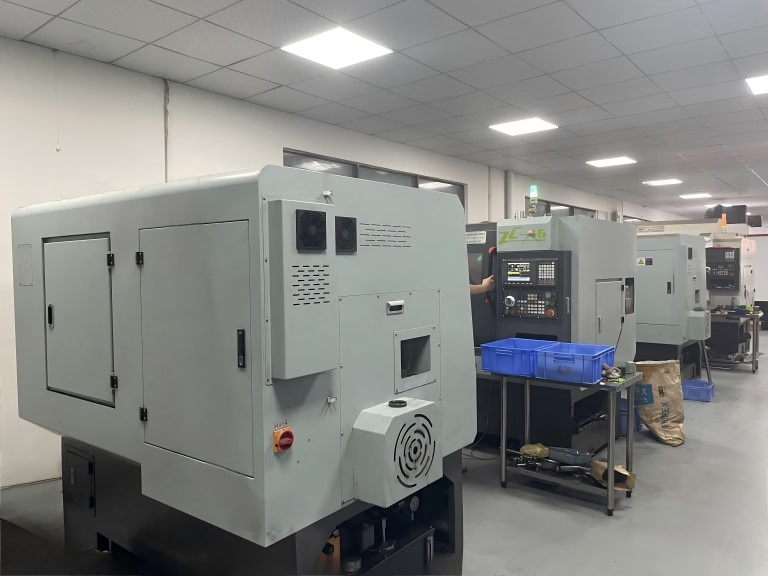
A modern CNC machining service is only as modern as its spindles. Look for simultaneous 5-axis machining centers, mill-turn centers and enough 3-axis capacity to absorb the simple work without blocking the tight work.
Mill-turn centers matter when a part needs a turned OD and a milled slot or port in one setup. Every extra setup adds a datum shift, and datum shifts are where tolerance stacks go wrong.
Size limits are practical. A 4,000 mm maximum processing size with 4,000 × 400 × 150 mm travel covers long extrusions and rails. Medium and compact travels handle housings, manifolds and small precision parts. If your part sits between two size classes, ask which machine the shop plans to run.
- 1Ask for the machine nameA quote that lists the machine type is a quote that was planned.
- 2One setup beats twoFewer setups mean fewer tolerance stacks.
Match the alloy and finish to the function
Aluminium 6061-T6 is the default for prototype housings, and 7075 is the one to pick when you need stiffness at lower mass. 2024 machines well but does not weld or anodize as cleanly, so check the finish plan before you commit.
Stainless 303 is fast to machine and fine for non-welded parts. 304 and 316L hold up in wet or corrosive service. 17-4PH (SUS630) is the one to pick when you need strength after heat treatment. Titanium TC4 (Ti-6Al-4V) and Inconel cut slowly; budget the cycle time, not just the material cost.
As-machined finish covers most functional parts at Ra 1.6–3.2 μm. Sealing faces and sliding surfaces usually want Ra 0.8–1.6 μm, and optical or seal-critical faces can go to Ra 0.2–0.8 μm. Each step up the finish ladder adds a separate operation.
- 1Finish callouts cost moneyOnly specify the Ra where the drawing needs it.
- 2Plating changes dimensionsElectroless nickel and hardcoat anodizing shift sizes; tell the shop before it machines.
What certifications actually cover
ISO 9001:2015 covers the general quality system. IATF 16949:2016 is the one automotive buyers ask for, and it means the shop is set up for PPAP-style documentation and traceability. ISO 13485:2016 is the medical device standard, relevant when your part touches a regulated product.
ISO 27001:2022 is about information security, not parts. For a modern CNC machining service it matters when you send proprietary drawings, CAD models or tooling data. Uploads should be secure and confidential, and an NDA should be available on request.
Ask whether the certificate covers the site that will machine your part. A group certificate with several plants can hide the fact that your work runs somewhere else.
- 1Match cert to industryIATF for automotive, ISO 13485 for medical, ISO 9001 as the floor.
- 2Check the site scopeThe certificate should name the plant running your order.
Lead time, MOQ and quotescope you should test
A quotation and free DFM analysis within 12 hours is a reasonable benchmark. It tells you the shop has engineering capacity to review the drawing before it prices it. If pricing takes a week and comes back without comments, the shop probably quoted the model file and never opened the tolerances.
Production can start within 24 hours once the PO and material are in place, and parts ship in 3–5 days for typical runs. Historical late-delivery probability below 2% is the kind of number you can ask a supplier to support with records.
No minimum order quantity is a real signal. It means the shop will run one prototype and a 10,000+ part run on the same floor without a setup penalty clause. For hardware teams that iterate weekly, that matters more than a marginal unit price.
- 1Test the first quoteSend a part with one deliberately tight feature and see if anyone comments.
- 2Ask about material stockLead time often follows the alloy, not the machine.
Six steps to qualify a modern CNC machining service
Run these in order. Each one can eliminate a supplier before you spend engineering time.
- 1Send a real drawing, not a sample part photoInclude GD&T, datums and material spec. A shop that quotes from a photo will guess at the tolerances you actually need.
- 2Ask for DFM feedback with the priceLook for comments on wall thickness, tool access, thread depth and finish callouts. Free DFM analysis within 12 hours is a fair test.
- 3Confirm the machine and the setup countAsk which machine class runs the part and how many setups it needs. Fewer setups usually means a more stable process.
- 4Check the inspection planRaw material check, in-process monitoring and final inspection should all be named. Request reports for the critical features only, so the paperwork stays useful.
- 5Verify certification scope and NDAMatch the certificate to your industry and confirm it covers the plant doing the work. Sign an NDA before sending CAD if the design is sensitive.
- 6Run a small first order before a production releaseOne to five pieces proves the process. Measure them yourself on the features you care about, then release the full run.
Questions buyers ask before ordering
Can a modern CNC machining service hold ±0.005 mm on a production run?
Yes, on selected features and with the right machine, fixturing and shop temperature. It is not a shop-wide claim.
Ask which features will be held at that band and how they will be measured. If the answer is vague, treat the tolerance as ±0.025 mm in your planning.
What is the real difference between 3-axis and 5-axis for my part?
5-axis lets the tool reach angled faces and undercuts in one setup. That removes datum shifts and often removes a fixture.
If your part is prismatic with features on two faces, 3-axis with a good fixture is cheaper. If it has compound angles, deep pockets on multiple faces or contoured surfaces, 5-axis usually wins on total cost.
How should I set an MOQ when I only need a few prototypes?
Start with no minimum order quantity if the supplier allows it. A shop that runs one piece and a 10,000+ piece run on the same floor will quote both.
Use the prototype run to validate the process, then negotiate production pricing on the same drawing revision so nothing changes between stages.
Which certifications should I require for automotive or medical parts?
Automotive buyers usually ask for IATF 16949:2016. Medical device work points to ISO 13485:2016. ISO 9001:2015 is the baseline for general industrial parts.
Add ISO 27001:2022 when you are sharing proprietary CAD and tooling data. It covers how the shop protects your files.
How fast can a quote and a first article come back?
A quotation and free DFM analysis within 12 hours is a realistic target for a staffed engineering desk. Production can start within 24 hours once material is released.
Typical parts ship in 3–5 days. Ask for the inspection report with the shipment so you can verify critical features before assembly.
What should I send with the RFQ to get an accurate price?
Send 3D CAD, a 2D drawing with GD&T, material and finish spec, quantity per revision, and any target date. Note which features are critical and which are cosmetic.
Mention if the part will be anodized or plated, because coating thickness changes machined dimensions and the shop needs to compensate.
Send a drawing, get a quote and DFM notes
Upload your CAD and tolerances. We return pricing and manufacturability comments within 12 hours, with no minimum order quantity.
12-hour quote100% inspectionNo MOQNDA on request
More from GreatLight
We publish setup notes, tooling trials and inspection data from the factory floor.











