
PMMA CNC Machining Service: What to Check Before You Order
A practical guide for engineers and procurement teams sourcing acrylic parts. We cover the tolerances a PMMA CNC machining service can hold, where the material cracks, which finishes are worth the money, and the questions that separate a real supplier from a broker.
In this article
- 1
- 2
- 3
- 4
- 5
- 6
- 7
- 8
- 9
Key takeaways
Choosing a PMMA machining supplier: what to weigh
Use this table to compare quotes. A low price with vague answers on any row usually shows up as scrap later.
| Criterion | What to ask | What a good answer looks like |
|---|---|---|
| Tolerance | Can you hold ±0.005 mm on acrylic? | Yes, with a first-article report. |
| Cutter strategy | Which flute count and geometry for PMMA? | Polished single or double flute, carbide, plastic geometry. |
| Cooling | Air, mist or flood? | Air or mist. Flood risks thermal shock on cast sheet. |
| Stress relief | Do you anneal cast acrylic? | Yes, before and after machining when needed. |
| Finish | What Ra can you deliver as-machined? | Ra 0.8–1.6 μm on flats, polishing quoted separately. |
| Inspection | Do you supply dimensional reports? | Yes, on request. 100% inspection before shipment. |
| MOQ | What is your minimum order? | No minimum. One prototype to 10,000+ parts. |
| NDA | Can you sign before we send files? | Yes, NDA available on request. |
Why PMMA behaves differently at the spindle
PMMA, sold as Acrylic, Plexiglas or Perspex, is a transparent thermoplastic with about 92% light transmission. It is stiffer and harder than polycarbonate, which is why it machines to a cleaner edge and holds a better surface. It is also more brittle. Where PC absorbs impact and deforms, PMMA chips and cracks.
The material has a glass transition temperature near 105 °C and low thermal conductivity. Heat generated at the cutting edge has nowhere to go. It builds up in the chip and the workpiece. Once the tool tip passes that threshold, the material smears instead of shearing. You see it as a cloudy band on the wall, a burr that will not break off, or chips welded back onto the surface.
That single property drives most of the process decisions. Tool geometry, spindle speed, feed, depth of cut and chip evacuation are all chosen to keep the cutting zone cool. If a shop quotes acrylic work using the same parameters as aluminium, the finish will show it.
Sheet stock matters too. Extruded acrylic is cheaper and more uniform, but cast sheet has better optical properties and is the normal choice for lenses and light guides. Cast sheet also carries residual internal stress from manufacturing. Machining removes material and unbalances that stress, which is when parts bow or craze.
What a PMMA CNC machining service can actually hold
Feature tolerance and optical tolerance are two different numbers, and quotes should separate them. A milled pocket or bolt circle in PMMA can hold ±0.005 mm on a well-controlled machine. An optically clear face is a surface-finish requirement, not a dimensional one, and it depends on tool condition and polishing after machining.
Flatness on thin sheet is the harder problem. A 3 mm acrylic panel will move after clamping release if the stock was not stress-relieved. The same part in 10 mm stock is far more stable. If your design has a large thin web, expect to discuss fixturing rather than tolerance.
Part size sets the machine. GreatLight runs 127 high-precision CNC machines across three plants, including 16 simultaneous 5-axis centers, 12 four-axis mills, 27 three-axis machines and 16 mill-turn centers. Maximum processing size is 4,000 mm, with travels of 4,000 × 400 × 150 mm and 750 × 1,150 × 550 mm on the larger platforms.
For parts with undercuts, angled light ports or contoured optical surfaces, 5-axis work removes the need to re-fixture. Every re-clamp on acrylic is a new chance to scratch a polished face or introduce a stress point.
Tooling, cooling and the parameters that protect the finish
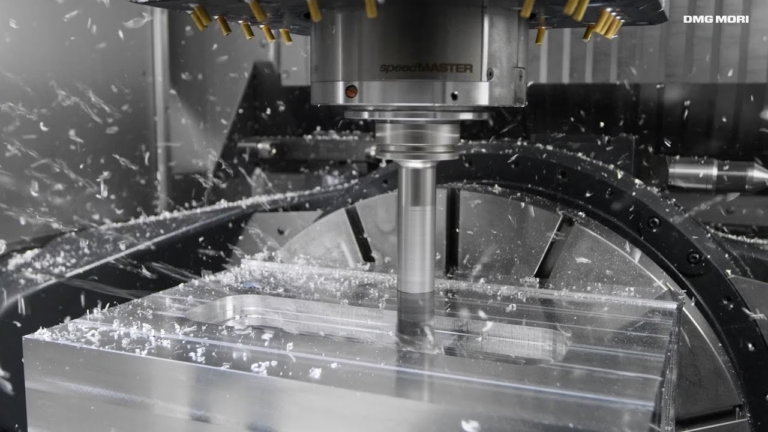
Use sharp, highly polished carbide tools ground for plastics. Single-flute or two-flute cutters with a high helix and a large gullet clear chips fast. A cutter designed for aluminium has the wrong rake angle and rubs rather than cuts. Dull tooling is the most common cause of a milky edge.
Spindle speed runs high, feed is low to moderate, and depth of cut stays light. Those three settings together limit the heat pushed into each pass. A constant stream of high-pressure air or mist carries chips away and cools the edge without the thermal shock that flood coolant can cause on cast sheet.
Drilling needs its own attention. A standard 118° point drill will grab on breakthrough and can star-crack the exit face. Use a sharper point angle, reduce feed as the tip exits, and back the workpiece with a sacrificial plate.
Tapping and threading in PMMA work, but thread engagement should stay conservative. Acrylic threads strip more easily than metal, so specify a coarser pitch and avoid very fine threads in thin walls.
Surface finish and post-processing choices
As-machined PMMA comes off the machine at roughly Ra 1.6–3.2 μm. That is fine for brackets, jigs and internal parts. With a clean setup and fresh tooling, a shop can reach Ra 0.8–1.6 μm on flat faces, which is enough for many visible covers. Fine finishes down to Ra 0.2–0.8 μm are achievable but should be quoted as a controlled operation, not assumed.
Optical parts need more than a good cutter. Flame polishing and vapor polishing both dissolve the surface layer to produce clarity, and both can round edges or distort thin features. Diamond-edge fly cutting is another route for flat optical faces and leaves a clean, predictable surface.
GreatLight offers bead blasting, tumbling, brushing and polishing as part of its surface finishing service. For PMMA, bead blasting gives a uniform matte look and hides tool marks. It also destroys optical clarity, so do not specify it on a lens.
Laser marking works on acrylic and produces good contrast, but minimum character height is 1.5 mm. Below that, the mark becomes unreadable and the heat-affected zone spreads.
Lead time, MOQ and what a quote should tell you
GreatLight provides a quotation and free DFM analysis within 12 hours. Production can start within 24 hours once a design is confirmed, and parts typically ship in 3–5 days. Historical late-delivery probability is below 2%. Those numbers apply to confirmed orders with released drawings, not to specifications still under revision.
There is no minimum order quantity. One prototype and a 10,000+ part run both go through the same shop. That matters for PMMA because the first article often reveals a stress or fixturing problem that is cheaper to fix before tooling is committed.
A useful quote breaks out material grade, stock thickness, machining operations, finishing, inspection and packaging. If a quote lists only a part price and a lead time, you cannot tell what happens if the first article fails inspection.
Uploads are handled as confidential, and an NDA is available on request before drawings are shared. Ask for this early if the part is an unreleased optical design.
Certifications and inspection data worth asking for
GreatLight holds ISO 9001:2015, IATF 16949:2016, ISO 13485:2016 and ISO 27001:2022. The first two matter for automotive and general industrial buyers. ISO 13485 is the one medical device teams look for. ISO 27001 covers how your files are stored and shared.
Inspection is 100% before shipment, with raw material checks, in-process monitoring and final inspection. Reports are available on request. For PMMA, ask specifically for dimensional results on critical features and a note on surface condition.
Qualification rate on this shop floor is 99.99%. Treat that as a process indicator, not a guarantee for your specific design. A thin acrylic window with a deep pocket is still a hard part, and the first article is where you find out.
If your program needs material traceability, say so at quote stage. Certificates of conformance and material batch records take time to prepare and should not be a surprise request after shipment.
Step by step: from file to a clean acrylic part
This is the sequence we follow on PMMA jobs. Use it as a checklist when comparing suppliers.
- 1Confirm the material gradeState cast or extruded sheet, thickness and color. Cast is the default for optical parts; extruded is fine for non-visual brackets.
- 2Run DFM before quotingFlag thin walls under 1.5 mm, deep pockets, sharp internal corners and any feature that traps chips. Adjust the design before cutting metal, not after.
- 3Stress-relieve the stockAnneal cast sheet before machining when the part is thin or heavily pocketed. This reduces the chance of bowing and crazing after release.
- 4Select cutter and parametersPolished single or double flute carbide, high spindle speed, moderate feed, light depth of cut. Air or mist cooling only.
- 5Control the fixturingUse soft jaws or vacuum plates. Metal clamps leave marks and concentrate stress on acrylic surfaces.
- 6Drill and tap carefullyReduce feed on breakthrough, support the exit face, and keep thread engagement conservative.
- 7Finish and inspectPolish or bead blast as specified. Measure critical features, check for crazing under light, and report results before packing.
Questions buyers ask about PMMA machining
Can PMMA be machined to optical clarity?
Yes, but not by milling alone. As-machined acrylic lands around Ra 1.6–3.2 μm, which is visibly hazy on a light guide.
Optical faces need diamond-edge fly cutting, flame polishing or vapor polishing after machining. Each method has trade-offs on edge sharpness and dimensional change, so specify which one you want.
Why do my acrylic parts crack after machining?
Usually internal stress in cast sheet plus a stress riser. Sharp internal corners, aggressive feed on breakthrough and clamping pressure all concentrate load.
Annealing before and after machining, adding corner radii and switching to a sharper drill point solve most of these failures.
Is PMMA a good choice over polycarbonate?
Choose PMMA when you need optical clarity, scratch resistance and weatherability. It transmits about 92% of visible light and holds up outdoors.
Choose polycarbonate when impact resistance matters more than clarity. PC is tougher but scratches easily and yellows faster under UV.
What tolerance should I specify on acrylic parts?
Specify ±0.005 mm only on features that need it. Over-tolerancing thin acrylic drives cost and inspection time without improving function.
For non-critical dimensions, ±0.1 mm or general tolerance is usually enough and keeps the part affordable.
Do you machine one-off acrylic prototypes?
Yes. There is no minimum order quantity, so a single prototype runs through the same process as a production batch.
Quotation and free DFM analysis come back within 12 hours, and parts typically ship in 3–5 days.
Will coolant damage my PMMA parts?
Flood coolant can cause thermal shock on cast acrylic and leave residue in fine features. Air blast or mist is the safer choice.
If a shop insists on flood cooling for PMMA, ask how they control the temperature differential at the cut.
Send your PMMA drawing and get a real answer
Upload your file for a quote and free DFM analysis within 12 hours. No minimum order, confidential handling, and inspection reports on request.
12-hour quoteNo MOQ100% inspectionNDA available
More from GreatLight
We publish setup notes, tooling trials and inspection data from the factory floor.











