
Prepared CNC Machining Services: A Buyer's Guide
This guide is for engineers and procurement teams comparing prepared CNC machining services. We explain what the term actually covers, which checks separate a real prepared shop from a standard job shop, and where the limits sit.
In this article
- 1
- 2
- 3
- 4
- 5
- 6
- 7
- 8
Key takeaways
What to check before you send a PO
Five checks, what good looks like, and the failure mode behind each one.
| Check | Good sign | Failure mode |
|---|---|---|
| Tolerance claim | A number tied to a feature size | One blanket tolerance for the whole part |
| Lead time | Quote, DFM, and start date all stated | Vague "fast turnaround" with no dates |
| MOQ | One piece to 10,000+ parts | Setup fee that only pays off at volume |
| Certifications | ISO 9001, IATF 16949, ISO 13485, ISO 27001 | Certificate named but never shown |
| Quote detail | DFM notes on walls, radii, and datums | Price only, no machining feedback |
| Inspection | 100% inspection before shipment | Sample check on the first article only |
| Confidentiality | NDA available on request | Uploads handled without a written policy |
Pick the shop that answers before you ask
If a supplier cannot state tolerance, lead time, inspection, and certificate scope in writing, the word prepared is marketing. Ask for those four answers and the decision usually makes itself.
What prepared CNC machining services actually cover
Prepared CNC machining services are a workflow, not a machine type. The shop has already fixed the material stock, the workholding, the tool list, and the inspection routine for the part family you are asking about. Your RFQ drops into a process that exists. It does not start a process from zero.
That distinction shows up in the first 24 hours. A standard job shop reads your drawing, picks a machine, and quotes. A prepared shop reads the same drawing and tells you which features will move, which radii are too tight for the tool it intends to use, and where a datum shift will hurt you. Production can start within 24 hours because the decisions were made earlier.
In practice, prepared CNC machining services sit between rapid prototyping and full production tooling. You get machined parts at ±0.005 mm, not molded parts at a fraction of the cost per unit. You also skip the weeks of fixture design that a fresh production program would need.
- 1Pre-validated materialsAluminium 6061-T6, 7075, 17-4PH, Ti-6Al-4V, PEEK, and others kept in known condition.
- 2Pre-set workholdingVises, soft jaws, and rotary tables sized for common part envelopes.
- 3Pre-planned inspectionDatums and critical features defined before the first cut.
Tolerance: the check that decides everything else
Start with the tightest tolerance on the drawing and the feature it applies to. ±0.005 mm is achievable, but it is not a shop-wide default. It applies to specific features on specific machines, usually with temperature control and a finishing pass that adds cycle time.
A part 500 × 500 × 450 mm can hold tight tolerances on the machined faces. A part 4,000 × 400 × 150 mm is harder because thermal growth over that length moves the number. Ask how the shop compensates. If the answer is "we just hold it," that is a gap.
Surface finish follows the same logic. Ra 0.2–0.8 μm needs a different tool path and a different feed than Ra 1.6–3.2 μm. Quote both and compare. A shop that prices them the same has not separated the processes.
One practical rule: put your tolerance block next to the feature list before you send the RFQ. If two features need ±0.005 mm and the rest need ±0.05 mm, say so. It cuts cost and it tells you whether the shop reads drawings.
Lead time and order size: where quotes hide risk
Lead time claims are easy to make and easy to check. Ask for four dates: quotation, DFM feedback, production start, and shipment. A prepared shop can quote and return free DFM analysis within 12 hours, start production within 24 hours, and ship parts in 3–5 days for standard work.
Watch the gap between the quote date and the start date. If it is open-ended, the shop is loading your job behind unknown work. A historical late-delivery probability below 2% is a number a shop can state because it tracks it. Ask for that number.
Order size matters less than it used to. No minimum order quantity means one prototype and a 10,000+ part run come off the same process. That is useful when a design change at 200 units would otherwise force a new setup.
The trap is a low unit price that only works at volume. If the setup charge disappears above 5,000 pieces, your prototype pricing was subsidized. That is fine for the prototype, but it tells you the shop's real cost structure.
Certifications and data handling
Four certificates cover most buyer requirements. ISO 9001:2015 covers the quality system. IATF 16949:2016 covers automotive. ISO 13485:2016 covers medical devices. ISO 27001:2022 covers information security.
Certification matters most when your part feeds a regulated product. A medical housing machined without an ISO 13485 process may still measure correctly, but the traceability and change control behind it will not pass an audit. Check the scope on the certificate, not just the logo.
Data handling is the check buyers forget. Your CAD files, drawings, and revision history are the design. Uploads should be secure and confidential, and an NDA should be available on request before you send anything.
Ask one question to test this: who can open my files, and where are they stored? A clear answer takes ten seconds. A vague one tells you the policy is informal.
- 1ISO 9001:2015Baseline quality management for general industrial parts.
- 2IATF 16949:2016Required for automotive and EV programs.
- 3ISO 13485:2016Required for medical device components.
- 4ISO 27001:2022Covers how your design data is protected.
Machine capability and finishing chain
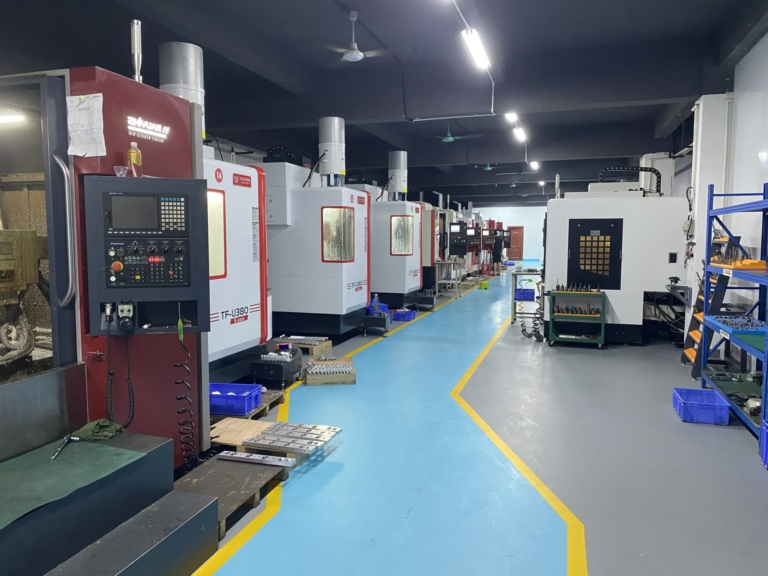
Prepared capacity is concrete. GreatLight runs 127 high-precision CNC machines across three wholly-owned plants covering 7,600 m², with 150 technicians. That includes 16 simultaneous 5-axis machining centers, 12 four-axis mills, 27 three-axis machines, and 16 mill-turn centers.
The 5-axis centers handle contoured surfaces and features on five sides in one setup. Mill-turn centers cut turned and milled features without a second fixture. Both reduce the datum shifts that cause scrapped parts late in a program.
Size range matters too. Maximum processing size is 4,000 mm, with machine travels from 500 × 500 × 450 mm up to 4,000 × 400 × 150 mm. A Ø400 mm rotary table covers round work that would otherwise need a different machine.
Finishing should sit in the same building. Anodizing, plating, powder coating, black oxide, bead blasting, brushing, polishing, and laser marking are all listed services. Outsourced finishing adds a week and a second quality record to manage.
How to evaluate a prepared CNC supplier in 6 steps
Work through these in order. Each step produces a yes or no, not an impression.
- 1Send a real drawing, not a sampleUse a part with at least one tight feature and one loose feature. A sample part hides how the shop handles tolerance conflict.
- 2Time the quote and read the DFM noteA prepared shop returns quotation and free DFM analysis within 12 hours. If there is no machining feedback, the quote came from a spreadsheet.
- 3Ask for the four datesQuotation, DFM, production start, and shipment. Compare them to the 12-hour quote, 24-hour start, and 3–5 day ship baseline.
- 4Check tolerance and finish separatelyConfirm ±0.005 mm on named features and ask which finish grade applies: Ra 0.2–0.8 μm, Ra 0.8–1.6 μm, or Ra 1.6–3.2 μm as machined.
- 5Request certificate scopeAsk for ISO 9001, IATF 16949, ISO 13485, or ISO 27001 documents depending on your industry. Read the scope line.
- 6Confirm inspection and NDA before release100% inspection before shipment with reports on request, and an NDA available on request. Do not upload files until both are in writing.
Frequently asked questions
Is prepared CNC machining different from rapid prototyping?
They overlap, but the intent is different. Rapid prototyping optimizes for speed on a single design iteration.
Prepared CNC machining services keep the same process window from prototype to production, so a design change at 200 units does not force a new setup.
How tight a tolerance can I actually expect?
±0.005 mm is achievable on named features with the right machine and finishing pass.
On long parts, thermal movement over the length is the limiting factor. Tell the shop which features matter instead of applying one tolerance to everything.
What is the minimum order quantity?
At GreatLight there is no minimum order quantity. Runs go from one prototype to 10,000+ parts.
That means prototype and production pricing come from the same process, which makes early cost estimates more useful.
Which materials are stocked or readily available?
Aluminium 6061, 6061-T6, 2024, 5052, 5083, 6063, 6082, 7075, and ADC12; stainless 303, 304, 316, 316L, 17-4PH, and 440C; steels including 1018, 1045, 4130, 4140, and 4340.
Titanium TA1, TA2, TC4 (Ti-6Al-4V), Inconel, magnesium AZ31B and AZ91D, copper alloys, and plastics such as POM, PEEK, PC, and ABS are also machined.
How are my files protected?
Uploads are secure and confidential, and an NDA is available on request before you send data.
ISO 27001:2022 covers information security, which is the certificate to ask for if your design data is sensitive.
What happens if a feature cannot be machined as drawn?
A prepared shop flags it in the DFM note that comes back with the quote, usually within 12 hours.
Typical notes cover wall thickness, internal corner radii, deep pockets, and datum choices. Fixing these before cutting is cheaper than fixing them after.
Send a drawing and test the process
Quotation and free DFM analysis within 12 hours. Production can start within 24 hours, with 100% inspection before shipment.
12-hour quoteNo MOQ100% inspectionNDA on request
More from the shop floor
We publish setup notes, tooling trials and inspection data from the factory floor.











