
Processing HDPE Using CNC: A Guide to Success
HDPE is soft, slippery and moves after you cut it. This guide explains the material behavior behind those three problems, gives the cutter geometry and parameters we use on the floor, and shows where CNC stops being the right process.
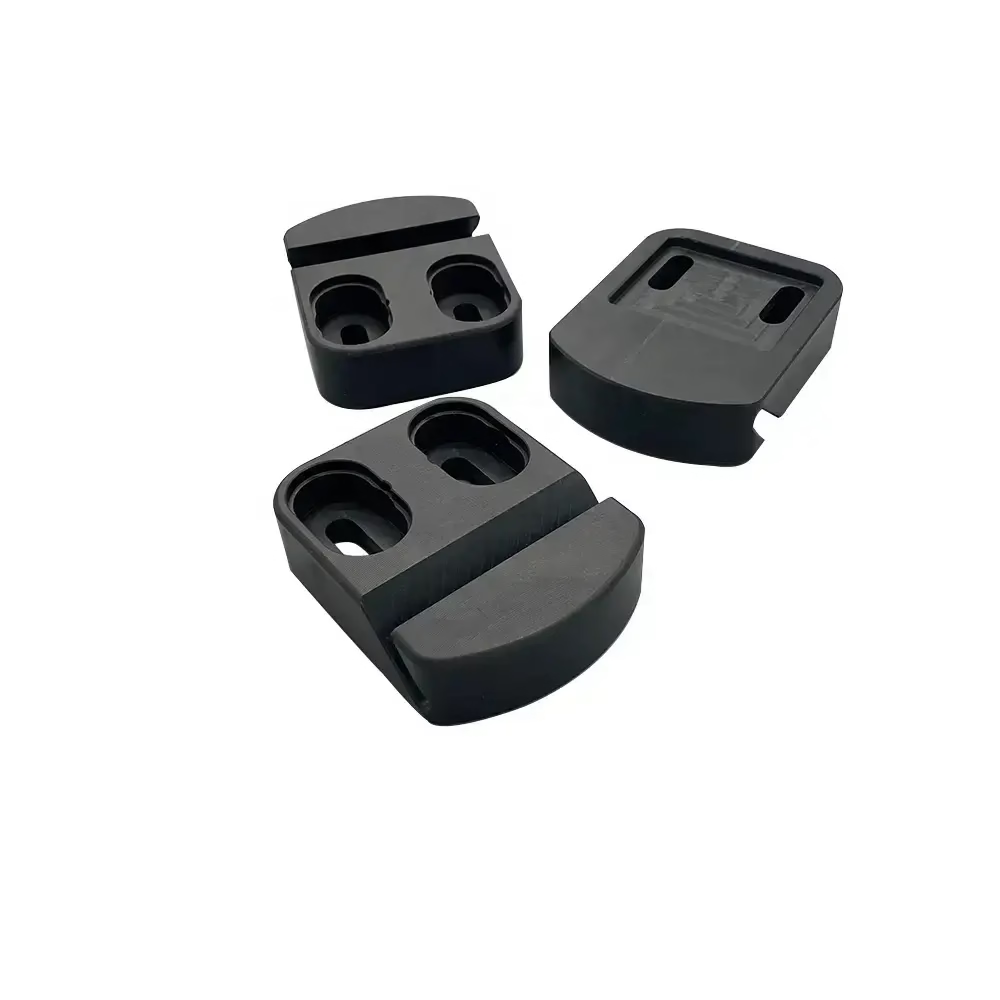
What HDPE does to a cutting tool
HDPE is a semi-crystalline thermoplastic with a low melting point and a high melt flow rate. That combination is the root of most machining problems. The chip does not shear off cleanly the way it does in brass or 6061 aluminum. It stretches first, then tears, and the friction of that stretch puts heat straight back into the workpiece.
The material also has a low coefficient of friction and low stiffness. A long boring bar pushed into it will deflect, because the part offers almost no resistance. The tool goes where the cutting force sends it, not where the toolpath says. That is why a roughing pass that sounds fine in aluminum produces a bell-mouthed hole in HDPE.
Thermal expansion closes the loop. HDPE expands roughly ten times more than steel for the same temperature rise, and it has poor thermal conductivity, so heat stays where the cut generated it. A part that measures on size at 40 °C can shrink 0.05 mm or more once it cools to room temperature.
None of this makes HDPE a bad machining material. It makes it a material that rewards sharp tools, light cuts and a plan for heat. Treat the plastic as the flexible thing it is and the process becomes predictable.
Cutter geometry and parameters that work
For milling, use two or three flutes in polished carbide. More flutes pack chips into the gullet and the chips cannot clear, so the cutter rubs instead of cutting. A positive rake of 10° to 20° and a sharp edge, no honing, slice the material instead of pushing it away.
Spindle speed usually lands between 2,000 and 4,000 rpm with a feed of 0.1 to 0.25 mm per tooth. Depth of cut of 0.5 to 1.5 mm per pass keeps the load low. If you hear a high-pitched squeal, the cutter is rubbing. Reduce speed and increase feed per tooth.
For turning, a sharp positive insert with a small nose radius between 0.2 and 0.4 mm and a rake angle around 15° to 20° separates the chip cleanly. Run 300 to 600 m/min surface speed with a feed of 0.1 to 0.3 mm per revolution.
For drilling, use 118° to 130° point angles with wide flutes and polished surfaces. Peck drilling at one diameter per peck clears chips. A pilot drill followed by a boring pass holds hole position better than a single drill through thick stock.
Compressed air is the coolant of choice. Flood coolant can work, but the fluid absorbs into the material and swells it, and the swell does not reverse evenly. If you must use coolant, use a water-soluble type at low concentration and dry the parts thoroughly.
Workholding and where the part moves
HDPE flexes under clamping pressure. A vise tightened to the same torque you use on steel will bow a 20 mm plate and spring it back after unclamping. Use soft jaws machined to the part profile, and clamp just enough to stop movement, not enough to deform.
For thin plates, vacuum fixturing or double-sided tape on a flat sub-plate spreads the load and avoids point pressure. For long parts, support the underside with a sacrificial MDF or HDPE spoilboard so the cutter pushes against something rigid.
Leave a roughing allowance of 0.3 to 0.5 mm and take a light finishing pass after the part has cooled. Cutting forces release internal stress in extruded stock, so a part machined to final size in one pass can bow by 0.2 mm overnight.
When tolerance is tighter than ±0.05 mm on a long dimension, machine the part oversize, let it rest, then finish. Skipping the rest is the most common reason a good-looking HDPE part fails incoming inspection.
Surface finish and edge quality
As-machined HDPE surfaces land around Ra 1.6–3.2 μm with a sharp cutter and clean chip evacuation. Pushing for Ra 0.8–1.6 μm is possible with a finishing pass of 0.1 to 0.2 mm radial engagement, but the gain is small and the risk of heat marks rises.
Fuzzy edges come from a dull cutter or too low a feed. The edge tears instead of shears. Replace the cutter and raise feed per tooth by 20 to 30 percent before you change anything else.
Deburring by hand with a sharp blade works better than abrasive paper, which smears the plastic and leaves a dull white edge. A light scrape along the cut line removes the fuzz and leaves a clean profile.
For parts that will be handled or cleaned often, bead blasting at low pressure gives a uniform matte surface and hides tool marks. High pressure will embed media in the soft surface, so keep it gentle.
When CNC is the wrong choice for HDPE
CNC wins when you need a few parts fast, complex geometry, or tolerances tighter than ±0.1 mm. It loses when the part is a simple profile needed in the thousands and the wall thickness is generous.
For large flat panels, a router or waterjet cuts faster and cheaper. For hollow tanks and ducts, rotational molding or blow molding produces the shape in one shot with no joints. Welded HDPE fabrication handles large enclosures that would need a 4,000 mm machine travel.
Injection molding takes over once volume passes roughly 10,000 parts and the geometry stays fixed. The tooling cost only pays back at that scale. Below it, machining a billet is usually cheaper.
A useful rule: if the part is a shaped block with holes and pockets, machine it. If the part is a shell that only needs a surface, mold it. Mixing the two is where budgets get wasted.
Process choice by part and volume
Use this to pick a process before you send a drawing.
| Part type | Typical volume | Best process | Why |
|---|---|---|---|
| Flat panel, simple outline | 1–500 | CNC router or waterjet | Fast, no tooling cost |
| Block with pockets and bores | 1–5,000 | 3-axis or 5-axis CNC | Holds ±0.005 mm on features |
| Hollow tank or duct | 50–10,000 | Rotational molding | One-piece shell, no joints |
| Large enclosure, welded | 1–100 | HDPE fabrication | Exceeds 4,000 mm travel limits |
| High-volume simple fitting | 10,000+ | Injection molding | Tooling pays back at volume |
Pick the process before the tolerance
If the part is a shaped block with features, machine it and budget for a rest before finishing. If it is a thin shell produced in volume, mold it and do not pay for CNC time.
Common questions
What tolerance can you hold on machined HDPE?
Our general machining tolerance is ±0.005 mm, and that applies to metals and stable plastics under controlled temperature.
On HDPE, the practical floor is looser. For short dimensions under 50 mm we hold ±0.05 mm on a good day. For long dimensions, we agree on ±0.1 mm or looser, because thermal movement after machining can eat the rest.
Does HDPE need coolant?
Compressed air is usually enough. It clears chips and carries away some heat without swelling the part.
Flood coolant absorbs into the material and changes dimensions. If you need it for a deep pocket, use a low-concentration water-soluble fluid and dry the parts completely before inspection.
Why do my HDPE holes come out oversize?
The cutter is deflecting, the chip is not clearing, or the part is hot when you measure it.
Check runout first, then shorten the tool overhang, then reduce depth of cut. A boring pass after drilling fixes most oversize holes without changing the setup.
Can you machine HDPE to a food-safe or medical finish?
We machine HDPE on dedicated vises and clean the machine before the run. Surface finish is as-machined or bead blasted, per your drawing.
HDPE is a common material for medical trays and fluid handling parts. We hold ISO 13485:2016 and ISO 9001:2015, and inspection reports are available on request.
How fast can you turn around an HDPE prototype?
Quotation and DFM feedback come back within 12 hours, and production can start within 24 hours after you approve.
Parts ship in 3–5 days for most jobs. There is no minimum order quantity, so a single prototype is fine.
What size HDPE parts can you machine?
Our largest travel is 4,000 × 400 × 150 mm. Medium machines cover 750 × 1,150 × 550 mm and 600 × 600 × 600 mm, and compact machines cover 500 × 500 × 450 mm and 500 × 310 × 200 mm.
We have 16 simultaneous 5-axis centers, 12 four-axis mills, 27 three-axis machines and 16 mill-turn centers. For a large HDPE panel, tell us the finished size and we will say whether it fits.
Send us your HDPE part
Upload a STEP file and we will come back with a quote and DFM notes within 12 hours.
12-hour quoteNo minimum order quantity100% inspection before shipment
More machining guides
We publish setup notes, tooling trials and inspection data from the factory floor.











