
How to Trade For CNC Machining Services Trader Work: 7 Checks
A CNC machining services trader sits between your drawing and the machines that cut your parts. Your part quality depends on who owns the spindles, not on who owns the email address. This guide lists the checks we would run before sending a purchase order, with the numbers that matter.
In this article
- 1
- 2
- 3
- 4
- 5
- 6
- 7
- 8
What matters before you place the order
Trader, broker, or direct machine shop
Same part, three supply routes
| Question | Trader with no floor | Direct machine shop |
|---|---|---|
| Who cuts the part? | Unknown subcontractor | Own 127 CNC machines |
| Tolerance control | Re-quoted at each step | ±0.005 mm, 100% inspection |
| Lead time | Quoted, then re-quoted | Parts ship in 3–5 days |
| First article cost | Setup passed through | No MOQ, one part accepted |
| Drawing changes | Relayed by email | DFM note within 12 hours |
| Certificates | Often generic copies | ISO 9001, IATF 16949, ISO 13485 |
| Confidentiality | NDA with middle party | NDA with the plant, secure uploads |
The short version
If your part has tight tolerance, a finish spec, or an NDA, buy from the shop that owns the machines. If it is a simple bracket at low volume, a trader can work.
Who actually owns the spindles
Most cnc machining services trader listings online are brokers. They take your drawing, forward it to a shop they know, and add margin on the way through. That is not automatically bad. The problem shows up when the quote is tight, the schedule slips, and nobody on the call has seen your part on a table.
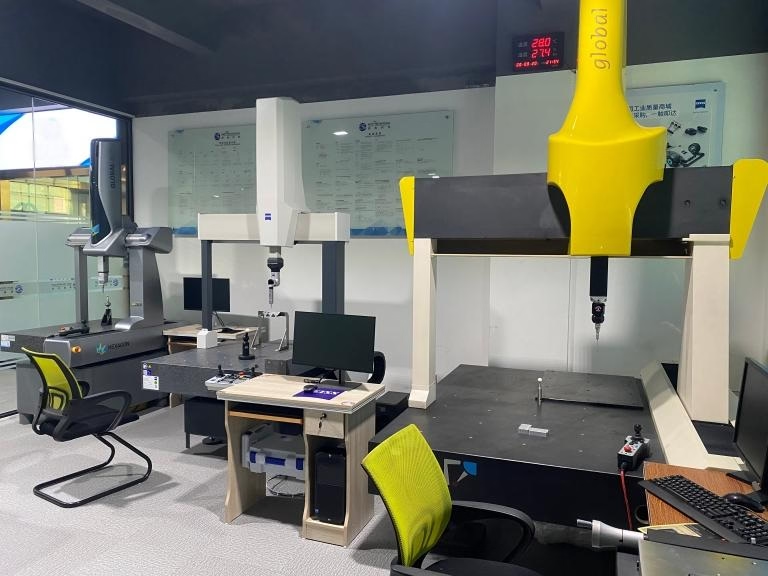
Ask for the plant address and the machine list. A real supplier can name the model and the travels of the machines that will run your job. We run 127 high-precision CNC machines across three plants in Dongguan and Singapore, including 16 simultaneous 5-axis centers, 12 four-axis mills, 27 three-axis machines, and 16 mill-turn centers. Maximum processing size is 4,000 mm.
If the answer is a vague sentence about partner factories, treat the quote as an estimate. Add two weeks to the promised date and expect one round of re-quoting after the first inspection report.
- 1Machine listModel, axis count, and travels for the machines on your job.
- 2Plant addressA site you can audit, not a registered office.
- 3Named process ownerOne engineer who answers technical questions.
Tolerance claims and how they are checked
Tolerance is where trading layers hurt most. A broker quotes ±0.005 mm because that is what the customer asked for, then discovers the chosen subcontractor cannot hold it on a 300 mm aluminum housing. Better to agree on tolerance per feature than to argue after the first article.
A credible supplier states both the number and the measurement. We hold ±0.005 mm (±0.0002 in) on critical features and inspect 100% of parts before shipment: raw material check, in-process monitoring, final inspection, reports on request. Surface finish is quoted the same way, from Ra 0.2–0.8 μm for sealing faces to Ra 1.6–3.2 μm for as-machined brackets.
Ask what happens when a dimension drifts. The answer should be a containment step and a report, not a discount. A 99.99% qualification rate only means something if failed parts are caught before the box is sealed.
- 1Tolerance by featureNot one global number across the whole drawing.
- 2Inspection planSampling or 100% check, stated up front.
- 3Report formatDimensional report and material certs on request.
Lead time, MOQ, and the quoting cycle
Lead time is a process question, not a sales question. A trader adds a day for the RFQ, a day for the subcontractor to respond, and another day to relay the DFM comments. That overhead lands on your schedule every time you change a chamfer.
We return a quotation and a free DFM analysis within 12 hours, start production within 24 hours, and ship parts in 3–5 days. Historical late-delivery probability is below 2%. There is no minimum order quantity, so a single prototype and a 10,000+ part run both go through the same quoting path.
Watch for MOQ hidden inside setup. Some traders quote a low unit price but charge a setup fee per revision. Ask whether the setup is repeated if the drawing changes after the first article.
- 1Quote turnaround12 hours including a DFM note.
- 2Production startWithin 24 hours of order confirmation.
- 3MOQNone, from one prototype to 10,000+ parts.
Certifications, materials, and finishing scope
Certificates are only useful if they cover the site doing the work. A broker can show an ISO 9001 scan from a partner that will not touch your order. Ask for the certificate number and the audited site address, then check that the two match the plant cutting your part.
GreatLight holds ISO 9001:2015, IATF 16949:2016, ISO 13485:2016, and ISO 27001:2022. That last one matters when your drawings are covered by an NDA. Uploads are secure and confidential, and an NDA is available on request.
Material and finish scope decide how many vendors sit in your supply chain. We machine aluminum 6061, 7075, and ADC12; stainless 303, 316L, 17-4PH; steels 1018, 4140, 4340; copper and brass C110, C36000; titanium TC4 and Inconel; and plastics from POM to PEEK. Finishing runs in-house: anodizing, plating, powder coating, bead blasting, polishing, laser marking.
- 1Certificate numberMatch it to the audited plant address.
- 2Material traceabilityMill certs available for the lot used.
- 3Finishing in-houseFewer handoffs, fewer dimension shifts.
Red flags in a trader quote
Some quotes are built to win the order rather than to run the job. The price looks fine until the first article, then every change is a change order. Others hide the machining route: a part that needs 5-axis work gets quoted as three setups on a 3-axis machine, and the tolerance stack fails on the second operation.
Read the quote for what is missing. No material grade, no finish spec, no inspection clause, no stated lead time in working days. If any of those are absent, the number is not comparable to a real quote.
A short pilot order settles most of this. Send one part, ask for the inspection report, and measure it yourself. One machined part tells you more about a cnc machining services trader than ten pages of capability claims.
- 1Missing material gradeThe cheapest quote often means the cheapest alloy.
- 2Undefined finishRa left blank shifts to the coarsest pass.
- 3Working-day ambiguityCalendar days and working days differ by 30%.
How to qualify a supplier in one week
Run these in order
- 1Send the drawing with a target tolerance tableMark critical features and the surfaces that seal or slide. Leave cosmetic faces unmarked so the shop can choose a cheaper pass.
- 2Ask for a DFM note, not just a priceA useful reply points at thin walls, deep pockets, or a thread that needs a different tool. We return this within 12 hours.
- 3Request the machine and plant listMatch the travels to your part envelope. Above 500 mm, check for a 4,000 mm machine and a Ø400 mm rotary table for angled features.
- 4Order one prototype before the production runNo MOQ means you can buy one part. Check dimensions against the report, then release the batch.
- 5Confirm the inspection and reporting clauseAgree on sampling or 100% inspection, report format, and who pays if a dimension is out.
- 6Settle confidentiality in writingSign the NDA before sending STEP files. Confirm that uploads are stored on the supplier side, not passed to a third party.
- 7Lock the lead time in working daysWrite the ship date and the revision-freeze date into the PO. A drawing change after that date resets the clock.
Questions buyers ask us
Can a trader hold ±0.005 mm on a large part?
It depends on the feature, not the part size. A 4,000 mm frame can hold ±0.005 mm on a bore if the machine is rigid and the setup is single. Long unsupported walls will move after clamping regardless of who quotes it.
Send the tolerance per feature. We will say which ones are routine and which ones need a different setup or a stress-relief step before finishing.
What is the real cost of a middle layer?
Usually 10–25% on unit price plus three to five days on the schedule. The technical cost is higher: DFM feedback arrives secondhand, so manufacturability problems surface at the first article instead of at quoting.
When the part is simple and the volume is low, a trader can be a reasonable convenience. When the part has tight tolerance, thin walls, or a finish spec, direct contact with the machine shop is cheaper in total.
Do you accept one-off prototype orders?
Yes. There is no minimum order quantity, so a single part and a 10,000+ part run follow the same process. Quotation and DFM analysis come back within 12 hours, and production can start within 24 hours.
Prototype parts usually ship in 3–5 days. If the design needs a fixture before machining, we flag that in the DFM note rather than after the order.
Which certifications should I ask for?
For general industrial parts, ISO 9001:2015 is the baseline. Automotive and EV work usually needs IATF 16949:2016. Medical device parts need ISO 13485:2016. If your drawings are sensitive, add ISO 27001:2022 for information security.
Ask for the certificate number and the audited site. A certificate that does not name the plant cutting your part is a document, not a control.
How do you handle a drawing change after the first article?
We treat it as a revision: the DFM note is updated, the setup is reviewed, and the quote is reissued with the change listed. If the change touches only a non-critical feature, the setup usually stands.
Write a revision-freeze date into the PO. Changes after that date move the ship date, and we would rather tell you that early than ship a part that matches the old drawing.
What finishes can be done without sending the part out?
Anodizing in clear, color, hardcoat and conductive grades, electroless nickel, zinc, silver and gold plating, powder coating, black oxide, bead blasting, tumbling, brushing and polishing, plus laser marking with a minimum character height of 1.5 mm.
Keeping finishing in-house avoids a second shipping leg, which is where small burrs and edge damage usually appear.
Send a drawing, get a real answer
Upload your STEP file and we return a quotation with a free DFM analysis within 12 hours.
12-hour quote100% inspectionNo MOQNDA on request
Follow GreatLight
We publish setup notes, tooling trials and inspection data from the factory floor.











