
What Can a 12 Axis CNC Machine Do?
A 12-axis machine is not a bigger 5-axis mill. It is a mill-turn platform where linear and rotary axes run at the same time on one part. This page explains how the axes are counted, where the extra motion helps, and when a 3-axis or 5-axis machine is the cheaper answer.
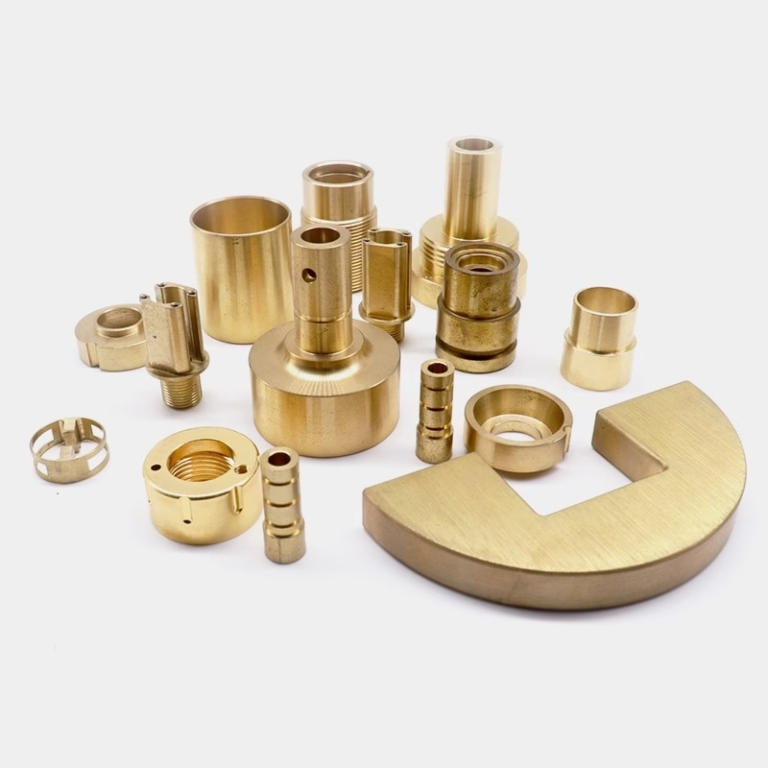
How a 12 Axis CNC Machine Counts Its Axes
Machine builders count every servo-controlled motion, not every direction the tool seems to move. A 3-axis mill has X, Y and Z. Add a trunnion and you get two rotary axes, which is how a 5-axis machine reaches five. A 12 axis cnc machine keeps going: subspindle, bar feeder, B-axis tool head, and one or two rotary tables on the lower turret all get numbered.
That is why a 12-axis lathe and a 12-axis mill are different animals. On a turning platform, most of the twelve axes belong to the turrets and the subspindle, so you can cut with two tools at once on the front and back of the part. On a machining center with a pallet changer, the extra axes are usually rotary tables, probing axes and load/unload motions. Same number on the spec sheet, very different work.
The practical question is not how many axes exist. It is how many move at the same time. Three linear axes plus a C-axis on the main spindle plus a B-axis on the tool head will machine a curved slot in one pass. A machine with the same twelve axes but no simultaneous control will still need three setups to reach the same face.
So when you ask what can a 12 axis cnc machine do, the honest answer starts with the control. Simultaneous interpolation, canned cycles and tool-tip tracking decide the output. Axis count is only the ceiling.
What a 12 Axis CNC Machine Can Do That 5 Axes Cannot
The first gain is access. A 5-axis trunnion reaches five sides of a part because the table tilts and rotates. Add a subspindle and a lower turret, and the same part can be picked up on the back side without a human touching it. That is one continuous process, not two.
The second gain is cycle time. Two turrets cutting at once, one roughing the OD while the other drills a cross hole, can cut cycle time 30-50% on parts with balanced work on both ends. The limit is stiffness. Simultaneous heavy cuts on a slender part push it away from both tools and the finish suffers.
The third gain is concentricity. When the subspindle picks up a turned part and mills the back face in the same program, the runout between the two ends is set by the machine, not by a fixture. For a hydraulic manifold or a gear blank, that matters more than speed.
None of this is free. Programming a 12-axis cycle takes longer than writing three 3-axis programs, and a collision costs more to recover. Use it where the part count and the geometry justify it. A one-off bracket rarely does.
We run these cycles on 16 mill-turn centers and 16 simultaneous 5-axis machining centers, so we can compare both routes on the same drawing before quoting. A 12-axis setup is worth it when a part has two or more functional ends, cross features, or a tolerance stack between faces that a fixture cannot hold.
Material and Size Limits on Multi-Axis Work
Aluminium is where multi-axis work pays off fastest. 6061-T6 and 7075 cut clean at 3,000-12,000 rpm with carbide, and the light cutting loads let both turrets run at once. Watch 7075 for stress movement after heavy stock removal; a stress-relief pass between roughing and finishing keeps flatness inside 0.02 mm.
Stainless 304 and 17-4PH need lower surface speeds and more coolant. On a mill-turn platform, 304 tends to work-harden if a second tool dwells in the cut, so we stagger the turrets rather than run them together on the same diameter. Titanium TC4 and Inconel cut at 40-60 m/min with heavy coolant; the extra axes help because the tool can stay in one setup and avoid re-clamping a part that has already relaxed.
Size sets the ceiling. Our largest travel is 4,000 × 400 × 150 mm, and the compact cells run 500 × 500 × 450 mm and 500 × 310 × 200 mm. A Ø400 mm rotary table covers most ring and flange work. Parts longer than the bar feeder capacity have to be chucked in two operations, which gives back some of the setup savings.
Plastics behave differently. POM and PEEK hold tolerance well but cut faster with air blast than flood coolant. Carbon fibre needs diamond-coated tooling and dust extraction, and the second turret is usually idle because the dust path is hard to control on two sides.
Accuracy, Finish, and Where the Limits Sit
Multi-axis work does not automatically hold tighter tolerance. Our standard window is ±0.005 mm (±0.0002 in), and that number comes from the machine, the tooling and the thermal state of the part, not from the axis count. A twelve-axis machine left to warm up for 20 minutes will drift less than one started cold.
Surface finish follows the same logic. As-machined surfaces run Ra 1.6-3.2 μm. A high-finish pass reaches Ra 0.8-1.6 μm, and fine finishing with a small stepover gets to Ra 0.2-0.8 μm. On a mill-turn cell, the finish on the back face depends on the subspindle clamp force as much as on the cutter.
The real limits are part stiffness and tool reach. A long, thin shaft deflects under two cutting forces and the diameter drifts. A deep pocket still needs a long tool, and a long tool chatters. Extra axes do not fix either problem. They fix access and setup count.
That is the honest boundary. Use 12-axis capability for complex, multi-ended parts in stable materials. For everything else, the simpler machine is the better process.
How We Set Up a 12-Axis Cycle
Typical sequence for a turned part with cross features.
- 1Review the drawing for functional endsCount how many faces carry a tolerance or a mating surface. Two or more ends usually justify mill-turn.
- 2Choose the blank and workholdingBar feed for Ø5-80 mm stock, or a cast blank on a chuck. Confirm the subspindle can grip the finished OD without marking it.
- 3Split the operations between turretsUpper turret takes OD turning and facing, lower turret takes cross drilling and milling. Keep simultaneous cuts on opposite sides of the part.
- 4Set the handoffSubspindle picks up at 2,000-3,000 rpm with a light clamp force. Verify runout before the first back-face cut.
- 5Plan the inspection pointsProbe the datum after the handoff, then check a concentricity feature every 50 parts. Final inspection runs 100% before shipment.
- 6Tune the cycleStart single-turret to prove the program, then bring the second turret online and watch for chatter at 0.3-0.5 mm depth of cut.
Which Machine Fits the Part?
Compare by geometry, not by axis count.
| Part feature | 3-axis | 5-axis | 12-axis mill-turn |
|---|---|---|---|
| Single flat face, open tolerance | Best fit | Overkill | Overkill |
| Five sides, one setup | Three setups | Best fit | Works, slower setup |
| Turned OD plus cross holes | Two machines | Two setups | Best fit |
| Two ends concentric within 0.01 mm | Hard to hold | Fixture needed | Best fit |
| Deep cavity, short tool | Limited | Best fit | Not the point |
| Prototype, 1-5 pieces | Best fit | Good fit | Rarely worth it |
| 10,000+ parts, both ends worked | Not viable | Possible | Best fit |
When the Extra Axes Are Worth It
If a part has two functional ends or a tight tolerance between faces, a 12-axis mill-turn usually wins on setup count and concentricity. If it is a one-off bracket or a single-face plate, a 3-axis or 5-axis machine gets you the same part faster and cheaper.
Frequently Asked Questions
Is a 12-axis machine the same as a 5-axis machine with more motors?
No. A 5-axis machine usually refers to simultaneous control of five axes on one spindle. A 12-axis platform adds a subspindle, extra turrets and sometimes a bar feeder, so the axes cover handling and second-operation work as well as cutting.
Can a 12-axis machine replace two separate operations?
Often yes, when the part has a turned front end and a milled or drilled back end. The subspindle transfers the part inside the cycle, so concentricity comes from the machine rather than from a second fixture.
What materials suit multi-axis mill-turn work?
Aluminium 6061-T6 and 7075, stainless 304 and 17-4PH, titanium TC4, and most engineering plastics. Inconel and titanium need lower surface speeds and more coolant, but the single-setup benefit still holds.
Does more axes mean tighter tolerance?
No. Tolerance comes from machine geometry, tooling, fixturing and thermal control. Our working window is ±0.005 mm, and it applies to 5-axis work as much as to 12-axis work.
How many parts justify the longer programming time?
There is no fixed number. If the part has two or more functional ends and needs more than five pieces, the setup savings usually pay back the programming. A single prototype rarely does; 3-axis or 5-axis is the better route there.
Can you quote from a drawing before we commit?
Yes. Send a STEP or IGES file and we return a quotation with a DFM analysis within 12 hours. Production can start within 24 hours after drawing approval, and parts ship in 3-5 days.
How is confidentiality handled?
Uploads are secure and confidential. We can sign an NDA on request before you send production files, and the same applies to prototype work.
Send a Drawing, Get a Process Recommendation
Tell us the functional faces and the tolerance stack. We will say whether 12-axis mill-turn, 5-axis or 3-axis is the right route, and quote it within 12 hours.
12-hour quote100% inspectionNo minimum order quantity
More machining notes
We publish setup notes, tooling trials and inspection data from the factory floor.











