
What Can a 13 Axis CNC Machine Do?
A 13 axis cnc machine is not one giant machine. It is a synchronized cell of spindles, rotary tables and loaders under one control. This page explains how the axes add up, what parts justify the setup, and where the concept stops making sense.
How 13 Axes Are Counted in a Real System
The number is a sum, not a single slide. A 5-axis machining center already carries three linear axes (X, Y, Z) plus two rotary axes (A and C, or B and C). A second spindle in the same enclosure adds two more. A trunnion table, a bar feeder, a pallet shuttle and a part probe each contribute their own controlled axis. Add them and 13 arrives quickly.
That matters because the axes are not equivalent. Three linear axes move the tool through space. Rotary axes reorient the workpiece. Loader and pallet axes move parts in and out. Only the axes that touch the cut affect geometry. The rest affect throughput and setup count.
A machine sold as 13-axis usually means 5 to 7 cutting axes plus 4 to 8 handling axes under one control. The controller has to interpolate all of them at once, which is why the servo tuning and post-processor matter more than the headline number.
So when a shop quotes a 13 axis cnc machine, ask which axes cut and which axes move. The answer tells you whether you are buying geometry or automation.
What a 13 Axis CNC Machine Can Actually Cut
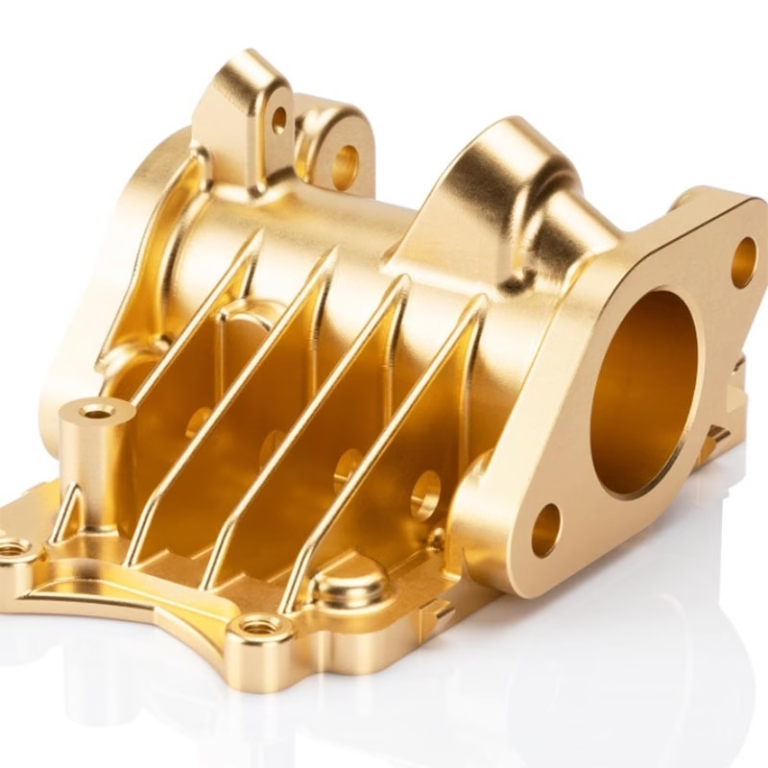
The practical payoff is access. With a rotary table and a spindle that can tilt, the tool reaches five faces of a prismatic part without a second setup. Add a sub-spindle or a second turret and the back face is machined in the same cycle. For a housing with bores on four sides, that removes three re-fixturing steps.
Single setup also removes stacked error. Every time a part is unclamped and moved to a new fixture, the datum shifts. A 0.01 mm shift on setup two becomes a 0.03 mm stack by setup four. Machining all faces in one cycle keeps the bore-to-bore relationship inside ±0.005 mm.
Tool orientation is the second gain. On a contoured surface, the control keeps the cutter normal to the surface instead of letting the flank rub. Cutting conditions stay constant across the whole profile, so finish lands at Ra 0.8–1.6 μm and secondary polishing is often unnecessary.
Complexity has a cost. Programming a 13-axis cycle takes longer than a 3-axis job, and a collision check is mandatory. The setup only pays back when the part has demanding multi-face tolerances or when volume is high enough to amortize the cycle time.
Where the Extra Axes Stop Helping
Most parts do not need 13 axes. A flat bracket, a shaft with a single turned diameter, a plate with holes on one face: a 3-axis mill or a lathe does the job faster and cheaper. Adding axes to simple geometry just adds setup and programming time.
Rigidity is the real ceiling. Every rotary axis in the loop is a joint. Stack an A axis on a C axis on a trunnion and the stiffness at the tool tip drops. Heavy interrupted cuts in 4140 or titanium tend to chatter on a long kinematic chain, so shops often run smaller depths of cut to compensate.
Accuracy also depends on where the axis sits. A rotary table with a large swing has more angular error at the part than a compact one. A Ø400 mm rotary table at 10 arc-seconds of error moves the part edge noticeably more than a small trunnion does.
Then there is the human side. Fewer setups means fewer chances to catch a mistake. A 13-axis cycle that runs wrong for two hours produces a lot of scrap before anyone notices. In-process probing and a first-article check are not optional on these machines.
Which Parts Justify a 13 Axis Setup
The parts that fit share a pattern: many features on many faces, tight relationships between them, and enough volume or value to absorb the programming. Think transmission housings, pump bodies, medical instrument frames, robot arm joints and aerospace actuator bodies.
Material matters too. Aluminium 6061, 7075 and 2024 cut freely on a long kinematic chain. Stainless 17-4PH and Inconel push the same setup harder. If the part is Inconel and the walls are thin, a 5-axis machine with a rigid trunnion usually beats a larger cell.
Volume sets the break-even. A one-off prototype can run on a 5-axis center with two setups and still be cheaper than programming a 13-axis cycle. Above a few hundred pieces, the cycle-time saving from one-setup machining starts to dominate.
Prototype work has a different logic. When the design will change next month, a flexible 5-axis setup absorbs the change faster than a hard-tooled cell. We often run the first articles that way, then move to the multi-axis cycle once the geometry freezes.
5-Axis vs 13 Axis: Which Setup Fits the Part
Pick the row that matches your geometry, volume and material.
| Part condition | Best setup | Reason |
|---|---|---|
| Features on 1–2 faces | 3-axis mill | No reorientation needed |
| Contoured 3D surface, one setup | 5-axis simultaneous | Tool stays normal to surface |
| Bores on 4–5 faces, tight relation | 5-axis with rotary table | One setup, no stacked error |
| Multi-face plus back-side turning | Mill-turn center | Turning and milling in one cycle |
| High-volume housing, 6 faces | 13 axis cell | Loaders and spindles cut idle time |
| Thin-wall Inconel, low volume | 5-axis, rigid trunnion | Short kinematic chain resists chatter |
Verdict
If the part has features on five or six faces and the volume is high, a 13 axis cnc machine removes enough setups to pay for itself. If the geometry is simple or the run is short, a 5-axis center is the better buy.
Common Questions
Is a 13 axis cnc machine a single machine?
No. It is usually a cell: one or two machining centers, rotary tables, a pallet changer and loaders, all driven by one control. Some builders do sell a single platform with 13 controlled axes, but the cell version is more common.
The distinction matters at the quote stage. A cell has more moving parts to set up, so programming and first-article time run higher than a standalone machine.
Can a 13 axis machine hold ±0.005 mm?
Yes, when the machine is calibrated and the part is rigid enough. The tolerance comes from the machine geometry plus the fixture, not from the axis count.
On a long kinematic chain, thermal drift and servo error accumulate. In-process probing and a temperature-stable shop are what keep the number repeatable over a full shift.
When should we stay with 5-axis instead?
When the part has features on one to three faces, when the run is short, or when the material is hard and the walls are thin. A 5-axis center has a shorter kinematic chain and cuts those parts more stably.
A 13 axis cell pays back on volume and on multi-face tolerance. If neither applies, the extra axes are cost without benefit.
Does one setup really remove that much error?
It removes the error that comes from re-clamping. Each time a part leaves a fixture, the datum can shift by a few microns, and those shifts stack across setups.
Cutting five faces in one cycle keeps bore-to-bore and face-to-bore relationships inside the same datum chain. That is the main reason aerospace and medical housings are run this way.
What should we send for a quote?
Send the 3D model, a 2D drawing with the critical tolerances, the material, the surface finish and the quantity. Note which faces carry the tight relationships.
We return a quotation and a free DFM analysis within 12 hours. Uploads stay confidential, and an NDA is available on request.
What materials run well on these cells?
Aluminium grades like 6061, 7075 and 2024 are the easiest. Stainless 303, 304 and 17-4PH work well at moderate depths of cut.
Titanium TC4, Inconel and magnesium AZ31B are possible, but the cycle needs lighter cuts and more attention to thermal growth.
Send the Drawing, Get a Machining Plan
Upload your model and tolerances. We reply with a quotation and a free DFM analysis within 12 hours.
12-hour quote100% inspection±0.005 mm
More machining notes
We publish setup notes, tooling trials and inspection data from the factory floor.











