
What Can a 5 Axis CNC Machine Do?
A 5 axis cnc machine adds two rotary axes to the three linear ones, so the tool can reach a face that a 3-axis machine cannot. Here is what that actually buys you on a part, where the limits sit, and when a 3-axis setup is still the smarter job.
How the Two Extra Axes Change the Cut
On a 3-axis mill, X, Y and Z move the tool in straight lines. The part stays where the fixture put it. Every angled face, every undercut, every hole that does not point down the Z axis needs a second setup, a new fixture, or a re-clamp. Each of those steps adds a chance to lose position.
A 5 axis cnc machine adds two rotary axes, named A, B or C depending on which way they turn. Either the spindle tilts or the table tilts and rotates. The result is the same: the tool can approach the workpiece from almost any direction while the part is still clamped once.
That single change is the whole story. It is not that the machine cuts faster. It is that features which used to require three or four setups now come off in one continuous toolpath, with no re-datum between them. On a part with a true position callout of 0.02 mm across four faces, that difference decides whether the part passes inspection.
The rotary axes also let the tool stay normal to a curved surface. On a sculpted blade or a contoured mold cavity, a ball nose cutter held at a fixed angle leaves a step over the whole face. Tilting the tool keeps the contact point at the tip, where the cutting speed is predictable.
- 13-axisTool moves in X, Y, Z only. Angled features need more setups.
- 24-axisOne rotary axis, usually around X. Good for cylinders and slots.
- 35-axisTwo rotary axes, simultaneous or indexed. Reaches compound angles in one setup.
What a 5 Axis CNC Machine Does That 3-Axis Cannot
The clearest answer to what a 5 axis cnc machine does shows up on parts with compound angles. An impeller blade twists as it rises. A turbine blade leans back and tapers. A medical implant follows a bone surface that curves in two directions at once. None of those faces are parallel to any machine axis, so a 3-axis spindle cannot lie flat against them.
Undercuts are the second case. If a feature sits behind a lip, a straight tool cannot reach it without cutting through the lip first. Rotary motion lets the tool swing in from the side. A cross-drilled oil gallery in a hydraulic manifold is a small version of the same problem.
Thin walls and deep pockets are the third. When a part is long and slender, the tool tends to push it away from the cutter. A machine that can tilt the part lets the cutter work down the wall instead of across it, which spreads the cutting force and reduces chatter.
The fourth case is simply part count. A housing with features on five faces can be machined in one setup. That removes four re-clamps, four datum transfers, and the scrap that follows when one of them drifts. For a 200-piece run, that is where the cost difference lives.
- 1Compound anglesFaces that lean in two directions at once.
- 2UndercutsFeatures hidden behind a lip or shoulder.
- 3Slender partsTilting the part controls cutting force and chatter.
- 4Five-face partsAll faces cut in one setup, no re-datum.
Tolerances, Finish and What Drives Them
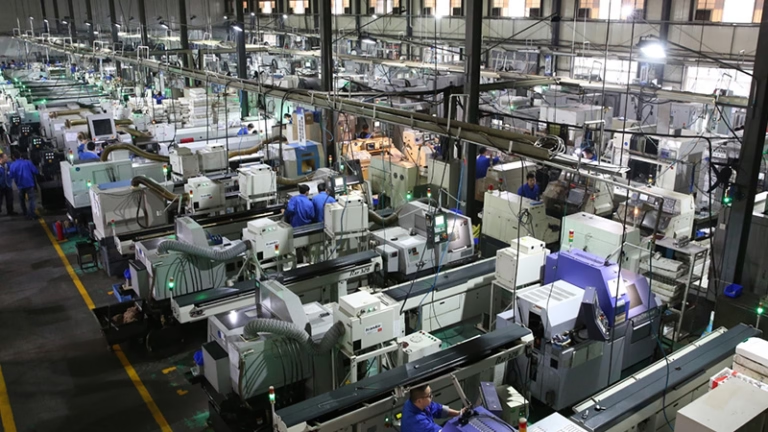
Rotary axes do not automatically make a machine accurate. Every extra axis adds a link in the error chain: the rotary encoder, the table bearing, the pivot point of the trunnion. That is why a 5-axis machine has to be thermally stable and probed often. GreatLight runs 16 simultaneous 5-axis machining centers and holds ±0.005 mm (±0.0002 in) across them.
Finish depends more on the toolpath than the axis count. A well-planned 5-axis path leaves Ra 0.8–1.6 μm as machined on many aluminium parts. Where the surface matters, we take it to Ra 0.2–0.8 μm. A poorly planned path on the same machine leaves witness marks that no polishing budget can hide.
Rigidity sets the practical ceiling. A trunnion table that carries a heavy workpiece has to stay stiff while it rotates. When it does not, the tool deflects and the tolerance drifts on the far side of the part. Deep cuts in titanium and Inconel punish this faster than aluminium does.
Thermal drift is the other limit. A machine that ran cold in the morning will not hold the same numbers after four hours of cutting. On tight-tolerance work, we let the spindle warm up and probe the part between operations rather than trusting the first offset.
- 1±0.005 mmHeld across our 5-axis centers.
- 2Ra 0.8–1.6 μmTypical as-machined finish.
- 3Ra 0.2–0.8 μmWhere the drawing calls for it.
- 4Probe between opsCatches thermal drift before it becomes scrap.
Where 5-Axis Stops Making Sense
A 5 axis cnc machine is not the default answer. For a flat bracket with four holes and a pocket, a 3-axis mill will do the job faster and cheaper. Programming time is shorter, the fixture is simpler, and the machine hour rate is lower. Adding rotary motion to that part buys nothing.
Workpiece size is a hard boundary. Rotary tables have a swing limit and a load limit. A part that fits the linear travels may still be too heavy or too tall for the trunnion. GreatLight handles up to 4,000 mm in the large travel envelope, but a long shaft still often belongs on a mill-turn center instead of a 5-axis.
Material matters too. Aluminium and brass cut cleanly at high rotary speeds. Titanium and hardened tool steel need slower passes, and the rotary axes spend more time holding position under load. On those jobs, we plan extra roughing passes and leave less stock for the finishing path.
Programming and simulation cost real hours. A trusted 5-axis path is verified for collision against the fixture, the table and the tool holder. That work pays off on a run of 50 parts. On a single one-off, it may not.
- 1Simple prismatic parts3-axis is faster and cheaper.
- 2Overweight or oversized workCheck table load and swing first.
- 3Very short runsProgramming and simulation may not pay back.
- 4Soft, gummy plasticsChip evacuation and heat can be the real problem.
How We Decide and Run a 5-Axis Job
- 1Read the drawing for feature directionCount how many faces carry tolerance. If more than two, 5-axis is worth pricing.
- 2Check the part against the machine envelopeCompare size and weight with the rotary table limits before quoting the route.
- 3Plan the setup and datumPick one datum that survives the whole cycle. Fewer datums means fewer stacked errors.
- 4Verify the toolpathSimulate against fixture, table and holder. Fix collisions in software, not on the floor.
- 5Cut a first articleMeasure the first part fully, including true position across faces, then release the run.
- 6Inspect 100% before shipmentRaw material check, in-process monitoring, final inspection. Reports on request.
5-Axis Against 3-Axis on the Same Feature
Use this as a first filter before you send a drawing out for quote.
| Feature type | 3-axis route | 5-axis route |
|---|---|---|
| Flat plate, holes on one face | One setup, fast | No advantage |
| Compound-angle face | Angled fixture or multiple setups | One setup, tool normal to face |
| Undercut behind a lip | Often impossible in one piece | Tool swings in from the side |
| Deep pocket, thin wall | Chatter risk, light passes | Tilt the part, cut down the wall |
| Features on five faces | 4-5 setups, 4 datum transfers | One setup |
| Large simple prism | 3-axis is cheaper | Pays for itself only if tolerance is tight |
| Sculpted surface, Ra 0.8 μm | Hand polishing after milling | Better as-cut finish, less hand work |
The Short Answer
If your part has compound angles, undercuts or tolerances spanning more than two faces, a 5 axis cnc machine removes setups and stacked error. If it is a flat prismatic part on a loose tolerance, book the 3-axis machine and keep the money. Send us the drawing and we will tell you which one your part actually needs, with a free DFM analysis inside 12 hours.
Questions Engineers Ask Next
Does 5-axis always mean simultaneous motion?
No. Many jobs run in 3+2 mode, where the table tilts to an angle and locks, then the tool cuts in three linear axes. That is indexed 5-axis work. It reaches the same faces as simultaneous cutting but the toolpath is simpler and the machine moves stiffer.
Simultaneous motion is for curved surfaces where the tool has to stay normal to the face while all five axes move together. That is where CAM programming gets harder and cycle time goes up.
How tight a tolerance can a 5-axis machine hold?
The machine is only half the answer. We hold ±0.005 mm (±0.0002 in) on our 5-axis centers, but that number assumes a stable fixture, a warm spindle and a part that is not deflecting under the cutter.
On a slender part, the limiting factor is usually workholding, not the machine. Probing between operations catches drift before it turns into scrap.
Can a 5-axis machine cut hard materials like titanium?
Yes. TC4 (Ti-6Al-4V) and Inconel are common on the aerospace side. The catch is heat and tool wear. Rotary axes hold position under load for longer, so we reduce stepover, plan extra roughing passes and keep coolant flow high.
Aluminium and brass are the easy case. They cut at high rotary speeds with predictable tool life.
What surface finish comes off the machine?
On aluminium, an as-machined surface typically lands at Ra 1.6–3.2 μm, and a well-planned finishing path reaches Ra 0.8–1.6 μm. Where the drawing is tighter, we go to Ra 0.2–0.8 μm.
A 5-axis path often needs less hand polishing on sculpted faces because the tool stays normal to the surface and the stepover is even.
How many parts make 5-axis worth it?
It depends on how many setups the 3-axis route needs. If the 3-axis route needs four setups, 5-axis often pays back on the first part. If it needs one setup, the crossover is much higher.
There is no minimum order quantity here. We run from one prototype to 10,000+ part runs, so a single part can be priced either way.
Which industries use it most?
Aerospace and medical devices lead, because their parts carry curved surfaces and tight true-position callouts across several faces. Automotive and EV work uses it for housings and engine components. Robotics uses it for joint housings and brackets with compound angles.
Industrial machinery and new energy are steady users too, mostly for manifolds and machined housings where undercuts would otherwise need a second operation.
Send the Drawing, Get the Route
Upload your file and we will tell you whether 5-axis or 3-axis is the cheaper correct answer, with a quotation and DFM analysis within 12 hours.
12-hour quote100% inspection±0.005 mm
More from the Shop Floor
We publish setup notes, tooling trials and inspection data from the factory floor.











