
What Products Made on a CNC Machine? Six Families That Fit
Almost any solid part can be cut on a CNC machine if you can reach the surfaces and hold the blank. This page explains which part families actually belong on a mill or lathe, which geometry forces a different process, and how to judge a drawing before you send it out.
In this article
- 1
- 2
- 3
- 4
- 5
- 6
- 7
- 8
What Products Made on a CNC Machine Look Like, in Plain Terms
A CNC machine removes material with a spinning cutter or a stationary tool pressed against a spinning blank. That single fact decides almost everything. If a tool can reach a surface from one or more directions, and the blank can be clamped without moving, the part can be cut. If not, no amount of programming will save it.
So the honest answer is broad: housings, shafts, brackets, manifolds, implants, mold inserts, gears, heat sinks, valve bodies, fixtures, and prototype enclosures all come off CNC machines every day. Materials run from aluminium 6061 and 7075 to 316L stainless, Ti-6Al-4V, PEEK, and carbon fibre. The process does not care about the product category, only about the geometry.
Where people go wrong is assuming the category decides. It does not. Two brackets in the same product line can take completely different routes: one mills in 20 minutes, the other needs five setups and a custom fixture. The drawing decides, not the label on the box.
This page walks through six product families that fit cleanly on a CNC machine, the geometry limits behind each one, and the cases where you should stop and choose a different process entirely.
- 1Prismatic partsFlat faces, pockets, holes, and slots cut from solid block on a 3-axis or 5-axis mill.
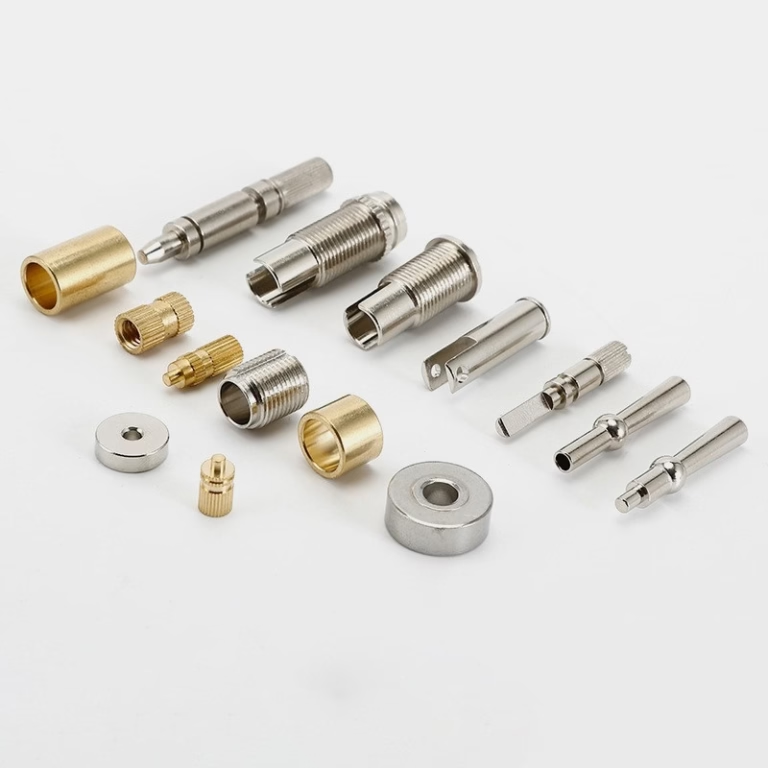
- 2Rotational partsShafts, bushings, and fittings turned on a lathe, often with milling on a mill-turn center.
- 3Complex freeform surfacesImpellers, blades, and organic shapes that need simultaneous 5-axis motion.
Prismatic Parts: Housings, Brackets, and Enclosures
This is the largest group of products made on a CNC machine. A prismatic part starts as a block, plate, or extrusion and gets pockets, holes, slots, and faces machined into it. Think electronics enclosures, motor housings, gearbox covers, mounting brackets, and instrument panels. A 3-axis mill handles most of them; add a fourth axis and you cut four faces in one setup.
The geometry that works here is anything a tool can enter from above or from the side. Pocket depth matters more than pocket shape. A rule of thumb: keep pocket depth under 4× the cutter diameter, because a long, thin tool deflects and leaves chatter marks. Deep, narrow ribs are the classic failure case.
Wall thickness is the second limit. Below about 0.8 mm in aluminium and 1.0 mm in stainless, thin walls start to spring away from the cutter and vibrate. You can still cut them, but expect extra passes, a rougher surface, and a higher scrap risk. If the design needs 0.4 mm walls, sheet metal fabrication or die casting is usually the better route.
For housings with features on five or six faces, a 5-axis machining center cuts them in one or two setups. GreatLight runs 16 simultaneous 5-axis centers, with travels up to 4,000 × 400 × 150 mm, so large frames and long extrusions stay on one machine.
- 1Good fitPockets, through holes, counterbores, flat sealing faces, tapped holes M2 and up.
- 2Watch outSharp internal corners. A cutter has a radius, so a square corner needs a square broach or EDM.
Rotational Parts: Shafts, Fittings, and Bushings
Anything round and mostly symmetric belongs on a lathe. Shafts, pins, bushings, spacers, hydraulic fittings, nozzles, and connector shells turn fast and hold tight tolerances. On a CNC lathe, diameters hold ±0.005 mm (±0.0002 in) routinely, and the surface often comes off the tool at Ra 0.8–1.6 μm without extra polishing.
The limit is length-to-diameter ratio. A shaft that is 10× longer than its diameter bends under cutting force, so it needs a tailstock, a steady rest, or a Swiss-type lathe with a guide bushing. GreatLight uses precision Swiss-type lathes for exactly this reason: small-diameter, long parts stay supported right at the cut.
Cross holes, flats, and slots on a turned part used to mean a second setup on a mill. A mill-turn center does both in one program. That removes the re-chucking error, which is often the largest single source of position error on a turned part.
If the part is a near-perfect body of revolution with no cross features, a lathe alone is faster and cheaper. If it has three flats and two radial holes, put it on a mill-turn center and save a fixture.
- 1Good fitTurned diameters, threads, grooves, tapers, and face features on one axis.
- 2Watch outLong slender shafts beyond 10:1 without support. They chatter and taper.
Complex Surfaces: Impellers, Blades, and Organic Shapes
This is where 5-axis machining earns its place. A curved blade, a turbine impeller, a prosthetic socket, or a sculpted mold cavity cannot be reached by a 3-axis tool without leaving witness marks or collision. Simultaneous 5-axis motion keeps the tool normal to the surface and reaches undercuts in one continuous path.
The trade-off is programming time and machine time. A 5-axis toolpath takes longer to prove out, and the cut itself is slower because the machine moves five axes at once. For a flat plate with holes, 5-axis is wasted money. For a closed impeller with 12 blades, it is the only practical route.
Surface finish on these parts depends on stepover, tool radius, and feed rate. A ball-nose cutter with a 0.5 mm stepover leaves a scallop height around 0.01–0.03 mm, which usually meets Ra 1.6–3.2 μm as machined. Tighter finishes need a smaller stepover or a polishing pass.
Typical products here are pump impellers, compressor rotors, propeller blades, orthopedic implants, and blow-mold inserts. Aerospace and medical work leans on this family heavily, and both need traceable inspection reports, not just a good-looking part.
- 1Good fitFreeform surfaces, undercuts, deep cavities, and features on five or six faces.
- 2Watch outVery deep, narrow cavities. Tool reach and shank clearance set the real limit.
Small Precision Parts: Connectors, Implants, and Instrument Components
Below about 50 mm in size, the challenge flips from reach to rigidity and handling. Small parts on a big machine lose accuracy because the tool is long relative to the cut. A compact machine with 500 × 310 × 200 mm travels holds better than a large one doing the same job.
Products in this family include surgical instruments, dental abutments, connector pins, sensor housings, watch components, and micro-fluidic manifolds. Features of 0.2 mm are routine on a good machine; below 0.1 mm you need to think about tool availability, not machine capability.
Material matters more at this scale. A titanium implant cuts slowly and wears tools, so cost per part climbs. PEEK and POM cut fast but move with temperature, so keep coolant steady and measure after the part reaches room temperature.
Inspection is the hidden cost. At ±0.005 mm, a caliper is not enough. You need a coordinate measuring machine, and often an optical comparator for small radii and thread forms. GreatLight inspects 100% of parts before shipment and can supply reports on request.
- 1Good fitFeatures above 0.2 mm, tight tolerances, small batches, and one-piece prototypes.
- 2Watch outFeatures under 0.1 mm, or parts too small to clamp without a custom fixture.
Tooling and Fixtures: Mold Inserts, Jigs, and Dies
CNC machines build the tooling that makes other parts. Mold cores and cavities, die inserts, jigs, check fixtures, and electrode blanks all start as machined stock. Here the tolerance is often tighter than the production part, because every error in the tool repeats on every shot.
A mold cavity with a sculpted cooling channel or a sharp parting line needs 5-axis milling plus EDM for corners the cutter cannot reach. Wire EDM cuts the square internal corners, and mirror-spark EDM puts a fine finish on surfaces that will be visible on the molded part.
Tool steel and hardened stock change the cutting strategy. Pre-hardened 4140 at 30 HRC cuts with carbide at moderate speeds. Above 45 HRC, you either anneal, machine, and re-harden, or move to EDM and hard milling with specialized tooling.
This family is a good example of why process choice is not about the product name. A mold insert and a bracket might look similar in a photo, but the insert needs EDM, polishing, and a heat-treat step that the bracket never sees.
- 1Good fitMold cores, cavities, die inserts, jigs, and gauges with tight positional tolerances.
- 2Watch outHardened steel above 45 HRC. Plan EDM or hard milling, not standard carbide.
Prototypes and Low-Volume Production Runs
CNC machining has no tooling cost, so it fits prototypes and bridge production perfectly. One part or 10,000 parts use the same program. That is why so many products made on a CNC machine start as a machined prototype before they move to casting or injection molding.
The economics shift with volume. At 1 to 500 parts, machining usually wins. At 5,000 parts, die casting or injection molding starts to beat it on unit cost, but only after you pay for the tool. Machining stays useful for the pre-tooling run that proves the design.
Iteration speed is the real advantage. Change a wall thickness, re-cut, and hold the new part the same week. GreatLight can start production within 24 hours of a released drawing, and parts typically ship in 3–5 days.
There is no minimum order quantity here, from one prototype to 10,000+ part runs. That removes the usual pressure to over-order just to hit a supplier's batch size, which matters when a design is still moving.
- 1Good fitDesign verification, fit checks, bridge production, and spares for legacy equipment.
- 2Watch outHigh volumes with a frozen design. Compare against casting or molding before committing.
Which Process Fits Which Geometry
Pick the row that matches your part, not the product category.
| Part geometry | Best process | Why it fits | Watch out |
|---|---|---|---|
| Flat plate with holes and pockets | 3-axis milling | Tool reaches all features from one direction | Deep pockets need a long, thin cutter |
| Box with features on four sides | 4-axis milling | Rotary table indexes between faces | One setup still misses the fifth face |
| Impeller or curved blade | 5-axis simultaneous | Tool stays normal to the surface | Slow cycle and long programming time |
| Shaft with a cross hole | Mill-turn center | Turning and milling in one program | Machine cost per hour is higher |
| Thin-walled enclosure under 0.8 mm | Sheet metal or die casting | Forming avoids wall deflection | Machining thin walls risks chatter |
| Square internal corner | Wire EDM or broaching | A round cutter cannot cut a sharp corner | Adds a second operation and lead time |
| Mold cavity in hardened steel | Hard milling plus EDM | Cuts above 45 HRC without annealing | Special tooling and slower feeds |
| 1 to 500 identical parts | CNC machining | No tooling cost, fast turnaround | Unit cost drops slowly with volume |
When Machining Is the Right Answer
If the part can be reached by a tool and held in a fixture, machine it. If it has thin walls, high volume, or a frozen design, compare against casting, sheet metal, or molding before you commit to a spindle.
Questions Engineers Ask Next
Can a CNC machine make parts with internal cavities?
Yes, but only if a tool can enter through an opening. A closed internal cavity cannot be machined from solid stock. It needs a split design, a cast core, or an EDM electrode shaped to burn the cavity.
If the cavity must stay closed, casting or additive manufacturing is the realistic route, often followed by CNC finishing on the sealing faces.
What materials can be machined?
Aluminium 6061, 7075, and 2024; stainless 303, 304, 316L, and 17-4PH; steels 1018, 1045, 4130, 4140, and 4340; copper and brass grades; titanium Ti-6Al-4V; Inconel; magnesium; and plastics including ABS, PC, POM, PEEK, and carbon fibre.
Material choice changes cutting speed, tool wear, and achievable finish more than most people expect. Titanium and Inconel cut slowly and cost more per part than aluminium.
How tight a tolerance can CNC hold?
GreatLight holds ±0.005 mm (±0.0002 in) on critical features, with surface finishes down to Ra 0.2–0.8 μm when the application needs it.
Holding that on every dimension of a large part is a different problem. Usually only a few features are critical, and the rest run at a looser tolerance to keep cost down.
Is CNC machining cheaper than 3D printing for prototypes?
It depends on geometry and material. A simple bracket in aluminium is usually cheaper machined than printed in metal. A complex lattice or hollow shape is cheaper printed.
For functional testing under load, machined parts behave like the production material. Printed parts often do not, especially in the build direction.
What finishes are available after machining?
Anodizing in clear, colour, hardcoat, or conductive; electroless nickel, zinc, silver, and gold plating; powder coating and black oxide; bead blasting, tumbling, brushing, and polishing; and laser marking with a minimum character height of 1.5 mm.
Pick the finish before you finalize dimensions. Anodizing and plating add a thin layer that can push a tight tolerance out of spec.
How do I know my drawing is machinable before I order?
Send the file. GreatLight returns a quotation and a free DFM analysis within 12 hours, flagging features that need a different process or a design change.
The most common flags are sharp internal corners, pockets deeper than four times the cutter diameter, and walls thinner than the material allows.
Send a Drawing, Get a Machinability Check
Upload your file and we return a quote plus DFM notes within 12 hours. No minimum order quantity, and uploads stay confidential.
12-hour quoteFree DFM analysis100% inspectionNDA on request
More Machining Notes
We publish setup notes, tooling trials and inspection data from the factory floor.











