
Wholesale CNC Machining Machine Services: What to Check Before You Commit
This guide is for engineers and sourcing staff who buy milled or turned parts through a wholesale CNC machining machine services channel. It lists the checks that separate a real production floor from a sales desk, and it shows which jobs suit each route. Read it and you can score a supplier in about twenty minutes.
In this article
- 1
- 2
- 3
- 4
- 5
- 6
- 7
- 8
- 9
Key takeaways
Wholesale retailor vs. manufacturer: what changes for your part
Use this to sort the requests sitting in your inbox.
| Factor | Wholesale retailor | Manufacturer-direct |
|---|---|---|
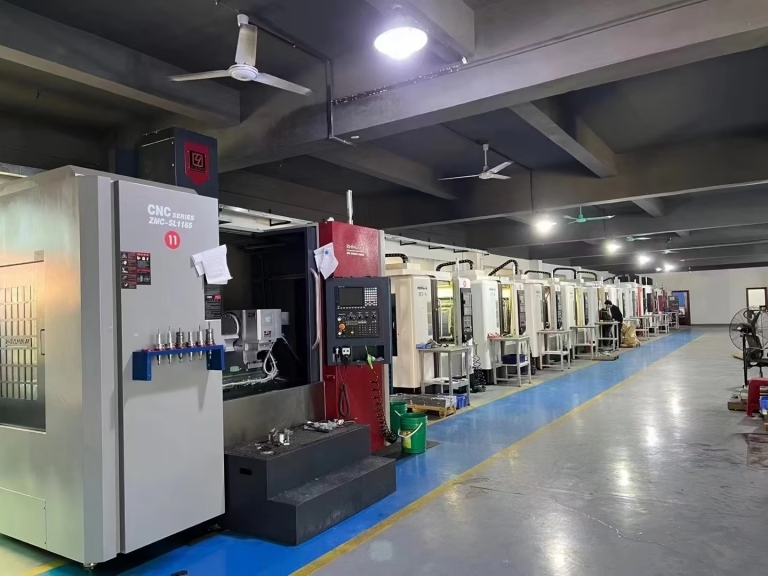
| Who runs the machine | Subcontracted shop, often unnamed | Own floor, 127 CNC machines |
| Tolerance control | Depends on the chosen shop that week | ±0.005 mm held in-house |
| First-article report | Forwarded if the shop supplies it | CMM data from our own metrology |
| Lead time quote | Adds 1–3 days of coordination | Production starts within 24 hours |
| Minimum order | Often bundles small jobs together | No MOQ, one piece to 10,000+ |
| DFM feedback | Sales summary, thin on detail | Engineer notes on the model |
| Certificates | Copies from partner shops | ISO 9001, IATF 16949, ISO 13485, ISO 27001 |
| Problem ownership | Split between seller and shop | Single party accountable |
How to score the answers you get back
Weight the rows by how much a failure would cost you.
| Question | Weak answer | Strong answer |
|---|---|---|
| Which plant cuts the part? | A partner we trust | Our Dongguan plant, machine group B |
| How is ±0.005 mm verified? | We have CMM | First article plus in-process check at op 20 |
| Lead time? | Depends on the shop | Start within 24 hours, ship in 3–5 days |
| Minimum order? | 500 pieces per batch | No MOQ, one piece to 10,000+ |
| File handling? | We keep it secure | ISO 27001:2022 scope, NDA on request |
| DFM feedback? | Looks manufacturable | Three notes on wall thickness and datum choice |
When a wholesale retailor is the right call
Use a wholesale CNC machining machine services retailor when the job mixes unrelated processes, such as machining plus die casting plus vacuum casting under one purchase order, and the tolerances are loose enough that a handoff will not hurt. Go manufacturer-direct when the part carries a real tolerance, a regulated industry certificate, or a deadline you cannot move.
Start with the supply chain, not the price
A wholesale CNC machining machine services retailor is an aggregator. It markets capacity, collects orders, and routes the work to partner shops. That model can work, but it means the entity quoting you does not control the spindle speed, the fixture, or the operator. When a dimension drifts, the fix passes through two companies.
A manufacturer-direct route is narrower. One company owns the equipment, employs the machinists, and carries the quality record. For parts with a real tolerance callout, that single point of accountability removes the most common source of delay: the handoff.
The practical test takes one email. Ask which plant will cut the part, and ask for that plant's certificate numbers. A retailor will name a partner or stay vague. A manufacturer will name its own sites.
- 1Good signThe reply names a specific facility and machine class.
- 2Red flagThe reply only repeats the word factory without a location.
- 3Ask nextWho signs the inspection report that ships with the parts?
Tolerance claims need a measurement path
Every supplier lists a tolerance. Few explain how they hold it. ±0.005 mm on a 200 mm aluminium housing is a different problem from ±0.005 mm on a 12 mm stainless pin. The first needs thermal control and a stable fixture. The second needs a good chuck and a sharp tool.
Ask what machine class runs the feature. A 5-axis center with a Ø400 mm rotary table handles angled holes and contoured pockets in one setup, which removes the stack-up error you get from three separate fixtures. For flat plates under 500 mm, a 3-axis machine is often the cheaper and equally accurate choice.
Surface finish follows the same logic. Ra 0.8–1.6 μm is a normal machined finish for most mating faces. Ra 0.2–0.8 μm usually means a finishing pass, a smaller step-over, or a secondary polish. If the drawing calls for the fine band, expect a longer cycle and budget for it.
- 1Fit the process to the feature5-axis for compound angles; 3-axis for flat, open geometry.
- 2Confirm the reportRaw material check, in-process monitoring, and final inspection.
- 3Do not over-specifyA blanket ±0.005 mm on every dimension adds cost with no benefit.
Lead time, MOQ, and the real cost of switching
Lead time is where wholesale models show their seams. Each handoff adds a queue. If the retailor sends the job to a shop that is already loaded, your promised date slips without anyone telling you. Manufacturers with their own floor can start production within 24 hours of a released order and ship parts in 3–5 days on standard work.
Minimum order quantity changes the calculus for prototypes. Some wholesale channels push small jobs into batches to hit a partner shop's minimum, which delays your one-off bracket. No minimum order quantity means the same process sheet covers a single prototype and a 10,000-part run, so the first article actually predicts the production part.
Add up the soft costs before you compare unit price: engineering time spent explaining the same drawing twice, expedited freight after a slip, and the rework loop when a subcontracted shop reads the print differently. Those items rarely appear on the quote.
- 1Quote turnaroundQuotation and free DFM analysis within 12 hours.
- 2Production startWithin 24 hours once the order is released.
- 3Delivery riskHistorical late-delivery probability below 2%.
Certifications and confidentiality, read the scope
Certificates are often pasted into a slide deck without their scope. ISO 9001:2015 covers a general quality system. IATF 16949:2016 applies to automotive production and adds traceability and change-control requirements. ISO 13485:2016 is the medical device standard. If your part lands in an engine bay or a surgical tray, the general certificate is not enough.
ISO 27001:2022 covers information security. For a machine shop, that means your CAD files, drawing revisions, and quantities are handled under a defined access policy. It matters most when the parts are unreleased or the program is under embargo.
Confidentiality is a separate conversation. Secure upload and an NDA available on request are the baseline. Ask how long files stay on the server and who can open them. A supplier that cannot answer that question in one sentence has not thought about it.
- 1Automotive partsAsk for IATF 16949:2016 and the traceability method.
- 2Medical partsAsk for ISO 13485:2016 and the inspection record format.
- 3Unreleased designsAsk for ISO 27001:2022 scope and file retention rules.
Material and finish capability tells you the machine list
A supplier that quotes aluminium but hesitates on 17-4PH or Inconel is telling you something about its tooling and coolant setup. Stainless 316L and titanium TC4 work-harden, so they need rigid setups, sharp edges, and slower surface speeds. A shop that runs them daily has the inserts and the experience on the shelf.
Finishes have the same signal. Anodizing, hardcoat, electroless nickel, and bead blasting are common. Laser marking with a minimum character height of 1.5 mm is a practical limit worth knowing before you put a 0.8 mm serial number on the drawing.
Ask for a material and finish matrix. If the answer is a list of names without process notes, you are talking to sales, not to the floor.
- 1Aluminium6061-T6, 7075, 6082, ADC12 for housings and brackets.
- 2Stainless and titanium303, 316L, 17-4PH, TC4 for wear and corrosion duty.
- 3PlasticsPOM, PEEK, PC, ABS for insulators and low-load parts.
Seven steps to qualify a wholesale CNC machining machine services supplier
Run these in order. Stop at the first step that fails.
- 1Send one real part, not a test blockUse a drawing with at least one tight feature. A bracket with a Ø6 H7 bore and a flatness callout reveals more than a cube.
- 2Request the DFM notes with the quoteA useful reply flags thin walls under 0.8 mm, deep pockets beyond 4× diameter, and tolerances that need a second setup.
- 3Ask which machine will run the feature5-axis for compound angles, mill-turn for shafts with cross holes, 3-axis for open plates. Vague answers mean the work is being shopped out.
- 4Confirm the inspection planRaw material certificate, in-process checks at the critical dimension, and a final report on request. 100% inspection before shipment is the baseline.
- 5Check the certificate scopeMatch ISO 9001, IATF 16949, ISO 13485, or ISO 27001 to your industry. A copy without a scope page proves little.
- 6Place a small first orderOne to five pieces. Measure them yourself. Compare the as-received finish to the Ra band on the drawing.
- 7Scale only after the first article passesMove to the 10,000-part run once the process sheet, fixture, and inspection method are locked.
Questions buyers ask before the first order
Can a wholesale channel hit ±0.005 mm?
It can, if the partner shop has the right machine and metrology. The risk is not the number, it is the accountability. When a dimension drifts, the fix passes between seller and shop.
Ask for the first-article CMM data and confirm which company signs the final inspection report. If both answers point to the same plant, the tolerance claim is auditable.
Is a lower unit price worth a longer lead time?
Run the math on the whole order, not the piece price. Add expedited freight, engineering hours spent re-explaining the drawing, and the rework loop if the subcontracted shop reads a datum differently.
For a one-off prototype, a two-day slip rarely matters. For a line-stop part, it usually costs more than the price gap.
What does no minimum order quantity actually mean?
It means the supplier will run one piece without bundling it into another batch. The same process sheet, fixture plan, and inspection method carry from the prototype to the production run.
That continuity is the point. A prototype made on a different machine than the production part predicts very little about the production part.
Which certificate do I need for automotive or medical parts?
Automotive production parts should come from a supplier holding IATF 16949:2016, which adds traceability and change control on top of ISO 9001. Medical device parts should come from an ISO 13485:2016 holder.
Ask for the scope page, not just the logo. A certificate covering a different site or process does not cover your order.
How do I protect an unreleased design?
Start with secure upload and a signed NDA before you send the model. Ask how long files stay on the server and who inside the company can open them.
ISO 27001:2022 is a useful filter because it forces a written access policy. If the supplier cannot describe that policy in one sentence, treat the file as exposed.
What should the first order look like?
Order one to five pieces and measure them yourself against the critical dimensions. Check the as-received finish against the Ra band on the drawing.
If the first article passes, lock the process sheet and scale. If it fails, you have lost a few days instead of a production run.
Send a drawing and get a manufacturability answer
Upload your model and we will return a quotation with DFM notes within 12 hours. One prototype or 10,000 parts, same process sheet, 100% inspection before shipment.
12-hour quoteNo minimum order quantity100% inspection
More from the shop floor
We publish setup notes, tooling trials and inspection data from the factory floor.











