
5 Metal CNC Machine Secrets to Drastically Cut Your Production Costs
This page is for design engineers and sourcing managers who own a machined metal part and a cost target. Each section explains one lever that moves unit cost on a metal CNC machine, when it applies, and when it does not. Read it before you release the next revision.
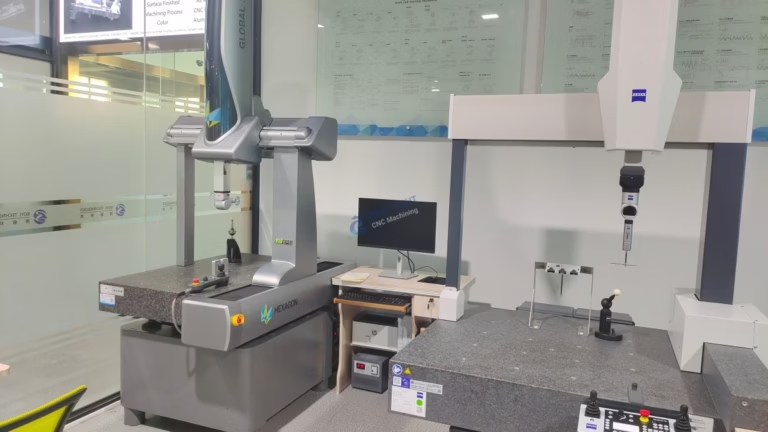
Five levers, not five slogans
Cost comes off a part in the setup, the routing, the material certificate and the paperwork. Those are the four places worth arguing about.
Fewer setups on a 5-axis metal CNC machine
Every extra clamping is a new datum, a new fixture and a new chance to scrap the part. On a 3-axis machine a part with features on five faces may need four or five operations. On a simultaneous 5-axis center the same part often comes off in one. That is the plainest way a metal CNC machine drastically changes the cost of a complex part.
The saving is not only the operator hours. Each setup carries fixture design, first-article checking and queue time. If a part needs three custom fixtures at USD 400 each, that is 1,200 dollars of tooling before the first good part exists. Consolidate the operations and most of that tooling disappears.
Positional 5-axis still needs the part to sit still while the table indexes. Simultaneous 5-axis cuts while the tool and the part move together, which is what lets a single setup reach undercut walls, deep pockets and blended radii. For a flat bracket with two holes, none of this matters. For a hydraulic manifold with ports on four faces, it is the whole cost story.
Hold tolerance in mind too. Re-clamping a part three times stacks three sets of positional error. One clamping on a 5-axis center keeps the datum intact, so features stay related to each other. GreatLight machines to ±0.005 mm ( ±0.0002 in) with 16 simultaneous 5-axis centers on the floor.
- 1Good fitParts with features on 3+ faces, deep pockets, blended surfaces, tight feature-to-feature position
- 2Poor fitSimple 2.5D plates, one-face work, small runs where setup time is already minor
- 3Watch forThin walls that deflect when the part rotates; sometimes a soft jaw beats a 5-axis cycle
Keep machining and finishing under one roof
A typical metal part needs milling, then deburring, then anodizing, then laser marking. Send each step to a different shop and you pay shipping twice, you pay each supplier's margin, and nobody owns the final dimension. When a plated part comes back oversized at a critical bore, the argument about who is responsible costs more than the rework.
A shop that runs the whole routing internally moves the part from the machine to the finishing line without a shipping box. Our Dongguan and Singapore plants hold 127 high-precision CNC machines plus anodizing, powder coating, bead blasting, passivation, plating and laser marking. The part never leaves the campus between operations.
This matters most on cosmetic parts and on parts with a post-finish tolerance. Anodizing adds a few micrometres per surface; if the finishing house never sees the drawing, that growth shows up as a rejected bore. When the same team inspects before and after finishing, the coating thickness is planned into the pre-finish dimension.
Logistics overhead is real but easy to underestimate. One purchase order, one inspection report, one point of contact. On a part with four process steps you remove three freight legs and three incoming inspections. That is usually a double-digit percentage of the piece price on small and mid-size lots.
- 1In-house hereCNC milling and turning, EDM, anodizing, plating, powder coating, blasting, laser marking
- 2Single point of qualityOne inspection record covers machining and finish; reports on request
- 3ConfidentialityUploads stay secure and confidential; an NDA is available on request
Pick the material with the machining in mind
Material choice is often made from a strength table and a corrosion table, then handed to the machine shop. Machinability rarely gets a vote, yet it drives cycle time, tool wear and scrap rate. Two alloys with similar yield strength can differ by a factor of two in cutting speed.
Free-machining grades exist for a reason. On stainless, 303 machines far more easily than 304 or 316 and still gives good corrosion resistance for indoor parts. Where 316L is required for a medical or marine environment, the cost difference is not a mistake; it is a specification. Know which one you actually need.
Aluminium is the same story. 6061-T6 is the default for a reason: good strength, good finish, stable supply. Switch to 7075 only when you need the higher strength, because it costs more per kilogram and cuts slower. ADC12 is a die-casting alloy and behaves differently again.
Harder alloys are not automatically expensive parts. Inconel and titanium TC4 (Ti-6Al-4V) cut slowly and wear tools, but they also resist deflection and hold a fine surface. Where the design calls for Ra 0.8–1.6 μm on a thin wall, a stiffer alloy can beat a soft one. Send the drawing and we will run a free DFM analysis within 12 hours, including a material suggestion.
- 1Free-machining choice303 stainless instead of 304 where corrosion demand allows
- 2Keep the spec316L for medical and marine; do not downgrade to save cycle time
- 3Ask earlyMaterial swaps are cheap at the quote stage and expensive after first article
Machinability and typical use by alloy group
Relative cutting behavior on a metal CNC machine. Ratings are for comparison between groups, not absolute values.
| Alloy | Machinability | Typical part | Watch for |
|---|---|---|---|
| 6061-T6 aluminium | High | Brackets, housings, fixtures | Thin walls can chatter |
| 7075 aluminium | Medium | Aerospace structures, high-load parts | Higher cost per kg |
| 303 stainless | High | Shafts, fittings, indoor hardware | Lower corrosion resistance |
| 304 / 316L stainless | Low to medium | Medical, marine, food contact | Work hardening, tool wear |
| 1018 / 1045 steel | Medium | Shafts, plates, weldments | Rusts without coating |
| 4140 / 4340 steel | Low | High-stress shafts, gears | Pre-hardened stock cuts slower |
| TC4 (Ti-6Al-4V) | Low | Aerospace, implants | Heat at the cutting edge |
| Inconel | Very low | Hot sections, high-temp parts | Short tool life, slow feeds |
| C36000 brass | Very high | Connectors, valves, bushings | Density adds shipping weight |
| POM / PEEK plastic | High | Insulators, wear pads | Thermal growth, clamping marks |
Certifications that prevent rework and audit cost
Paperwork is a cost line. If your customer requires an IATF 16949 or ISO 13485 supplier, a shop without the certificate forces you into extra incoming inspection, deviation reports and sometimes a full audit of your own process. That overhead lands on the piece price without adding a single feature to the part.
Certification also changes how problems get handled. Under a certified quality system, nonconformance data is recorded, root cause is traced and the corrective action is documented. You get a report instead of an apology. For automotive and medical buyers that record is often the reason the part can ship at all.
GreatLight holds ISO 9001:2015, IATF 16949:2016, ISO 13485:2016 and ISO 27001:2022. The last one matters for customers whose drawings are sensitive: it covers how design files and uploads are protected, not just how parts are made.
Inspection is part of the same system. We check raw material on arrival, monitor in-process dimensions, and inspect 100% of parts before shipment, with reports on request. The qualification rate across production is 99.99%. If you currently re-inspect every lot at your dock, that step can often be reduced to a sampling check.
- 1AutomotiveIATF 16949:2016 covers process control and traceability
- 2MedicalISO 13485:2016 covers device component documentation
- 3DataISO 27001:2022 covers file and upload security
Scalability from one prototype to a 10,000-part run
A shop that is cheap at 10 pieces is often the wrong shop at 10,000, and the reverse is just as common. The cost curve changes shape when you move from a vise and a probe to soft jaws and a fixture plate. Ask how the process will be re-planned between the two volumes.
We run no minimum order quantity, from one prototype to 10,000+ part runs, on the same machines and the same inspection system. That means the prototype you approve is made by the process that will make the production parts, so the first article is not a different animal from lot 50.
Capacity matters for the ramp. Our three wholly-owned plants cover 7,600 m² with 150 technicians and 127 high-precision CNC machines: 16 simultaneous 5-axis centers, 12 four-axis mills, 27 three-axis machines and 16 mill-turn centers. Maximum processing size is 4,000 mm.
Lead time is the other half of scalability. Quotation and free DFM analysis come back within 12 hours, production can start within 24 hours, and parts ship in 3–5 days. The historical late-delivery probability is below 2%. Those numbers only hold if the routing was planned for the volume you actually order, so tell us the annual quantity up front.
- 1Same processPrototype and production parts run on the same machines and inspection plan
- 2Volume rangeNo MOQ, from one part to 10,000+ runs
- 3Size rangeUp to 4,000 mm maximum processing size
Questions engineers ask next
When is 5-axis actually cheaper than 3-axis?
It is cheaper when the part has features on three or more faces, when custom fixtures would be needed, or when re-clamping would stack tolerance. The setup and tooling savings usually outweigh the higher machine rate.
It is not cheaper for flat plates, simple shafts or one-face work. On those parts a 3-axis cycle with a good fixture is faster and the 5-axis rate just adds cost.
How do I know if my material choice is driving cost?
Look at three things: cutting speed, tool life and scrap rate. Free-machining grades such as 303 stainless or 6061-T6 aluminium cut fast and hold size well. Alloys like Inconel or TC4 cut slowly and wear tools quickly.
If the corrosion or temperature requirement does not truly demand the harder alloy, a swap at the quote stage can cut cycle time without changing function. Send the drawing and we will say which side of the line your part sits on.
Do certifications really change the price?
Yes, through inspection and documentation rather than machining. A certified supplier produces traceable records, in-process monitoring and a corrective-action path. That removes incoming inspection and deviation handling on your side.
For automotive and medical programs the certificate is often a condition of shipping at all, so the comparison is not price against price; it is a qualified supplier against an unqualified one.
What tolerances and finishes can you hold?
We machine to ±0.005 mm ( ±0.0002 in). Surface finishes run from Ra 0.2–0.8 μm for fine work through Ra 0.8–1.6 μm for general precision parts, with Ra 1.6–3.2 μm as-machined.
Finishing options include anodizing, electroless nickel, zinc, silver and gold plating, powder coating, black oxide, bead blasting, tumbling, brushing, polishing and laser marking with a minimum character height of 1.5 mm.
Can you handle both the prototype and the production order?
Yes. There is no minimum order quantity, so a single prototype and a 10,000+ part run can both be quoted on the same drawing. Keeping both on one process means the approved first article matches the production part.
Tell us the expected annual volume when you request the quote. The routing, fixture plan and inspection frequency are set differently for 50 parts than for 5,000.
How fast can I get a quote and parts?
Quotation and free DFM analysis come back within 12 hours. Production can start within 24 hours after you approve the drawing, and parts typically ship in 3–5 days.
The historical late-delivery probability is below 2%. Uploads are secure and confidential, and an NDA is available on request before you send files.
Send the drawing, get a costed route
Upload your part and we will return a quote plus a free DFM analysis within 12 hours, with the material and setup plan that fits your volume.
12-hour quote100% inspectionNo MOQNDA on request









