GreatLight CNC Machining Factory logo
CNC Machining
Rapid Prototyping
Materials
Industries
News
About GL

Get Instant Quote

Precision gear manufacturing

Bevel Gears

Spiral, Zerol and straight bevel gears cut, hardened and ground in-house. We hold ±0.005 mm and check tooth contact before anything ships. One prototype or a 10,000-piece run.

Spiral bevelZerol bevelStraight bevelGround tooth flanks±0.005 mm100% inspection
oplus_262178
2011Manufacturing since
127High-precision CNC machines
±0.005 mmAchievable tolerance
99.99%Qualification rate
Where bevel gears go wrong

Four failures we get called in to fix

Bevel sets fail for the same handful of reasons. Each one shows up on the bench, not on the drawing.

01

Tooth contact lands on the toe or the heel

The set was cut without a contact check. Load sits on one end of the flank, the pattern walks under torque, and the pair starts whining within a few hundred hours. No amount of lapping saves a pattern that was set wrong at the start.

02

Backlash closes up after heat treatment

Distortion moves the teeth a few hundredths. A set that measured fine green comes back tight and seizes at operating temperature. This is a process planning problem, not a grinding problem.

03

Bore and mounting face are not coaxial

A 0.02 mm runout at the bore throws the whole mesh off. The gearbox runs hot on one side, lubrication breaks down, and you replace a bearing that was never the cause.

04

The supplier can cut teeth but cannot finish them

Hobbing is only half the route. Without a grinder and a lapping setup, the flank finish stays at Ra 3.2 μm and the set never gets quiet at speed.

How we cut bevel gears

One shop from blank to lapped set

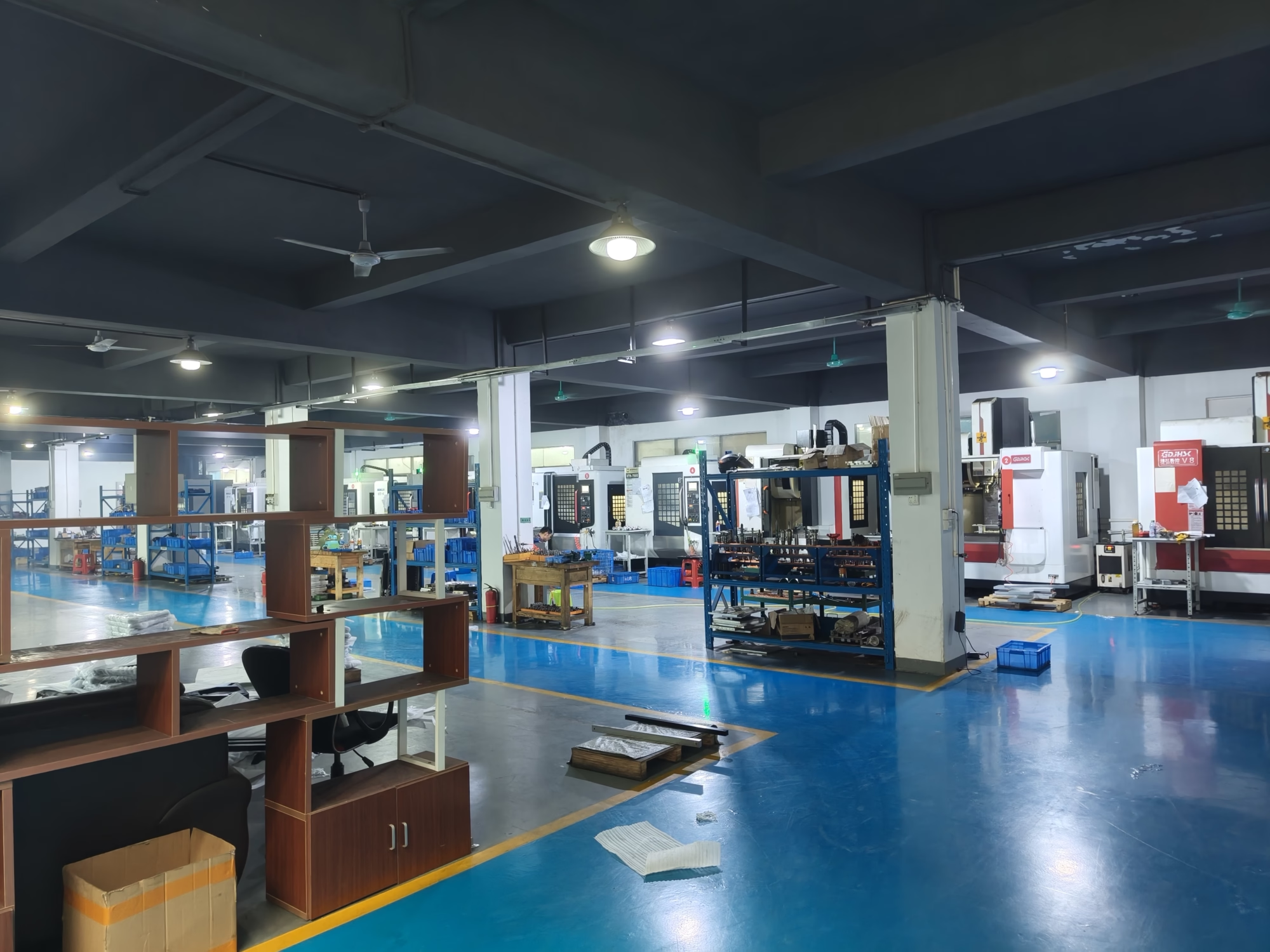
Turning, gear cutting, heat treatment, grinding and inspection under one roof in Dongguan.

CNC Lathe Technical Specifications Terminology
Gear cutting

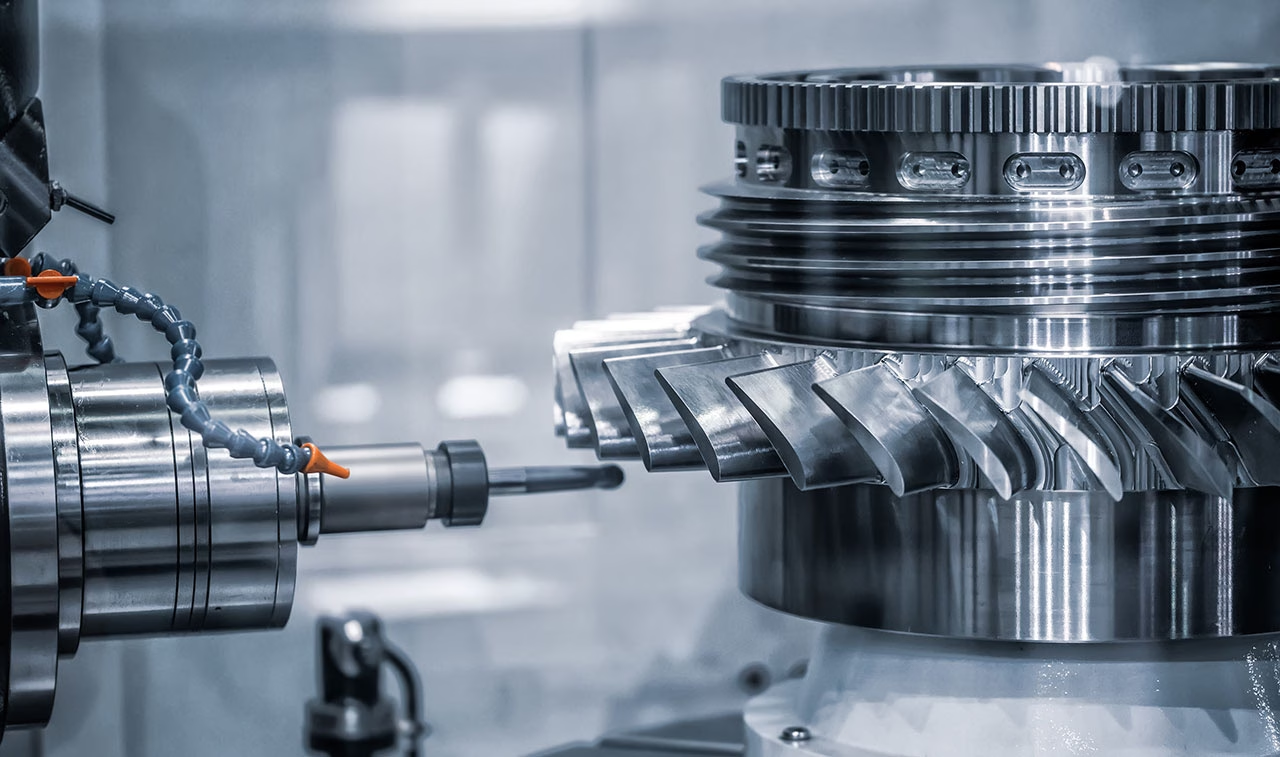
Spiral and Zerol bevel gears cut on 5-axis centers

Spiral bevel sets carry high loads quietly because the teeth engage gradually instead of all at once. The spiral angle and the hand of the spiral have to match the mating pinion, so we cut pinion and gear as a pair, never as two separate jobs.

Zerol bevel gears give you the same smooth engagement with a zero spiral angle. That matters when the gear has to run in either direction, or when you want spiral-bevel behavior on a shaft that does not tolerate axial thrust. We cut both on 16 simultaneous 5-axis machining centers, with a Ø400 mm rotary table for the larger ring gears.

  • 1
    Pair-matched cuttingPinion and gear cut from the same setup so the contact pattern lands where the design intends.
  • 2
    Spiral or ZerolRight-hand and left-hand, any pressure angle you specify on the drawing.
  • 3
    Up to 4,000 mmMaximum processing size across the shop, with 750 × 1,150 × 550 mm travels on the mid-size mills.

6011
Finishing and hardening

Heat treat, then grind the flanks back to size

Case hardening is where bevel gears usually lose their geometry. We plan the allowance for it and grind after, so the tooth thickness you specified is the tooth thickness that ships. Ground flanks reach Ra 0.8–1.6 μm as a normal production finish, and Ra 0.2–0.8 μm when the application calls for it.

Lapping comes last. We run the pair together with marking compound and read the contact pattern across the flank, then adjust until it sits in the middle of the tooth. If the pattern cannot be brought in, the part does not leave the building.

  • 1
    Ground after hardeningDistortion is removed by grinding, not compensated for on the drawing.
  • 2
    Tooth contact checkPattern read on marking compound and recorded for the pair.
  • 3
    Inspection reportsRunout, backlash and contact pattern documented on request.

Get Instant Quote

Selection guide

Which bevel type fits your drive

Pick by load, speed and whether the shaft can take axial thrust.

TypeBest forWatch out for
Straight bevelLow-speed drives, hand feed, differentialsNoisy above moderate rpm; load hits the tooth all at once
Spiral bevelHigh load, quiet running, vehicle axlesProduces axial and radial thrust; needs matched pinion
Zerol bevelReversing drives, spiral behavior without thrustSlightly lower load rating than a true spiral set
HypoidOffset axes, packaging tight around the axleRequires special lubricant; sliding action at the flank
Ground spiralServo and spindle drives needing low backlashGrinding adds cost; justified only on tight backlash specs
What we do

Services around the gear set

A bevel gear is rarely the only part on the drawing.

01

5 Axis CNC Machining

Simultaneous 5-axis cutting for gear blanks, housings and the mating shafts in the same tolerance band.

02

CNC Milling & Turning

Shafts, hubs and ring gear blanks turned and milled to the bore and face the gear will be cut against.

03

Heat Treatment Coordination

Case hardening and through hardening planned into the routing so grinding allowance is correct.

04

Part Surface Finishing

Black oxide, electroless nickel, zinc and hardcoat anodizing for corrosion and wear.

05

Rapid Prototyping

Fit-check prototypes before you commit to a hardened gear set and its tooling.

06

Inspection & Reporting

Runout, backlash, tooth thickness and contact pattern measured on the finished pair.

Capacity

Bevel gear production range

Numbers only from our own machine list.

ItemCapabilityNotes
Achievable tolerance±0.005 mm±0.0002 in on request
Fine finishRa 0.2–0.8 μmGround flanks
Standard ground finishRa 0.8–1.6 μmNormal production finish
As-machined finishRa 1.6–3.2 μmPre-grind condition
Max processing size4,000 mmAcross the shop
Rotary tableØ400 mmFor larger ring gears
Order quantity1 to 10,000+ partsNo minimum order quantity
First article3–5 daysFrom released drawing
Why GreatLight

Six things that decide whether the set is quiet

Data we can point to on the shop floor, not adjectives.

15Y

Cutting gears since 2011

Fifteen years of gear and machined part production across three wholly-owned plants in Dongguan and Singapore.

127

High-precision CNC machines

16 simultaneous 5-axis centers, 16 mill-turn centers, 12 four-axis mills and 27 three-axis machines.

±0.005 mm

Held on finished parts

Tolerance on checked features after hardening, not on the green blank.

76

Engineers and technicians on the floor

150 technicians in total, with process planning done by the people running the machines.

ISO

Four certifications

ISO 9001:2015, IATF 16949:2016, ISO 13485:2016 and ISO 27001:2022.

12H

Quote and DFM analysis

Drawing review with manufacturability notes returned within 12 hours.

7,600 m²Manufacturing space
3Wholly-owned plants
99.99%Qualification rate
<2%Historical late-delivery risk
Where these gears run

Industry requirements and what we deliver

CNC Machining Services Comparison 2026 Fictiv vs Xometry vs GreatLight

Automotive & EV drivetrains

Differential and reduction gears where backlash control decides cabin noise.

  • ±0.005 mm
  • IATF 16949
  • Pair-matched
CNC Machining Services Online

Industrial machinery

Right-angle drives and index tables that run continuously for years.

  • Ra 0.8–1.6 μm
  • Ground flanks
  • Case hardened
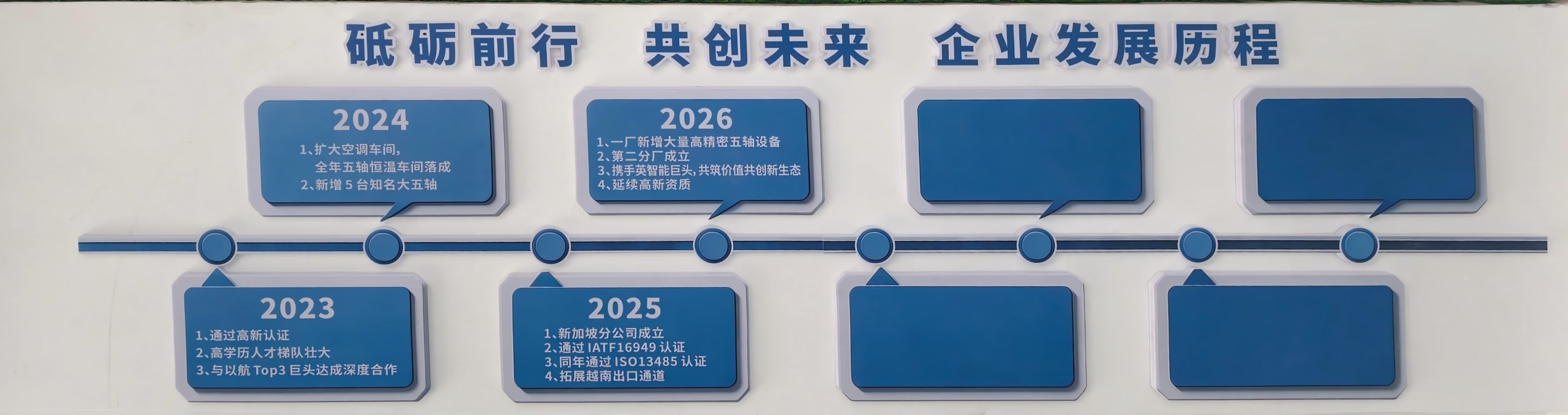
Forge ahead with determination and create the future together.

Robotics & automation

Servo axes that need low backlash and repeatable positioning.

  • Backlash measured
  • Contact pattern checked
  • 100% inspection
GreatLight Metal new factory building

Aerospace and defense

Low-volume, fully documented gear sets with material traceability.

  • Material certs
  • Inspection reports
  • 1 to 10,000+ parts
FAQs

Questions engineers ask before ordering bevel gears

When should I choose a bevel gear over a worm gear?

Bevel gears suit right-angle drives where efficiency matters. A worm set gives you high reduction in one stage and self-locking, but it loses more energy to sliding friction.

If your input speed is above a few hundred rpm and efficiency is on the spec sheet, use a bevel pair. If you need 50:1 in one stage and the drive can run hot, a worm is the cheaper answer.

Spiral or straight bevel for a low-speed application?

Under roughly 300 rpm with moderate load, straight bevel teeth are cheaper to cut and easier to inspect. They get noisy as speed rises because the whole tooth engages at once.

Spiral bevel sets cost more but run quieter and carry more load at the same size. If the gearbox will be heard by an operator, spiral is usually worth it.

What backlash can you hold on a finished set?

Backlash is set from the drawing and verified on the assembled pair. It depends on module, center distance and how the housing controls the shaft positions.

Send the housing bore positions along with the gear drawing. Backlash that looks achievable on the gear alone can disappear if the bearing seats are not held tight.

Do you cut pinion and gear as a matched pair?

Yes. Cutting the pair from the same setup is the only way to guarantee the contact pattern lands correctly under load.

We record the pattern on marking compound and keep the pair together through heat treatment, grinding and lapping so the two parts never get mixed with another set.

Which materials do you use for bevel gears?

Case-hardening alloy steels such as 4140 and 4340 are the usual choice for loaded drives. We also machine 1045, 1018 and 4130 where hardening is not required.

Stainless grades 303, 304, 316, 17-4PH and 440C cover food, medical and corrosive environments. Bronze and brass work for low-load, low-speed sets.

How do you handle distortion from heat treatment?

We leave grinding allowance based on the section thickness and the hardening cycle, then grind after treatment to bring tooth thickness and runout back to spec.

For tight sets we plan a second stress relief before final grinding. That adds a step but it is cheaper than scrapping a hardened batch.

Can you reverse-engineer a gear from a worn sample?

Yes, if we can recover the module, pressure angle, spiral angle and hand from the sample. Heavily worn flanks are harder to measure, so a drawing or a mating part helps.

We will tell you up front what can and cannot be determined from the sample before you commit to a production run.

What do you need to quote a bevel gear?

A drawing with module, number of teeth, pressure angle, spiral angle and hand, plus material, heat treatment and backlash. A 3D model helps but does not replace the tooth data.

Send files through the quote page and you get a price plus DFM notes within 12 hours. NDA is available before you send anything.

Send your bevel gear drawing

Upload the tooth data and we will come back with a price and manufacturability notes within 12 hours.

12-hour quote100% inspectionNo minimum order quantityNDA on request

Trusted by engineers and manufacturers worldwide

Tesla Ford Motor Company BYD Auto Denso Magna International Boeing Airbus Medtronic KUKA FANUC