GreatLight CNC Machining Factory logo
CNC Machining
Rapid Prototyping
Materials
Industries
News
About GL

Get Instant Quote

Worm Gear Manufacturing

Worm Gears

We machine matched worm and wheel sets for 20:1 to 300:1 reduction. Bronze wheels, hardened alloy shafts, ±0.005 mm tolerances, and DFM feedback within 12 hours of your upload.

Ratios 20:1 to 300:1±0.005 mmBronze + hardened steel1 pc to 10,000+ISO 9001 / IATF 16949
CNC Lathe Technical Specifications Terminology
20:1–300:1Reduction ratio range
±0.005 mmAchievable tolerance
127High-precision CNC machines
15 yrsGear machining experience
Where worm drives go wrong

Four failures that start in the gear cutting room

Most worm drive complaints trace back to a small number of process decisions made long before assembly.

01

Is the worm thread form drifting off spec?

A worm cut with the wrong axial pitch or pressure angle mates badly with the wheel. The contact patch moves to one edge of the tooth flank, load concentrates, and the drive runs hot within minutes. Re-cutting the worm means scrapping both members of the set.

02

Is the center distance off by a few hundredths?

Worm and wheel center distance sets backlash. Miss it by 0.05 mm and the drive either binds or rattles. Either way the wheel wears unevenly and the reduction ratio no longer holds under reversing loads.

03

Is the bronze wheel the wrong alloy?

Tin bronze and aluminum bronze behave differently against a hardened steel worm. Pick the cheaper one and the wheel becomes the wear part, especially in continuous-duty applications where sliding contact dominates.

04

Do you have a hardness mismatch?

Worm gears work on sliding contact, not rolling contact. A soft worm running against a hard wheel will gall. The usual rule is a hardened and ground worm paired with a softer bronze wheel, and that pairing has to be planned at the material stage.

How we build worm gear sets

One shop for the worm, the wheel, and the housing fit

Matching the two members of a worm drive is easier when the same team cuts both.

6011
Cutting the worm

Turning, hobbing, and thread grinding on hardened shafts

Worms are turned from alloy steel such as 4140 or 4340, heat treated, then thread ground to final form. Grinding after heat treat is what keeps the axial pitch and pressure angle stable. A worm cut before hardening will move during quench.

For lower-duty drives we can hob and finish turn without grinding. For drives running above roughly 1,000 rpm at the worm, ground threads are the safer choice.

  • 1
    Axial pitchHeld to print across the full thread length, checked on the optical comparator.
  • 2
    Lead accuracyMeasured over multiple thread turns, not just a single pitch.
  • 3
    Surface finishThread flank ground to Ra 0.8–1.6 μm for sliding contact.

Get Instant Quote

GreatLight Metal new factory building
Cutting the wheel

Bronze wheels hobbed to match the worm they run with

The wheel is cut with a hob that matches the worm's thread form. If both parts come from us, we hold the pair together and check contact pattern on a mating fixture. That avoids the classic problem of two good parts that do not run well together.

Throated wheels are the norm for higher ratios. Straight-faced wheels are cheaper and work fine for light loads and low speeds.

  • 1
    Tin bronzeC93200-class alloy for continuous duty and higher sliding speeds.
  • 2
    Aluminum bronzeHigher strength, better for shock loads, needs good lubrication.
  • 3
    Contact patternChecked on a mating fixture before the set ships.
Selection guide

Which worm gear configuration fits your drive

Use this as a starting point. Final geometry depends on load, speed, duty cycle, and lubrication.

ConfigurationTypical ratioBest forWatch out for
Cylindrical worm, straight-faced wheel5:1 to 20:1Light loads, intermittent dutyLower contact area, faster wear
Cylindrical worm, throated wheel20:1 to 100:1General reduction, continuous dutyAlignment sensitive
Ground worm, throated bronze wheel20:1 to 300:1Higher speed, higher dutyNeeds proper lubrication
Multi-start worm5:1 to 20:1Higher speed reductionLower self-locking tendency
Single-start worm40:1 and upSelf-locking, high reductionLower efficiency, more heat
What we make

Gear and transmission machining services

Worm gears sit inside a wider set of gear and shaft work we run every week.

01

Worm gear sets

Matched worm and wheel pairs cut together, checked on a mating fixture before shipment.

02

Spur and helical gears

Hobbed and shaped gears up to 4,000 mm, with grinding for hardened parts.

03

Bevel and ring & pinion

Cut and lapped pairs for right-angle drives where a worm box is too tall.

04

Shafts and housings

Turned and milled to the same datum scheme as the gear, so bearing fits line up.

05

Heat treatment coordination

Case hardening, through hardening, and nitriding arranged with the finishing step in mind.

06

Prototype to production

One set for a test rig or a 10,000-piece run, on the same process and inspection plan.

Capability range

Machining scope for worm gear work

ItemRangeNotes
Maximum part size4,000 mmLarger worms split into sections
Tolerance±0.005 mm±0.0002 in, on critical diameters
Thread flank finishRa 0.8–1.6 μmGround worms, sliding contact
Materials4140, 4340, 17-4PH, bronzeOther alloys on request
Quantities1 to 10,000+No minimum order quantity
Inspection100% before shipmentReports on request
Why GreatLight

Numbers behind the gear work

±0.005

Tolerance in mm

Held on bore, journal, and center-distance features. That is ±0.0002 in.

12 h

Quote and DFM turnaround

Upload a drawing or STEP file and get a quotation plus manufacturability notes within 12 hours.

24 h

Production start

Once drawings and material are confirmed, cutting can begin within 24 hours.

127

CNC machines

16 simultaneous 5-axis centers, 16 mill-turn centers, plus lathes and gear cutters.

99.99%

Qualification rate

Measured across shipped lots, with 100% inspection before shipment.

3

Wholly-owned plants

7,600 m² in Dongguan plus a Singapore factory at Joo Koon Circle.

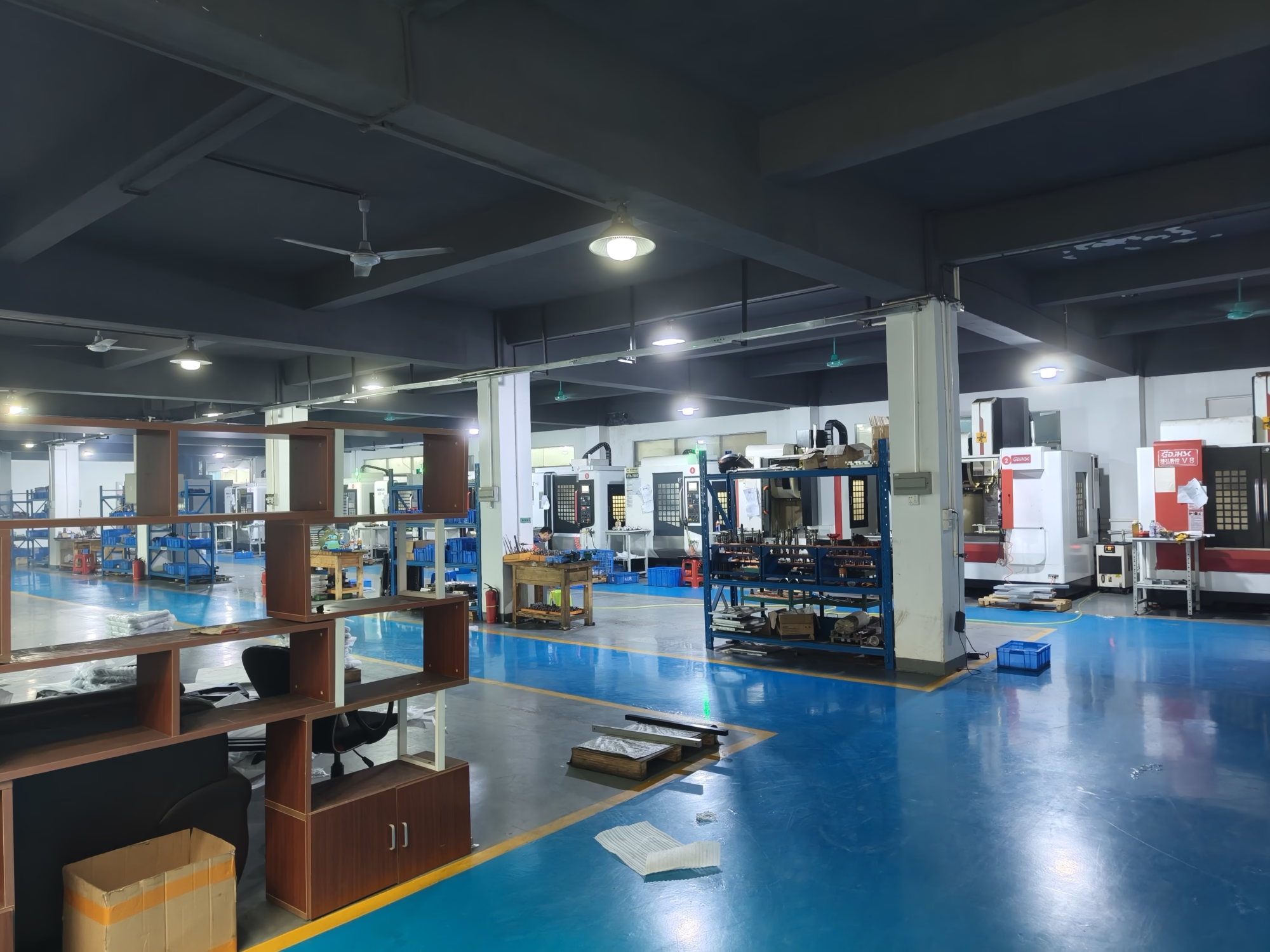
7,600 m²Manufacturing space
150Technicians
ISO 9001 / IATF 16949Quality systems
< 2%Historical late-delivery rate
Sector requirements

What different industries ask of a worm drive

Leader in Cnc Machining Service China

Industrial machinery

Indexing tables and conveyor drives need repeatable backlash after thousands of cycles.

  • Ratios 40:1–100:1
  • Ground worms
  • Backlash held on mating fixture
CNC Machining Services Online

Robotics & automation

Small worm boxes in joints need low backlash and quiet running at low speed.

  • Compact housings
  • ±0.005 mm fits
  • Low-noise thread finish
oplus_262178

Automotive & EV

Actuator and steering drives need a documented process chain from bar stock to shipped set.

  • IATF 16949 process
  • 100% inspection
  • Traceable lots
cnc machining

Medical devices

Positioning drives need smooth motion and a finish that will not shed particles.

  • Ra 0.2–0.8 μm option
  • ISO 13485 process
  • Cleaned before packing
FAQs

Worm gear questions we get from engineers

What reduction ratio can a single worm gear set handle?

A single-start worm commonly lands between 20:1 and 300:1. Ratios above roughly 100:1 are achievable but efficiency drops and heat becomes the limiting factor.

If you need more than 300:1, a two-stage arrangement is usually the better call than pushing one set harder.

Should the worm or the wheel be the harder part?

The worm. Worm drives work on sliding contact, so a hardened and ground steel worm running against a softer bronze wheel gives the longest life.

Reversing that pairing causes galling, especially at higher sliding speeds.

What center distance tolerance can you hold?

We hold ±0.005 mm on critical diameters and bores. Center distance in an assembled housing is a different number because it stacks the housing bore tolerances with the gear tolerances.

Send the full assembly drawing and we will check the stack rather than the individual parts.

Can you cut a worm to match an existing wheel?

Yes, if you send the wheel and its measured thread form. We reverse the geometry from the wheel, then cut a worm that produces the contact pattern you want.

Without the mating part, we can only work from the drawing, and the result may need lapping at assembly.

Which bronze should I specify for the wheel?

Tin bronze for continuous duty and higher sliding speeds. Aluminum bronze when shock loads are the bigger concern.

If the drive runs dry or with marginal lubrication, neither alloy will save it. Fix the lubrication first.

How do you check a worm gear set before shipment?

100% inspection before shipment covers the critical diameters, thread form, and bore fits. Worm and wheel pairs are checked together on a mating fixture for contact pattern and backlash.

Inspection reports are available on request.

What is the smallest and largest quantity you run?

One piece for a test rig, up to 10,000+ parts for production. There is no minimum order quantity.

Prototype and production runs use the same process plan, so what passes on the bench will match what ships later.

Do you sign NDAs for gear drawings?

Yes. Uploads are treated as confidential, and an NDA is available on request before you send drawings.

We can also restrict which engineers see the files if your program requires it.

Send your worm gear drawing

Upload a drawing or STEP file and get a quotation with manufacturability notes within 12 hours. No minimum order quantity, 100% inspection before shipment.

12-hour quoteNo minimum order100% inspectionNDA on request

Trusted by engineers and manufacturers worldwide

Tesla Ford Motor Company BYD Auto Denso Magna International Boeing Airbus Medtronic KUKA FANUC