
Buy CNC Machining Milling: Distributor or Direct Factory
This page explains what a machining distributor really does, where the model helps, and where it costs you time. It is written for engineers and sourcing managers who need to buy CNC machining milling work and want a clear way to decide between an intermediary and a factory that runs the spindles itself.
What This Page Covers
A distributor sells capacity it does not own. A factory sells capacity it runs. The difference shows up in quoting speed, tolerance control, and who answers when a dimension drifts.
What a Machining Distributor Actually Does
A machining distributor does not own the machines that cut your part. It aggregates capacity from a network of workshops, quotes your job, holds the customer relationship, and routes the work to whichever partner it selects. You sign one purchase order. The part may be made in three different shops across a region, and you will rarely know which one ran it.
That structure is not automatically bad. It is a trading layer, and trading layers exist because they solve a real problem: matching demand with available spindle time. When a shop is slow, the platform finds work. When a buyer needs a fast number, the platform finds a shop. Nobody owns the outcome, but the match gets made.
The practical consequence is information loss. Your drawing goes out as a package, comes back as a quote, then travels to a shop that never spoke to you. Questions about datum strategy or a tight bore get relayed through someone who is not standing at the machine. Each relay adds a day and a chance of misunderstanding.
So the question is not whether distributors are legitimate. It is whether your part benefits from the layer or gets hurt by it. That depends on geometry, tolerance, volume, and how much engineering conversation the job needs.
- 1One contract, many shopsYour order may split across several subcontractors you never audit.
- 2Quote without process detailNumbers arrive without a machining plan or fixture concept.
- 3Relayed engineeringDFM feedback passes through a non-technical middle layer.
Distributor Versus Direct Factory: Where Each One Wins
For simple geometry at steady volume, a distributor can be genuinely efficient. A bracket with generous tolerances, a bushing, a spacer, a plate with clearance holes: these parts do not need a conversation. They need a price and a ship date. If a platform already has a shop tooled for that family, you may get a lower number than a factory quoting the same job cold.
The model weakens as tolerance tightens. Once you are holding ±0.005 mm, or a true position callout on a bolt pattern, or a bore that must mate with a bearing, the process plan matters more than the price. Which machine, which workholding, which order of operations, how the part is measured. Those decisions belong to the people who will run the job.
Volume cuts the other way. At 10,000 pieces, tooling cost, cycle time, and fixture design dominate the unit price. A distributor quoting that volume is guessing through a partner. A factory quoting it can commit to a cycle time because it has already run the family.
The awkward zone is the middle: moderate complexity, moderate volume, tight but not exotic tolerances. Here the answer depends on how much design change is still coming. If the drawing is frozen, either route can work. If changes are likely, direct is faster.
- 1Distributor fitsSimple parts, frozen drawings, commodity tolerances, fast procurement.
- 2Direct fitsTight tolerances, mating features, volume tooling, open design questions.
- 3Cost driver shiftsAt volume, fixture and cycle time beat brokerage margins.
Matching the Sourcing Route to the Job
Use this as a first filter before you request quotes.
| Job characteristic | Distributor model | Direct factory |
|---|---|---|
| Tolerance band | ±0.05 mm and looser | ±0.005 mm achievable |
| Geometry | 2.5D, simple pockets, plates | 5-axis, contoured, thin walls |
| Volume | Small lots, repeat buys | 1 to 10,000+ pieces, one setup |
| Drawing status | Frozen, no changes expected | Changes likely mid-project |
| Engineering input | Quote only, no DFM | DFM before cutting |
| Inspection | Report from partner shop | In-house, 100% before shipment |
| Lead time control | Depends on partner queue | Scheduled on owned machines |
| Traceability | Often limited to shop name | Material certs and reports on request |
When Buying From the Factory Itself Pays Off
When you buy from the shop that owns the spindles, the feedback loop shortens to a few meters. A programmer can flag an undercut before the quote goes out. A machinist can tell you the wall is too thin for the fixture you drew. That conversation costs nothing and prevents a scrapped batch.
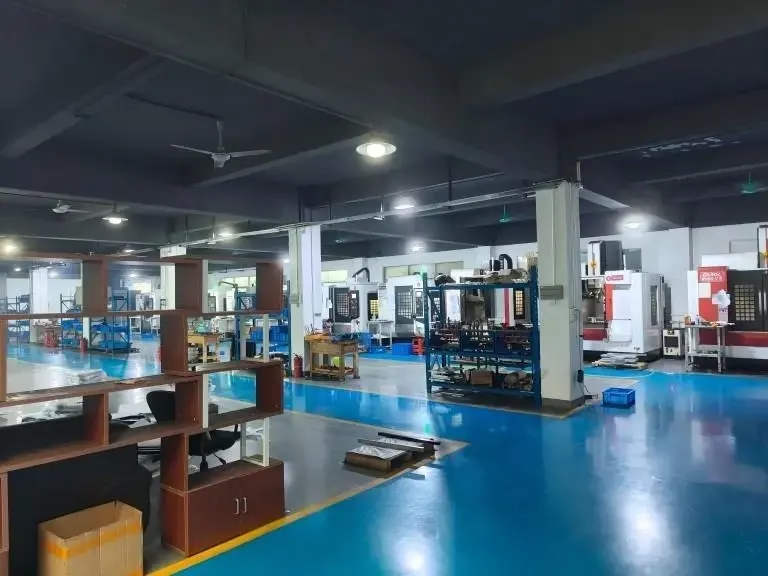
At GreatLight, the quote and the DFM analysis come back within 12 hours, and production can start within 24 hours. That is only possible because programming, machining, finishing, and inspection sit in the same building across 3 wholly-owned plants covering 7,600 m² in Dongguan, plus a Singapore factory. Nobody waits for a partner shop to answer an email.
Capacity matters here too. 127 high-precision CNC machines, including 16 simultaneous 5-axis machining centers and 16 mill-turn centers, mean a job does not sit in a queue behind someone else's priority. Maximum processing size reaches 4,000 mm, with travels of 4,000 × 400 × 150 mm on the large platform and 750 × 1,150 × 550 mm on the medium one.
Inspection is not a separate vendor either. Raw material check, in-process monitoring, and final inspection happen under one quality system, with reports on request. If a tool wears and a bore trends out of spec, the correction happens on the floor, not through a third party.
- 1Process ownershipThe team that quotes also programs, machines, and measures.
- 2Materials on handAluminium 6061, 7075, stainless 304, 316L, 17-4PH, titanium TC4, PEEK.
- 3CertificationsISO 9001, IATF 16949, ISO 13485, ISO 27001.
What You Give Up and What You Should Ask
Going direct is not free of trade-offs. A single factory has finite capacity and a finite material list. If your part needs a process nobody in the building runs, an honest factory will tell you so and you lose the one-stop convenience a platform advertises. That is still better than discovering it after the order.
Price is the other variable. A distributor aggregates shops competing on rate, so on commodity work it may quote below a factory with higher overhead. The gap narrows once you count the cost of a relayed question, a missed tolerance, or a second setup to fix a first article.
Before you commit, ask four things. Who owns the machines that will run this part? Who signs the first article report? What happens to the schedule if a tool breaks mid-run? And can we sign an NDA before drawings leave your side? At GreatLight, uploads are secure and confidential, and an NDA is available on request.
There is no minimum order quantity, so a single prototype and a 10,000-piece run go through the same engineering review. That is usually the cleanest way to test a supplier: send one hard part and watch how they handle it.
- 1Ask who machines itIf the answer is a partner name, you are buying brokerage.
- 2Ask about first articleA factory can walk you through the setup that produced it.
- 3Ask about confidentialitySecure uploads and a signed NDA before drawings move.
Frequently Asked Questions
Is it cheaper to buy CNC machining milling through a distributor?
On simple, high-volume commodity parts, sometimes. The platform can route the job to a shop with idle spindle time and quote a low rate.
On anything with tight tolerances or mating features, the brokerage margin and the cost of fixing a relayed mistake usually erase that advantage.
What tolerances can a direct factory hold on milled parts?
GreatLight holds ±0.005 mm (±0.0002 in) on machined features where the geometry allows it, across aluminium, stainless, steel, titanium, and engineering plastics.
Achievable tolerance depends on feature size, wall thickness, and how the part is fixtured. Send the drawing and we will tell you which callouts are realistic before the quote.
How do I keep my drawings confidential when requesting quotes?
Uploads are secure and confidential, and an NDA is available on request.
If your program requires a signed agreement before any file transfer, ask for it first. We will not start a review without it.
Can a distributor handle 5-axis or mill-turn work?
It can pass the job to a shop that runs those machines, but the quoting layer usually cannot discuss setup strategy.
That matters on contoured surfaces and single-setup mill-turn parts, where workholding and tool access decide whether the tolerance is repeatable.
What is the lead time difference between the two routes?
A direct factory quoting from its own schedule can return a quotation and free DFM analysis within 12 hours, start production within 24 hours, and ship parts in 3–5 days.
Through a distributor, each handoff adds time: quote to platform, platform to shop, shop back to platform. Historical late-delivery probability at GreatLight is below 2%.
Do I need a minimum order quantity to buy CNC machining milling?
No. There is no minimum order quantity, so one prototype and a 10,000+ piece run both go through the same review.
For volume work we quote tooling and cycle time separately so you can see where the unit price comes from.
Send the Drawing, Get a Machining Plan
Upload your files and an engineer will return a quotation with free DFM analysis within 12 hours. No minimum order quantity, NDA on request, 100% inspection before shipment.
12-hour quoteFree DFM analysis100% inspectionNDA on request









