
Cheap Copper CNC Machining: Where the Cost Actually Comes From
This page is for engineers and buyers sourcing copper and copper alloy parts who need to understand what makes a quote low or high. Read it and you can judge whether a cheap copper CNC machining offer is realistic for your geometry, tolerance, and volume.
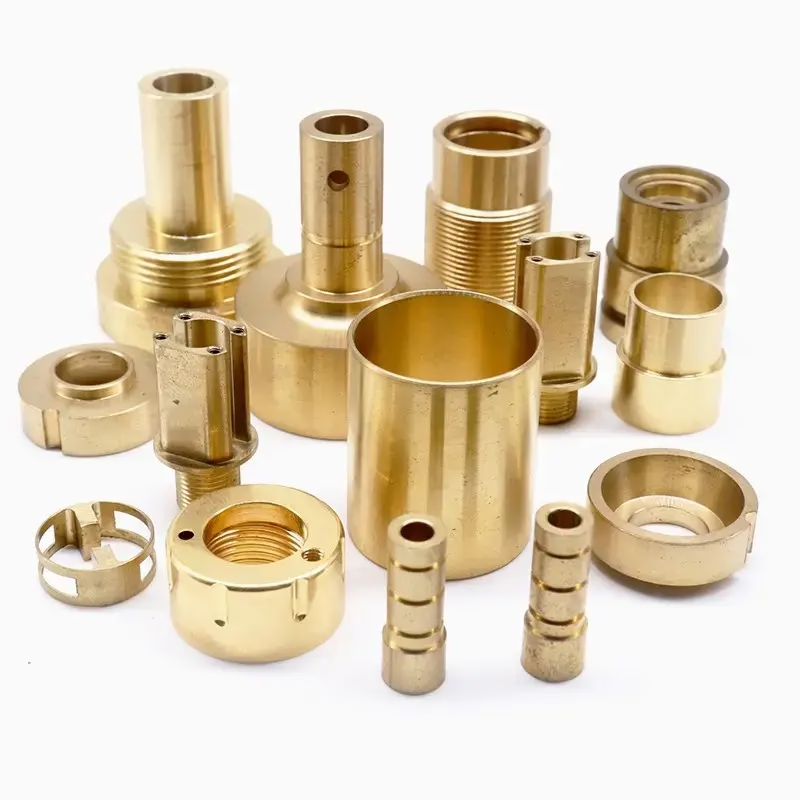
What makes a copper quote cheap or expensive
Copper is not hard to cut. It is hard to cut twice the same way.
Alloy choice sets the floor price
Copper pricing starts with the alloy, not the machine. C101 and C110 are oxygen-free and tough-pitch grades with very high conductivity, and they machine with long gummy chips that wrap around the tool. C36000 free-cutting brass breaks chips short and runs fast, so its machining cost per part is often lower even when the bar stock costs more. That single difference explains a large part of why two copper quotes for the same drawing come back far apart.
Tell a shop which property matters and the alloy choice narrows quickly. If the part carries current, C101 or C110 keeps resistance low. If it is a bushing, a fitting, or a decorative trim piece, C36000 or C27400 cuts cleanly and takes plating well. Beryllium copper sits at the other end: excellent spring and conductivity properties, but it is abrasive, expensive, and needs controlled handling of the dust.
We machine the copper and brass grades listed on our materials page, including C101, C103, C110, beryllium copper, C27400, C28000, and C36000. When a drawing does not name an alloy, we will suggest one and explain the trade-off before quoting, so the price you compare is for a real part, not a placeholder.
One more thing that trips up first-time buyers: copper scrap has real value. A shop that runs the alloy often can offset some material cost. A shop that buys one bar for your job cannot, and that shows up in the quote.
Why copper wears tools and how that shows up in price
Pure copper is soft, but it is abrasive in a way aluminium is not. Built-up edge forms on the cutting edge, then breaks off and takes carbide with it. Tool life on C110 can be a fraction of tool life on 6061 aluminium at the same feed. A shop quoting cheap copper CNC machining without accounting for tool changes will either lose money or cut corners on speed and finish.
Chip control is the second cost driver. Long stringy chips on C101 and C110 tangle around the tool holder and can scratch a finished surface. High-pressure coolant and peck-style toolpaths break the chip before it becomes a problem. Brass is the opposite: C36000 throws small chips, so it runs at higher feed and lower cost per part.
Thermal movement matters too. Copper expands more than steel for the same temperature rise, so a heavy roughing pass heats the part and the next measurement is wrong. We rough, let the part stabilize, then finish. That extra step costs time, but it is cheaper than scrapping a near-finished part.
For thin walls, heat sinks, and busbars, we often use 5-axis or mill-turn setups so more features come off in one fixturing. Fewer setups means less handling damage on soft copper and a lower total cost. Our shop runs 16 simultaneous 5-axis centers and 16 mill-turn centers, with a maximum processing size of 4,000 mm when the part is long and slender.
Where tight tolerance stops being cheap
Every tolerance band you tighten removes process options. A copper bracket held at ±0.1 mm can be milled on a 3-axis machine with simple fixtures. Take the same bracket to ±0.005 mm and you need temperature control, a probe, and a finishing pass that may be slower than the roughing. The price difference is not a markup. It is real machine time.
Our standard achievable tolerance is ±0.005 mm (±0.0002 in). Surface finish follows a similar curve: Ra 1.6–3.2 μm as machined is normal, Ra 0.8–1.6 μm takes a controlled finishing pass, and Ra 0.2–0.8 μm is reserved for contact surfaces where electrical or thermal contact resistance actually matters.
Ask yourself whether the tight callouts are functional. Many copper drawings carry a blanket tolerance copied from a steel part, and loosening the non-critical dimensions can cut cost without touching performance. If you are unsure which dimensions carry the function, send the drawing and we will mark the ones worth holding.
Inspection scales with tolerance as well. We inspect 100% of parts before shipment, covering raw material check, in-process monitoring, and final inspection, with reports on request. On a loose-tolerance run that is quick. On a ±0.005 mm run it is a meaningful share of the cost, and it should be in the quote rather than added later.
Copper and brass grades: machining behavior and typical use
Use this to sanity-check an alloy callout before you send a drawing.
| Grade | Machinability | Typical parts | Cost driver |
|---|---|---|---|
| C101 / C110 | Gummy chips, built-up edge | Busbars, contacts, heat spreaders | Tool wear, chip control |
| C103 | Similar to C110, low oxygen | Vacuum and electrical parts | Material price |
| Beryllium copper | Abrasive, needs dust control | Spring contacts, clips | Material and tool cost |
| C27400 / C28000 | Good, free-cutting brass | Fittings, connectors, hardware | Low, easy to run |
| C36000 | Excellent, short chips | Bushings, valves, trim | Lowest machining cost |
Setup, volume, and the honest limits of cheap
Setup is a fixed cost, so it dominates small quantities. A one-off copper prototype carries the full programming, fixturing, and first-article time. The same part at 10,000 pieces spreads that across many parts, and the per-piece price drops sharply even before any material discount. We have no minimum order quantity, so one prototype and a 10,000+ part run both go through the same shop.
Volume also changes the process. At low quantity we might mill a part from solid plate because the fixture is simple. At high quantity a die-cast or forged near-net blank can remove most of the material before the first cut, and the machining time falls. That switch is worth checking once a part passes a few thousand pieces a year.
There is a point where a quote is cheap because something was left out. Common signs: no material certificate, no first-article report, no deburr step, or a tolerance stated without a measurement method. Copper parts are often visible and often functional, so a burr inside a connector or a scratch across a contact face is a real defect, not a cosmetic one.
A fair low price comes from good process planning, not from skipping steps. We reduce cost by combining operations, choosing the right alloy, and running the part on the machine that fits its size instead of the largest one available. Our equipment ranges from 500 × 310 × 200 mm compact travels up to 4,000 × 400 × 150 mm for long parts, with a Ø400 mm rotary table for round work.
Lead time is part of cost too. A quote is issued with free DFM analysis within 12 hours, production can start within 24 hours, and parts typically ship in 3–5 days. Our historical late-delivery probability is below 2%. If a supplier promises a much lower price and a much longer or vaguer schedule, the two numbers are probably related.
Finishes, cleanliness, and what copper needs after machining
Copper tarnishes. A part that looks fine on the bench can show fingerprints and oxide within days if it is handled and shipped bare. For connectors and contacts this is not only cosmetic, because surface oxide raises contact resistance. Silver or gold plating over a clean copper surface is the usual answer when the part carries signal or low current.
We offer anodizing (clear, colour, hardcoat, conductive), electroless nickel, zinc, silver and gold plating, powder coating and black oxide, plus bead blasting, tumbling, brushing and polishing. Laser marking and engraving are available down to a minimum character height of 1.5 mm, which is enough for part numbers and traceability codes on most copper hardware.
Cleaning matters as much as the coating. Copper dust and chips embed in soft surfaces, so we deburr and clean before any plating step. If your assembly is sensitive to ionic contamination, say so on the drawing, because that changes the cleaning process and the packaging.
Quality paperwork is available when your industry needs it. Our plants hold ISO 9001:2015, IATF 16949:2016, ISO 13485:2016, and ISO 27001:2022 certifications, and our qualification rate is 99.99%. Uploads are secure and confidential, and we will sign an NDA on request before you send files.
Common questions about cheap copper CNC machining
Is C110 or C36000 cheaper for a turned copper part?
Per part, C36000 free-cutting brass is usually cheaper to machine because the chips break short and the tool lasts longer, even when the bar stock costs more than C110.
Choose C110 only when conductivity or a copper-specific property is required, for example a busbar or a heat spreader. If the part is a fitting or a bushing, brass will do the job at a lower total cost.
Can you hold ±0.005 mm on pure copper?
Yes, ±0.005 mm (±0.0002 in) is our standard achievable tolerance, and pure copper can be held there with temperature control and a separate finishing pass.
The part design still matters. Very thin walls, long unsupported sections, and sharp internal corners all move under cutting force, so we usually discuss wall thickness and fixturing before confirming the tolerance.
Does copper machining cost more than aluminium?
Usually yes, and the gap comes from tool life and chip control rather than material price alone. Built-up edge on pure copper shortens carbide life and forces slower feeds.
If cost is the driving factor, tell us which properties are functional. Sometimes an aluminium part with a plated contact area, or a brass part instead of pure copper, meets the requirement for less.
What surface finish can you achieve on copper contacts?
As machined we run Ra 1.6–3.2 μm, a controlled finish reaches Ra 0.8–1.6 μm, and fine work can reach Ra 0.2–0.8 μm.
For contact surfaces the finish interacts with plating. A very smooth surface with silver or gold plating gives the most stable contact resistance, so we plan the finishing step together with the coating.
How small an order will you take for copper parts?
There is no minimum order quantity. We run from a single prototype up to 10,000+ part runs on the same floor.
Small orders still carry setup, so the per-piece price is highest there. Once quantity grows we review whether a different blank, fixture, or machine class brings the unit cost down.
Can you machine copper parts up to 4,000 mm long?
Yes, the maximum processing size is 4,000 mm, with a long-part travel of 4,000 × 400 × 150 mm.
Long copper parts are prone to sag and thermal movement, so we plan support and check the part between passes rather than cutting straight to final size.
Send a copper drawing and get a real number
Send your copper or brass part and we will return a quote with free DFM analysis within 12 hours, including an alloy suggestion if the drawing does not name one.
12-hour quoteNo MOQ100% inspectionNDA on request









