
CNC Machine Services Raleigh NC: How to Pick a Supplier
This guide is for engineers and sourcing managers in Raleigh who need machined parts and want to compare suppliers on facts, not sales copy. We cover the four checks that decide whether a shop can actually hold your print: spindle count and axis configuration, tolerance and inspection, order quantity and lead time, and certification coverage.
In this article
- 1
- 2
- 3
- 4
- 5
- 6
- 7
Key takeaways
CNC machine services Raleigh NC: supplier comparison criteria
Use this table to score two or three shops side by side before you send a purchase order.
| Criterion | What to ask | Good answer | Red flag |
|---|---|---|---|
| Axis configuration | How many simultaneous 5-axis centers? | 16 or more, plus 3- and 4-axis capacity | Only 3-axis, no 5-axis listed |
| Tolerance | What tolerance do you hold on a 100 mm part? | ±0.005 mm, stated in writing | Vague answers like tight or high precision |
| Inspection | What is inspected before shipment? | 100% inspection, reports on request | Sample inspection only, no reports |
| Order quantity | What is your minimum order? | No MOQ, one part to 10,000+ | High MOQ or setup fee per revision |
| Lead time | Quote turnaround and ship window? | Quote in 12 hours, parts in 3–5 days | Quote takes a week, no ship window |
| Certifications | Which quality systems are certified? | ISO 9001, IATF 16949, ISO 13485, ISO 27001 | ISO 9001 only, or none stated |
| Size range | What is your maximum part size? | Up to 4,000 mm | Small envelope only, no large travel |
| Confidentiality | Do you sign an NDA? | NDA available on request | Refuses NDA or shares files widely |
The verdict for CNC machine services Raleigh NC buyers
Pick the shop that answers the four checks with numbers: axis capacity, a written tolerance with an inspection method, no minimum order quantity, and the certifications your industry actually requires. Everything else is sales copy.
Axis count and machine capacity
The first question to settle is how many axes the shop can run at once. A 3-axis vertical mill cuts from one direction. That covers brackets, plates, manifolds with open faces, and most parts you can draw in two views. It is fast and cheap per part.
Once a part has compound angles, deep pockets on more than one face, or an undercut, 3-axis work needs multiple setups. Each setup adds a fixture, a re-datum, and stack-up error. A simultaneous 5-axis center cuts those features in one clamping. You get better position between faces and fewer hand-offs.
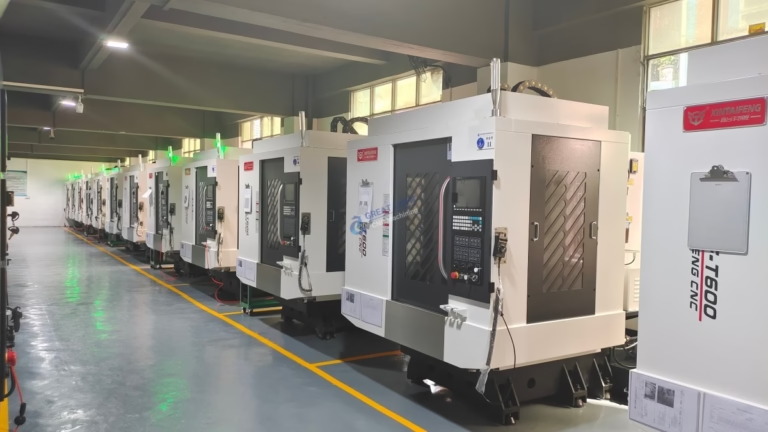
Capacity matters as much as axis count. A shop with one 5-axis machine and a full queue cannot protect your date. Look at the total floor: how many 3-axis, 4-axis, mill-turn, and 5-axis machines sit under one roof, and what the largest travel is.
Size is the hard limit. If your part runs past the machine envelope, no amount of skill fixes it. Know your maximum dimension before you ask for a quote.
- 13-axisPrismatic parts, open faces, one or two setups.
- 24-axisCylindrical parts with features around the bore.
- 35-axisContoured surfaces, undercuts, tight position between faces.
- 4Mill-turnShafts and housings that need turning and milling in one cycle.
Tolerance, finish, and how the shop proves both
A tolerance claim is only as good as the measurement behind it. ±0.005 mm on a 100 mm aluminum part is realistic on a temperature-controlled 5-axis center with sharp tooling. The same number on a thin-wall titanium part is a different problem, because the material moves after the cut.
Ask what the shop measures, with what, and how often. A workable answer names raw material check, in-process monitoring, and final inspection, with reports available on request. A weak answer is sample inspection only, or a promise that everything is checked without a report.
Surface finish follows the same logic. As-machined aluminum lands around Ra 1.6–3.2 μm. A high-quality cosmetic face is Ra 0.8–1.6 μm. Fine sealing or optical surfaces need Ra 0.2–0.8 μm, which usually means a finer stepover, a smaller tool, and a longer cycle.
If your drawing calls a tight finish, say so up front. It changes the toolpath, the cycle time, and sometimes the machine. A shop that quotes without asking is quoting a guess.
Order quantity, lead time, and quote turnaround
Minimum order quantity is where prototyping programs stall. If a shop wants 500 pieces before it will run your design, you cannot check the fit first. A no-MOQ shop lets you cut one part, assemble it, fix the CAD, and then scale to a production run without paying for new tooling.
Lead time splits into three clocks. The first is the quote. A shop that returns a quotation and a free DFM analysis within 12 hours is telling you how it will treat your production order. The second is the start. Production can begin within 24 hours when material is in stock and the program is clean. The third is shipping. A normal window is 3–5 days for machined parts.
No shop can promise a date that survives a tool break or a material shortage. What you can ask for is a track record. A historical late-delivery probability below 2% is a real number to hold a supplier to, and it is a fair question to ask about any shop you are considering.
For a Raleigh program, add transit to the total. Machine time is only part of the calendar.
Certifications, materials, and finishing under one roof
Certifications decide which programs a shop can even accept. ISO 9001:2015 is the baseline quality system. IATF 16949:2016 is required for automotive and EV work. ISO 13485:2016 is required for medical devices. ISO 27001:2022 covers information security, which matters when you send proprietary CAD to an outside supplier.
Material range is the next filter. Aluminum 6061-T6, 7075, and 2024 cover most fixtures and housings. Stainless 303, 304, 316L, and 17-4PH cover corrosion and food-contact parts. Titanium Ti-6Al-4V, Inconel, and magnesium AZ31B cover aerospace and lightweight work. Engineering plastics such as POM, PEEK, and PC cover insulators and low-friction parts.
Finishing is often the schedule breaker, because it moves the part to a second vendor. Anodizing, electroless nickel, zinc and gold plating, powder coating, black oxide, bead blasting, and laser marking should sit in the same supply chain as the machining. Laser marking has a floor: minimum character height 1.5 mm.
One vendor from raw stock to finished part removes the hand-off where most delays and damage happen.
Step by step: how to qualify a shop for CNC machine services
- 1Send the 3D model and a 2D printInclude material, tolerance, finish, and any critical-to-function dimensions. STEP or IGES plus a PDF drawing is enough to start.
- 2Ask for DFM feedback with the quoteA good shop flags thin walls, deep pockets with small corner radii, and features that need a custom tool. Free DFM analysis should arrive with the price.
- 3Confirm the axis plan for your partAsk which machine will run it and how many setups. If the answer is three setups on a 3-axis mill, ask what that does to position tolerance.
- 4Pin down tolerance and inspectionState the tolerance you need and ask how it will be verified. Request an inspection report if the part is critical.
- 5Check MOQ and production scalingRun one prototype first. Then ask whether the same program and fixture carry over to a 10,000-part run without new tooling charges.
- 6Match certifications to your industryISO 9001 for general work, IATF 16949 for automotive, ISO 13485 for medical, ISO 27001 when CAD confidentiality is a contract requirement.
- 7Agree on the finish and marking specName the finish type and color. Keep laser-marked characters at 1.5 mm minimum height so they stay legible after anodizing.
- 8Sign an NDA before releasing filesUploads should be treated as secure and confidential. An NDA on request protects both sides before the quote stage.
Frequently asked questions
Can a supplier outside Raleigh hold ±0.005 mm on my parts?
Yes, if the machine and the measurement system support it. ±0.005 mm is a normal capability on a temperature-controlled 5-axis center cutting aluminum with sharp tooling and a clean program.
The risk is not the location, it is the setup count. Every extra clamping adds position error between faces. Ask how many setups the part needs and how the shop checks the result.
What is the difference between 3-axis, 4-axis, and 5-axis for my part?
3-axis cuts from one direction and suits plates, brackets, and open-face parts. 4-axis adds rotation around one axis, which helps cylindrical parts with side features.
5-axis moves the tool and the part together, so compound angles and undercuts cut in one cycle. Fewer setups means tighter position between faces and less fixture cost.
Do I need a minimum order quantity to get a quote?
No. A shop with no minimum order quantity will quote a single prototype and a 10,000-piece run on the same drawing. That lets you verify the fit before committing to volume.
Watch for setup fees that appear only at low quantity. They are a soft MOQ and they change the economics of a prototype run.
How fast can machined parts ship after I approve the quote?
A workable timeline is a quote and DFM analysis within 12 hours, production start within 24 hours once material is in stock, and parts shipping in 3–5 days.
Complex geometry, specialty alloys, and multi-step finishing extend that. Ask for the ship window in writing rather than assuming it.
Which certifications should I require for automotive or medical parts?
Automotive and EV programs typically require IATF 16949:2016. Medical device work typically requires ISO 13485:2016. ISO 9001:2015 is the general baseline for industrial parts.
If your CAD and test data are sensitive, add ISO 27001:2022 for information security. Match the certificate to the contract, not to the marketing page.
How do I protect my design before sending files?
Ask for a non-disclosure agreement before the first upload. A shop that treats uploads as secure and confidential will sign one on request without friction.
Send only the files needed for the quote. A STEP model and a 2D print are usually enough to price the part.
Send your drawing, get a quote and DFM notes in 12 hours
Upload a STEP file and a 2D print. We return pricing, a free DFM analysis, and the machine plan for your part.
12-hour quote100% inspectionNo minimum orderNDA on request
More from GreatLight
We publish setup notes, tooling trials and inspection data from the factory floor.











