
CNC Machine Services Tacoma: How to Pick a Partner
This guide is for engineers and buyers in the Puget Sound area sourcing machined parts. It covers what to ask, what to measure, and when a local shop or an overseas partner fits better. Read it before you send the next RFQ.
In this article
- 1
- 2
- 3
- 4
- 5
- 6
- 7
- 8
- 9
Key takeaways
Tacoma CNC sourcing: what to check and what good looks like
Use this as a filter list when you compare quotes. The right column is a concrete benchmark, not a marketing claim.
| Check | What to ask | Benchmark to look for |
|---|---|---|
| Tolerance | Can you hold the tightest callout on the drawing? | ±0.005 mm on critical features, verified by report |
| Surface finish | What Ra can you reach as machined? | Ra 0.8–1.6 μm typical; Ra 0.2–0.8 μm on request |
| Lead time | When do chips actually start flying? | Quote in 12 hours, production start in 24 hours |
| MOQ | Will you run a single part? | No minimum order quantity |
| Certifications | Which quality systems are in scope? | ISO 9001, IATF 16949, ISO 13485, ISO 27001 |
| Inspection | What ships with the parts? | 100% inspection; reports on request |
| Confidentiality | Can you sign an NDA before files move? | NDA available on request |
The bottom line
Pick the supplier whose quote shows they read the drawing. Tolerance, finish and certification scope should match your part, not a brochure. Start with a pilot order, then scale.
What Tacoma buyers actually need from a machine shop
Tacoma sits in a manufacturing corridor shaped by aerospace, maritime and heavy transport work. That mix produces a specific demand pattern: small batches, tight tolerances, and parts that must survive vibration, salt air or thermal cycling. A shop that only runs long production runs on simple geometry will struggle with this work.
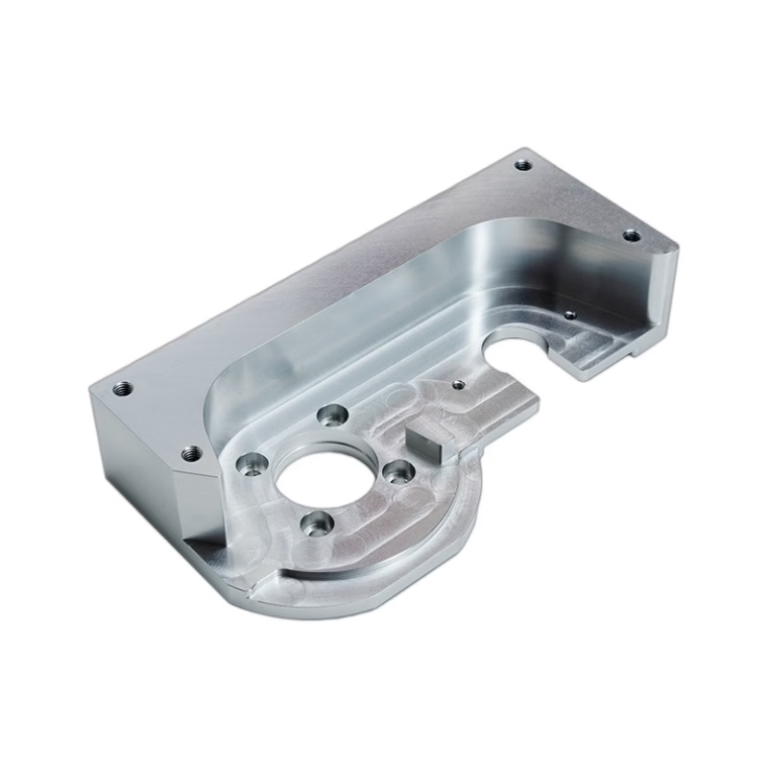
The parts we see from this region tend to be functional rather than decorative. Brackets, housings, manifolds, impellers, fixtures and prototype assemblies. Many arrive as a 3D model with a handful of critical dimensions, and the rest is left to the machinist. That is where process knowledge shows up, or does not.
One practical point. If you are comparing cnc machine services tacoma suppliers, do not compare price alone. Compare how each one reads the drawing. A shop that flags a thin wall, an inaccessible corner or a tolerance stack before quoting is worth more than a shop that simply returns a number.
The region also has a strong repair and retrofit culture. Fishing fleets, port equipment and machine tools all need replacement parts that were never designed for modern CAD. Reverse engineering a worn part into a machinable model is a normal request, not an exception.
- 1Small batches are normalTen to two hundred parts per release is common.
- 2Mixed materials in one orderAluminum, stainless and titanium often ship together.
- 3Documentation mattersCertificates and inspection reports are often required at delivery.
Matching the machining process to the part geometry
Three-axis milling handles prismatic parts with features reachable from one direction. It is fast and economical. Use it for plates, covers and simple housings where all holes and pockets open to the top face.
Four-axis adds a rotary table, so the tool can reach around the part. This suits shafts, bushings and cylindrical parts with cross-drilled holes or milled flats. It removes setups and keeps feature-to-feature relationships tight without special fixturing.
Five-axis machining is the answer when the geometry is free-form or the part needs many faces machined in one setup. Impellers, turbine blades, complex housings and organic brackets fall here. A single setup reduces datum shift and usually improves surface finish on curved surfaces.
The choice is not about which machine is more advanced. It is about how many setups the part needs and how much re-fixturing error you can tolerate. Each extra setup adds stack-up. That is the cost you are really managing.
- 13-axisPrismatic parts, one approach direction, lowest cost per part.
- 24-axisShafts and round parts with cross features.
- 35-axisFree-form surfaces and multi-face parts in one setup.
- 4Mill-turnParts combining turning and milling in a single cycle.
How tolerance and surface finish change the quote
Tolerance is the single biggest cost driver after material. A part held to ±0.005 mm needs temperature control, careful tool path planning and more inspection time. A part at ±0.05 mm does not. If only two features are critical, say so on the drawing rather than applying the tight tolerance everywhere.
Surface finish works the same way. Ra 1.6–3.2 μm is a normal as-machined result. Ra 0.8–1.6 μm needs a finer stepover or a finishing pass. Ra 0.2–0.8 μm usually means additional operations such as lapping or polishing on top of machining. Each step adds handling and risk of edge damage.
Material choice interacts with both. Aluminum 6061 and 7075 cut cleanly and hold tight tolerances well. Stainless 316L work-hardens and needs controlled feed rates. Titanium Ti-6Al-4V (TC4) generates heat and wears tools, so it demands slower parameters and more frequent tool changes. Inconel is slower still.
For medical and food-contact parts, finish and cleanliness are linked. A Ra 0.8 μm or better surface leaves fewer crevices for residue. That is a functional requirement, not cosmetic.
- 1Tight tolerance, few featuresName the critical dimensions explicitly.
- 2Fine finishRa 0.2–0.8 μm means extra operations and handling.
- 3Hard materialsTitanium and Inconel cost more in cycle time, not just stock.
Which certifications your project actually needs
Certifications are a filter. They tell you which quality system is in place, not how good the shop is. Match them to your industry and your customer's requirements, and do not pay for scope you will never audit.
ISO 9001:2015 is the baseline for general industrial work. It covers process control, traceability and corrective action. Most buyers expect it. Without it, you are relying on the shop's word for everything.
IATF 16949:2016 applies to automotive and EV programs. It adds requirements around APQP, PPAP and statistical process control. If your part goes into a vehicle, this is usually mandatory.
ISO 13485:2016 is for medical devices. It focuses on risk management and process validation. ISO 27001:2022 covers information security, which matters when you are sharing proprietary CAD files and drawings. Ask which one is needed before you shortlist.
- 1IndustrialISO 9001:2015 is the standard baseline.
- 2Automotive and EVIATF 16949:2016 with PPAP documentation.
- 3MedicalISO 13485:2016 and validated processes.
- 4IP protectionISO 27001:2022 for information security controls.
Lead time, minimum order quantity and the real cost of waiting
Lead time is not one number. It is quote time, plus programming, plus material procurement, plus machining, plus finishing, plus inspection, plus freight. Buyers who track only the machining days get surprised at the end.
A no-MOQ policy matters more than it sounds. Repair work, prototype iterations and bridge production all need small quantities. If a shop's minimum is 500 pieces, your one-off fixture becomes a 500-piece inventory problem.
Availability of stock also moves the date. Aluminum 6061 and 304 stainless are usually on the shelf. Titanium TC4, Inconel and beryllium copper may need to be ordered. That gap can be days or weeks, and it has nothing to do with machine capacity.
For a Tacoma buyer working with an overseas partner, the practical sequence is: quote in 12 hours, production start within 24 hours of approval, parts ship in 3–5 days for standard work. Historical late-delivery probability is below 2%, but that figure only holds when the drawing package is complete.
- 1Quote turnaround12 hours including DFM analysis.
- 2Production startWithin 24 hours after approval.
- 3Standard shipment3–5 days after machining and inspection.
- 4MOQNone. One prototype to 10,000+ parts.
Common mistakes when buying CNC machining
The most expensive mistake is quoting to the wrong drawing revision. Confirm the revision number and the date on the drawing before you approve anything. A part made to an old revision is scrap, and the argument over who pays costs more than the part.
The second is applying tight tolerances everywhere because it feels safer. It is not safer. It raises cost, lengthens inspection and increases the chance of a rejected lot on a feature that never mattered.
The third is ignoring material availability. A quote based on 7075 aluminum when only 6061 is in stock will move the delivery date. Ask what is on the shelf before you commit to a schedule.
The fourth is skipping the pilot. One or two parts will reveal how a shop handles setup, deburring, packaging and paperwork. That is a cheap test compared with a rejected production run.
- 1Wrong revisionConfirm revision and date before approval.
- 2Blanket tight toleranceTighten only what the function requires.
- 3Assumed stockVerify material availability with the quote.
- 4No pilot runTest with one to five parts first.
Step by step: how to qualify a CNC supplier
Run these in order. Each step removes suppliers that will cost you time later.
- 1Send a complete RFQ packageInclude 3D model, 2D drawing with GD&T, material spec, finish spec, quantity and target date. Missing information is the leading cause of slow quotes.
- 2Ask for DFM feedback with the priceA useful reply names specific risks: thin walls below 1 mm, deep pockets over 4× diameter, or tolerances that force a second setup.
- 3Check the tolerance capability against your calloutsConfirm the shop can hold ±0.005 mm on the features that need it, and agree which features are non-critical so nobody over-inspects.
- 4Confirm the certification scopeAsk for the certificate number and the scope statement. Verify it covers the process and material you are buying.
- 5Agree on inspection and reportingDecide up front whether you need first article inspection, material certificates or a full dimensional report with the shipment.
- 6Settle confidentiality before files moveSign an NDA if the design is proprietary. Confirm how files are stored and who has access.
- 7Plan freight and customs into the scheduleFor an overseas partner, add transit time to production time. Air freight from Dongguan to Tacoma is days, not hours. Sea freight is weeks.
- 8Run a small pilot order firstOrder one to five parts before committing to a production release. Inspect them, then decide.
Questions buyers ask before awarding a job
Can a single prototype be machined without a minimum order?
Yes. No minimum order quantity means a one-off prototype is a valid order. The cost per part is higher than a production run because programming and setup are spread over one piece, not hundreds.
For a prototype, expect the quote to include programming time. If you plan a production run later, mention it. The shop can often keep the same fixture and tooling, which lowers the follow-on price.
What tolerance can actually be held on a machined part?
±0.005 mm is achievable on critical features with the right machine, fixturing and temperature control. It is not realistic across every feature on a large part.
A practical approach is to mark the two or three dimensions that matter functionally, and leave the rest at a general tolerance. That keeps the process stable and the price reasonable.
How should I compare quotes from different shops?
Compare what is included, not just the number. Does the quote list material grade, finish, inspection level, packaging and freight terms? A lower price that excludes anodizing or inspection is not lower.
Also compare the DFM notes. A shop that identifies a risk before cutting metal is giving you information you can act on.
What certifications should I require for aerospace or medical parts?
For medical devices, ISO 13485:2016 is the relevant system. For automotive and EV programs, IATF 16949:2016 is standard. General industrial work usually requires ISO 9001:2015.
If your design files are sensitive, ISO 27001:2022 covers information security. Ask for the certificate scope, not just the logo.
How do I protect my design when sending files overseas?
Sign a non-disclosure agreement before files move. Confirm how the files are stored, who can access them, and whether they are deleted after the job.
Ask specifically about upload security if you use a web portal. A documented process is worth more than a verbal promise.
Which materials are commonly available without long lead times?
Aluminum 6061, 6061-T6 and 7075, plus stainless 303, 304 and 316L, are usually in stock. Brass C36000 and copper C110 are common as well.
Titanium TC4 (Ti-6Al-4V), Inconel and magnesium alloys often need to be ordered. Build that into the schedule before you promise a delivery date.
Send your drawing and get a real answer
Upload your CAD files and receive a quotation with DFM notes within 12 hours. No minimum order quantity.
12-hour quote100% inspectionNo MOQNDA on request
More from GreatLight
We publish setup notes, tooling trials and inspection data from the factory floor.











