
CNC Machining Services Camberley: A Buyer Guide for Engineers
This guide is for design and procurement engineers in Camberley and Surrey who need machined parts from a supplier they have not used before. It lists the checks that decide whether a quote is realistic, and where offshore capacity fits next to your local machine shop.
In this article
- 1
- 2
- 3
- 4
- 5
- 6
- 7
- 8
Key takeaways
Which Shop Fits Which Job
Use this table before you send an RFQ. It is about fit, not about one supplier being better than another.
| Job profile | Local Camberley shop | Offshore partner shop |
|---|---|---|
| One-off fixture, next-day need | Strong fit, short travel | Possible, but freight adds days |
| ±0.005 mm bore, 5-axis | Depends on machine list | Ask for machine list and CMM report |
| Hardened tool steel, fine detail | Often outsourced anyway | In-house EDM and grinding |
| 1 to 20 prototype parts | Good fit, easy to visit | No MOQ, DFM in 12 hours |
| 10,000+ parts per year | Capacity limited | Mill-turn and 5-axis cells |
| Automotive PPAP package | Needs IATF 16949 | IATF 16949:2016 available |
| Medical device components | Needs ISO 13485 | ISO 13485:2016 available |
| Parts over 1,000 mm long | Travel limits apply | Up to 4,000 mm processing size |
The Short Version
Mark the critical features, state the material grade, and ask for the process route and inspection plan before you release the order. If a supplier answers those four things clearly, the rest of the program usually follows.
Start With the Feature, Not the Supplier List
Most searches for CNC machining services Camberley start with a supplier list. That is the wrong first step. Write down the tightest feature on the drawing first: its size, its tolerance and its surface finish. Those three numbers narrow the field faster than any directory.
A bracket with ±0.1 mm edges and Ra 3.2 μm faces can run on a 3-axis mill in one setup. A hydraulic manifold with intersecting bores at ±0.01 mm and a Ra 0.8 μm seal face needs a different class of machine and a different inspection plan. Same material, same size envelope, very different cost.
When you know the tightest feature, you also know what to ask. Ask for the machine model, the number of setups, and how the critical dimension will be measured. A supplier who answers those three questions without hesitating is usually a supplier who has run the part before.
Finish is the check most often skipped. Ra 1.6–3.2 μm is a normal as-machined result. Ra 0.8–1.6 μm needs a controlled finishing pass. Ra 0.2–0.8 μm usually means grinding or a separate finishing operation, and it should be priced as one. If a quote lists one line item for a part with both a rough face and a sealing face, ask how the two are separated.
- 1Tightest tolerance firstIt sets the machine class, the setup count and the inspection method.
- 2Finish is a separate operationRa 0.2–0.8 μm rarely comes from the same pass as Ra 3.2 μm.
- 3Ask for the setup countEach extra setup adds a datum shift and a re-fixturing risk.
Read the Quote the Way a Machinist Reads It
A quote has four parts that matter: unit price, batch quantity, lead time and the assumptions behind them. The assumptions are where projects slip. If the quote says 'material included' but not which grade, you may get a substitute alloy that machines differently and finishes differently.
Ask for material grade by standard name. Aluminium 6061-T6 and 7075 behave very differently on thin walls. Stainless 303 machines freely; 316L work-hardens and needs slower feeds. Titanium Ti-6Al-4V and Inconel 718 need rigid setups and sharp tooling, so they cost more per hour even on the same machine.
Lead time is also two numbers, not one. The first is quote and DFM turnaround. The second is production and shipping. A useful benchmark: quotation and DFM analysis within 12 hours, production start within 24 hours, parts shipping in 3–5 days. If a supplier quotes 3–5 days total on a 5-axis job with a first-article report, ask which step was left out.
Finally, check the inspection line. 100% inspection before shipment should cover raw material check, in-process monitoring and final inspection. Reports on request is a normal clause. Reports always included is better. Ask which report you will receive and in what format.
- 1Material grade in writing6061-T6, 17-4PH, Ti-6Al-4V: the grade changes feeds, finish and price.
- 2Two lead timesQuote and DFM is one clock. Cutting and shipping is another.
- 3Inspection scopeRaw material, in-process, final. Ask what is recorded and what is only checked.
Certification: What It Covers and What It Does Not
ISO 9001:2015 covers quality management. It does not by itself prove that a supplier can hold ±0.005 mm on your part. IATF 16949:2016 adds automotive process discipline, including change control and traceability. ISO 13485:2016 adds medical device requirements. ISO 27001:2022 covers information security, which matters if your drawings are the product.
The practical question is not which certificates a supplier holds. It is which certificate applies to your part and what record that creates. An automotive bracket needs the IATF route. A surgical instrument housing needs the ISO 13485 route. A consumer enclosure may need none of them, and paying for the wrong paperwork adds cost without adding value.
Data handling is a separate risk. If your CAD files carry a new product geometry, a supplier with ISO 27001:2022 and a signed NDA is a reasonable baseline. Uploads should be secure and confidential, and an NDA should be available on request, not negotiated for two weeks.
One caution: certificates show a system, not a measurement. Request a first-article inspection report and a capability study for the feature you care about. A shop that will not share a sample report is telling you something.
- 1Match the certificate to the partIATF for automotive, ISO 13485 for medical, ISO 27001 for file security.
- 2Ask for a sample reportA first-article report proves measurement practice, not just paperwork.
- 3Baseline tolerance±0.005 mm (±0.0002 in) is the stated shop capability. Push tighter only with reason.
MOQ, Batch Size and the Cost Curve
Minimum order quantity decides whether a supplier is usable at prototype stage. A shop with no minimum order quantity will run one part and then run 10,000 parts on the same process, which keeps the transition clean. A shop with a 500-piece minimum forces you to prototype elsewhere and re-qualify later.
Unit price falls with quantity, but not evenly. The first drop happens when setup is amortized. The second drop happens when the part moves to a faster process, such as a mill-turn center or a dedicated fixture. Ask at which quantity the second drop starts. That number tells you whether the supplier plans to keep your part on the same machine forever.
Watch for the reverse trap: a very low prototype price with a very high production price. Prototype work is often quoted at cost to win the program. If the two prices are far apart, request a small-batch price at 50 and 500 pieces before you commit.
For parts that will run for years, ask about tooling life and fixture ownership. If a custom fixture is built for your part, who keeps it, and does it move with the program?
- 1No MOQ helps prototypesOne piece to 10,000+ runs on the same process avoids re-qualification.
- 2Ask for the second price breakIt shows when the part moves off the slow path.
- 3Small-batch checkGet 50-piece and 500-piece prices before signing a program.
Where an Offshore Partner Fits Beside a Camberley Shop
Local shops win on proximity. You can drive over, stand at the machine and settle a tolerance question in twenty minutes. For one-off fixtures, urgent rework and design iteration, that is hard to beat. Keep that relationship.
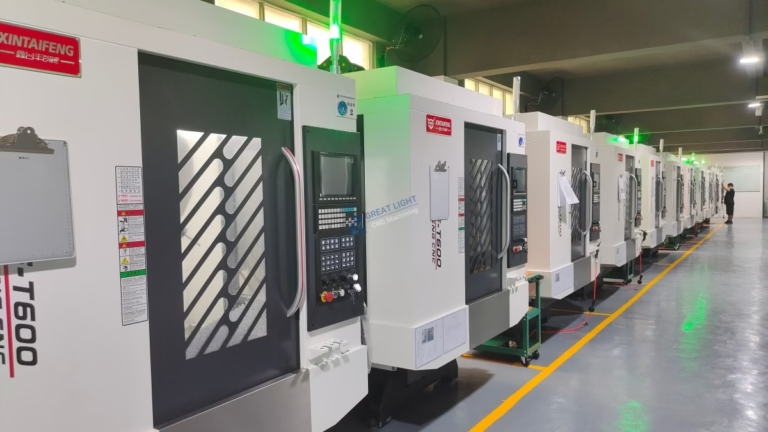
Offshore capacity wins on machine range and on long runs. A 7,600 m² plant with 127 high-precision CNC machines, including 16 simultaneous 5-axis machining centers, 12 four-axis mills, 27 three-axis machines and 16 mill-turn centers, can take work that a small shop would decline or subcontract. Maximum processing size reaches 4,000 mm, with travels such as 4,000 × 400 × 150 mm and 750 × 1,150 × 550 mm on the medium frames.
Process range matters too. Hardened steel and sharp internal corners often need EDM, which many job shops send out. In-house EDM, precision grinding and metal 3D printing (SLM) keep those steps under one quality system instead of three.
The honest split: send prototypes and urgent work locally, and send production volumes, hard materials and complex geometry to a partner built for it. The two are not competing for the same job.
- 1Local for speedIteration, rework and same-week fixes stay close to home.
- 2Offshore for range5-axis, mill-turn, EDM, grinding and SLM under one roof.
- 3One quality systemFewer handoffs means fewer places for a tolerance to drift.
Seven Steps Before You Release the Order
Run these in order. Each one removes a common cause of rework or late delivery.
- 11. Mark the critical featuresFlag every dimension with a tolerance tighter than ±0.05 mm and every surface finer than Ra 1.6 μm. Send the flagged drawing, not a general assembly.
- 22. State material by standard gradeWrite 6061-T6, 17-4PH or Ti-6Al-4V, not 'aluminium' or 'stainless'. Add the temper and any heat treatment.
- 33. Ask for the process routeRequest the machine type, setup count and whether EDM or grinding is needed. A route with three setups on a ±0.01 mm bore deserves a question.
- 44. Request DFM feedback in writingGood suppliers return manufacturability notes with the quote. Typical turnaround is quotation and free DFM analysis within 12 hours.
- 55. Fix the inspection planAgree which dimensions are measured, with what instrument, and which report you receive. 100% inspection before shipment is the baseline.
- 66. Confirm batch sizes and price breaksAsk for unit price at 1, 50, 500 and 5,000 pieces. The shape of that curve shows where the real production cost sits.
- 77. Settle confidentiality and shipping termsSign the NDA before releasing CAD. Confirm Incoterms, packaging and whether parts ship in 3–5 days from production start.
Questions Buyers Ask Next
How tight a tolerance can I actually specify?
Stated shop capability is ±0.005 mm (±0.0002 in). That is achievable on rigid setups with the right machine and a controlled temperature environment.
Do not apply it to every dimension. Tightening a non-critical dimension adds cost and inspection time without improving function. Mark only the features that need it.
Can a supplier hold a finish and a tolerance at the same time?
Yes, but usually in separate operations. A sealing face at Ra 0.2–0.8 μm is often ground after milling, which means an extra setup and an extra datum.
If both a rough face and a sealing face appear on the same part, ask how the supplier separates them. One line item for both is a warning sign.
What paperwork should arrive with the parts?
At minimum, a packing list with material grade and batch. For regulated work, a first-article inspection report and material certificates.
Ask before ordering, not after. Reports on request is a normal clause, but the request should be in the purchase order.
Is no minimum order quantity realistic?
Yes, when the shop runs a mix of prototype and production work on the same machines. No minimum order quantity means one piece to 10,000+ part runs on the same process.
The trade-off is that a single part carries the full setup cost. Expect the unit price at quantity one to be much higher than at 500 pieces.
How do I compare a local quote with an overseas one fairly?
Add freight, duty, currency risk and the cost of your own travel or inspection visits to the overseas number. Then compare landed cost per good part, not unit price.
Also count the cost of a rework cycle. A 3–5 day shipping window is useful only if the first article was approved before the run.
What should I do if the first article fails?
Stop the run and get the measurement data. A failed first article is usually a datum or fixture problem, not a machine problem.
Ask for the corrected setup and a new first-article report before production restarts. Suppliers with a documented in-process monitoring step catch this earlier than those who only inspect at the end.
Send the Drawing, Get a Route and a Price
Upload your CAD and flagged drawing. We return a quotation and free DFM analysis within 12 hours, with the machine route and inspection plan stated in the quote.
12-hour quote and DFMNo minimum order quantity100% inspection before shipmentNDA on request
More from the Shop Floor
We publish setup notes, tooling trials and inspection data from the factory floor.











