
Price for 5 Axis CNC Machining Service Company: What Actually Drives the Number
A quote from a 5 axis cnc machining service company is a sum of specific decisions, not a single rate. This guide breaks down the seven factors that move the price, shows where cheaper quotes hide their margin, and gives you the questions to ask before you send a purchase order.
In this article
- 1
- 2
- 3
- 4
- 5
- 6
Key takeaways
How Each Cost Factor Moves the Price
Ranges are typical shop behavior, not quoted rates.
| Cost factor | Low cost when | High cost when | Where the money goes |
|---|---|---|---|
| Part geometry | Prismatic, 3-axis reachable | Deep cavities, undercuts, thin walls | CAM programming and cycle time |
| Material | 6061, brass, ABS, POM | Ti-6Al-4V, Inconel, 17-4PH | Tool wear and slower cutting speeds |
| Tolerance | ±0.05 mm or looser | ±0.005 mm or tighter | In-process checks and slower feeds |
| Batch size | 500+ parts per setup | One-off prototype | Fixture, programming, first-article |
| Surface finish | As machined, Ra 3.2 μm | Ra 0.2–0.8 μm | Extra passes and hand polishing |
| Post-processing | Bead blast only | Hardcoat anodize plus laser mark | Outside vendor minimums |
| Lead time | Standard 3–5 day ship | Compressed schedule | Overtime and re-sequenced jobs |
Compare Scope, Not Just the Bottom Line
The cheapest 5-axis quote is usually the one with the narrowest scope. Fix the material grade, tolerance, finish, inspection, and date before you compare prices, and the real number becomes visible.
Part Geometry and Material: The Two Biggest Levers
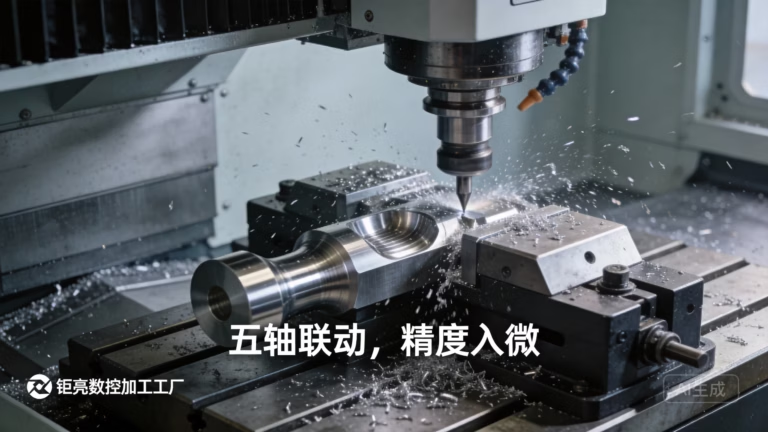
The shape of the part sets the floor on price. A 5 axis cnc machining service company earns its rate on parts that a 3-axis mill cannot reach in one setup: impellers, turbine housings, bone plates with compound curves, robot joint housings with interlocking rotational surfaces. Those features force the CAM programmer to build a collision-checked toolpath, and the machine to move two rotary axes at once.
Compare two parts from the same drawing family. A flat aluminum mounting plate with four holes might run 20 minutes of spindle time. A humanoid robot joint housing with undercut surfaces and a ±0.005 mm fit runs hours, because every approach angle needs its own tool and its own verification. The material removal is not the expensive part. The planning is.
Material changes cost in a less obvious way. Aluminum 6061, 6082, brass, and most plastics cut fast with low tool wear. Stainless 316L and 17-4PH work-harden and demand slower feeds. Titanium TC4 (Ti-6Al-4V) and Inconel push tool life down hard and often need coolant through the spindle. A material swap can double cycle time before any tolerance change is made.
One practical rule: if the drawing allows it, pick the material that meets the function and no more. An engineer who specifies Inconel for a bracket that sees no heat is paying for wear resistance nobody needs.
- 1Cheap geometryOpen pockets, flat faces, holes reachable from one direction.
- 2Expensive geometryUndercuts, deep ribs, thin floors under 1 mm, blended radii.
- 3Cheap material6061-T6, C36000 brass, POM, ABS.
- 4Expensive materialTi-6Al-4V, Inconel, 17-4PH, magnesium AZ91D.
Tolerance, Batch Size, and Finishing in the Price of a 5 Axis CNC Machining Service Company
Tolerance behaves like a volume knob, not a switch. Moving from ±0.1 mm to ±0.05 mm is usually free if the machine is in good shape. Moving from ±0.05 mm to ±0.005 mm is not. The shop slows the finishing passes, controls temperature, and inspects more often. On a tight-tolerance part, inspection can take as long as cutting.
Batch size spreads the fixed cost. Programming, fixturing, and first-article inspection happen once whether you order one part or 500. A prototype quoted alone looks expensive per piece. The same part at 500 pieces often drops by more than half per unit, because the setup is amortized and the operator stops re-clamping.
Finishing is where quotes surprise buyers. Machining leaves tool marks. If the drawing calls for Ra 0.8–1.6 μm, the shop adds a finishing pass. If it calls for Ra 0.2–0.8 μm, expect hand polishing or a secondary process. Anodizing, electroless nickel, zinc plating, and powder coating are usually outside services with their own minimum lot charge, so a small order can pay a full tank price for a handful of parts.
Laser marking is a smaller line item but worth checking. Minimum character height is 1.5 mm on most setups. If your part number is long and the marking area is small, the shop may need a different fixture or a different marking method.
- 1Tolerance tiers±0.05 mm standard, ±0.005 mm when the fit demands it.
- 2Batch sweet spotSetup cost is diluted hardest between 100 and 1,000 pieces.
- 3Finishing minimumsPlating and anodizing charge by lot, not by part.
- 4Marking limit1.5 mm minimum character height.
Lead Time, Certifications, and What They Add to the Quote
Lead time is a price variable, not a separate service. A normal schedule lets the shop plan tool changes, batch similar jobs, and run the machine at a sustainable feed. A compressed schedule means overtime, re-sequenced jobs, and sometimes a second setup. If you ask for parts in two days instead of five, expect the quote to reflect it.
Certifications shape who can bid, and they carry real overhead. ISO 9001:2015 covers general quality management. IATF 16949:2016 adds automotive traceability and change control. ISO 13485:2016 brings medical device documentation, which means more records per part. ISO 27001:2022 covers information security, which matters if your drawings are sensitive. A shop holding all four spends money maintaining them, and that cost sits inside the hourly rate.
Here is the buyer's trap. A quote from a shop without the certification you need may look 15 percent cheaper, until the audit fails and the parts cannot ship. Match the certification to the end use before you compare prices. Aerospace brackets, automotive sensor housings, and surgical instruments do not share the same paperwork burden.
Inspection depth is the last hidden line. Some shops inspect the first article and sample the rest. Others inspect 100 percent before shipment, with raw material checks, in-process monitoring, and a final report on request. Ask which one you are buying. The answer changes the price and the risk.
- 1Standard schedule3–5 days shipping on most machined parts.
- 2Compressed scheduleAdds overtime and re-sequencing cost.
- 3Medical and automotiveCertification drives documentation hours per part.
- 4Inspection scopeFirst-article plus sampling vs 100 percent before shipment.
How to Get a Quote You Can Compare
- 1Send a STEP file and a 2D drawingThe 3D model defines geometry; the 2D drawing defines datums, tolerances, and finish callouts. A model alone forces the shop to guess, and guessing gets priced in.
- 2State the quantity tiers you may orderAsk for one piece, 50, and 500. The price curve tells you whether the quote is setup-heavy or cycle-heavy.
- 3Name the material grade, not just the family6061-T6 and 7075 are not interchangeable. Write the grade and any temper or condition.
- 4Call out critical tolerances onlyMark the features that matter and leave the rest general. A drawing with ±0.005 mm on every dimension costs more than the part needs.
- 5List the finish and where it appliesSpecify masked areas, threads, and datum surfaces that must stay bare. Unmasked anodize changes dimensions by a few micrometres.
- 6Say when you need the partsGive a real need date. A shop can often hit a standard 3–5 day ship if you tell them early instead of asking for a rush.
- 7Ask what the quote excludesTooling, fixturing, outside finishing, freight, and inspection reports are common exclusions. Compare quotes on the same scope.
- 8Request a DFM note with the priceA shop that flags a 0.5 mm floor or an unreachable hole is telling you where the cost sits. That feedback is worth more than a small discount.
Questions Buyers Ask About 5-Axis Pricing
Why is a 5-axis quote higher than a 3-axis quote for the same part?
If the part is reachable in three axes, the 5-axis rate buys you capability you are not using. The premium appears when the part has undercuts, compound angles, or deep cavities that need multiple setups on a 3-axis machine.
On those parts, 5-axis often wins overall. One setup removes the re-clamping error and the extra fixture, so the total price can land below a multi-setup 3-axis route.
Does a tighter tolerance always cost more?
Not always. If your process capability already sits well inside the tolerance, the shop just measures more. The cost jumps when the tolerance approaches the machine's practical limit and the shop has to slow down, control temperature, and inspect in process.
A practical threshold on most 5-axis work is around ±0.005 mm. Below that, expect a step change in price and lead time.
How much does material choice change the price?
It can change cycle time by a factor of two or more. Aluminum and brass cut fast with long tool life. Stainless 316L and 17-4PH work-harden and need slower feeds. Titanium and Inconel add tool wear, lower cutting speeds, and sometimes special coolant.
The material cost itself is only part of it. The machining time and tool consumption usually dominate.
Is there a minimum order quantity?
Not everywhere. GreatLight runs from one prototype to 10,000+ part runs with no minimum order quantity. The catch is that a single part still pays the full setup cost, so the per-piece price is naturally higher.
If you expect volume later, tell the shop at the quoting stage. They can build the fixture and program with that in mind.
What should I do if two quotes differ by a lot?
Line up the scope first. Check material grade, tolerance callouts, finish, inspection level, certification, and delivery date. Most large gaps come from one quote excluding finishing or inspection that the other included.
If the scope matches and the gap remains, ask the cheaper shop to explain the cycle time. A realistic answer names the operations. A vague answer usually means the price will move after the order.
How do certifications affect what I pay?
They add documentation and process control, which show up in the hourly rate. IATF 16949:2016 requires traceability and change control. ISO 13485:2016 requires device-grade records. ISO 27001:2022 covers how your files are protected.
If your end product does not need a given certification, you should not pay for it. Match the certificate to the market the part ships into.
Send Your Drawing, Get a Priced DFM Note
Upload a STEP file and a 2D drawing. We return a quotation and a free DFM analysis within 12 hours, with the cost drivers named so you can see where the money goes.
12-hour quoteNo MOQ100% inspection before shipment
More from the shop floor
We publish setup notes, tooling trials and inspection data from the factory floor.











