
What Is a 7 Axis CNC Machine?
A 7 axis CNC machine coordinates seven motion axes at the same time to hold the tool and the workpiece in the right relationship. This page explains the two common builds, what the extra axes actually buy you, and when a 5-axis machine is the better call. Written for design and manufacturing engineers who have to pick a process, not a brochure.
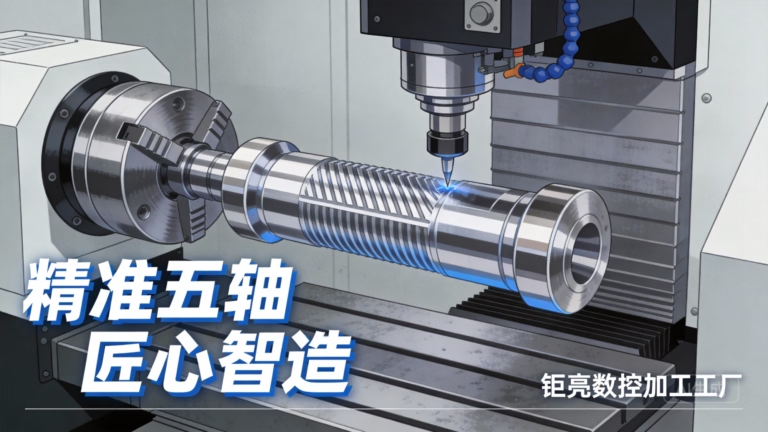
How a 7 Axis CNC Machine Differs from 5-Axis
Axis count is not a ranking. A 3-axis mill moves the tool in X, Y and Z while the part sits still. A 5-axis machine adds two rotary axes so the tool can approach a surface from almost any direction. A 7 axis CNC machine adds two more coordinated motions on top of that, and the controller keeps all seven moving in step.
Those two extra axes are not always rotary. On mill-turn equipment the seventh axis is often a subspindle that picks up the part after the first side is cut and machines the back without an operator touching it. On robotic cells the extra motion belongs to an arm that holds the workpiece instead of the tool.
The practical difference shows up in setup count. Every time a part is unclamped and re-fixtured, the datum shifts by whatever your fixture repeatability is. If that number is 0.02 mm, you cannot hold a 0.01 mm true position across two setups no matter how good the spindle is. Seven axes let the machine establish those relationships itself.
The cost is real. Programming takes longer, simulation is mandatory, and a crash in coordinated motion is expensive. A 7 axis CNC machine earns its keep on parts where geometry and tolerance relationships are the hard part, not on parts that are simply large or simply round.
The Two Builds You Will Actually See
The first build is a spindle carrier with an articulated head plus a powered worktable. The head provides two rotary motions, the table provides one or two more, and the remaining axes come from linear travel or a second spindle. This is the layout behind most mill-turn centers and it is the one that handles shaft-type and prismatic parts in the same cycle.
The second build couples a 6-axis articulated robot arm with a rotating table or a 2-axis spindle head. The arm controls X, Y and Z plus three wrist rotations, which is six axes. Add the table or the head tilt and you reach seven coordinated motions. Robotic cells suit very large or awkward parts where the part must move to the tool.
Both builds need a controller that can interpolate all seven axes together. That is the part people underestimate. Seven axes of simultaneous motion means the post-processor, the kinematic model and the collision simulation all have to be correct before the first chip is cut.
In our own shop the workhorse is still a 5-axis machining center, and we have 16 of them running simultaneously. We add robot handling or a subspindle when the part family justifies it. The extra axes are a tool for a specific problem, not a default upgrade.
What Seven Coordinated Axes Buy You on the Part
The first benefit is one-setup completion of critical features. When a bore, a face and a bolt pattern are all cut in the same clamping, their relationships come from the machine's own accuracy instead of the repeatability of two fixtures. That is how ±0.005 mm true position across a part stays achievable.
The second is tool access. A 5-axis machine reaches five faces of a cube, but it cannot always get the tool shank clear of the part on deep pockets or undercut flanges. The extra articulation lets the holder swing away from a wall without losing the cutting point. Long-reach tools chatter, and chatter is what ruins Ra 0.8–1.6 μm finishes on side walls.
The third is unattended second-side work. A subspindle or a robot that flips the part removes the operator from the loop, which removes the variability that comes with it. For a 10,000-part run, that flip is often the difference between holding a 3–5 day ship window and missing it.
None of this changes the physics of cutting. Seven axes do not make a tool stiffer or a material easier to machine. Titanium TC4 still needs low surface speed and heavy coolant. The axes change how you present the tool, not how the tool behaves.
Where the Extra Axes Stop Helping
Short, simple parts lose money on a 7 axis CNC machine. If a bracket is finished in two operations on a 3-axis mill in 8 minutes, moving it to a seven-axis cycle adds programming time, simulation time and setup cost with nothing gained. The part does not get better. It just costs more.
Tight-tolerance bores that need a single continuous cut are another boundary. If the geometry allows a 5-axis machine to interpolate the feature in one pass, adding axes only adds stack-up. Every additional rotary axis brings its own angular error and its own thermal drift, and those add to the error budget.
Deep, narrow cavities remain a problem regardless of axis count. Seven axes cannot reach a pocket that is 4 mm wide and 60 mm deep with a tool that has enough stiffness to cut it. That part is a job for EDM or a different design, not a different machine.
Programming and simulation hours are the hidden cost. A seven-axis cycle on a complex part can take several days to prove out. If your order quantity is one prototype, that time may not be recoverable. If it is 500 units, it usually is.
5-Axis vs 7 Axis: Which Fits the Part
Match the machine to the geometry, not to the marketing
| Part characteristic | 5-axis center | 7 axis CNC machine |
|---|---|---|
| Faces reached in one setup | Up to five | Five plus back-side or undercut |
| Typical setup count | One or two | Usually one |
| Best batch size | 1 to 10,000+ | Prototype through high volume |
| Programming effort | Moderate | High; simulation required |
| Typical size envelope | Up to 4,000 mm | Large or awkward parts |
| Second-side handling | Manual re-fixture | Subspindle or robot arm |
| Error budget | Two rotary axes | Four or more rotary motions |
| When it wins | Prismatic parts, tight bores | Shafts, deep pockets, complex relationships |
Pick the Machine That Matches the Tolerance Map
If your critical tolerances are on one or two faces and the part fits a 5-axis envelope, use a 5-axis center and save the programming hours. Choose a 7 axis CNC machine when critical features sit on opposite sides of the part, when a deep pocket needs shank clearance, or when second-side handling drives your cost. The axis count should follow the print, not lead it.
Common Questions
Is a 7 axis CNC machine always better than a 5-axis machine?
No. Seven axes solve a specific problem: getting to features on opposite sides of a part, or clearing the tool shank in deep geometry, without re-fixturing.
For a simple prismatic part with tolerances on one face, a 5-axis machine will hit the same numbers faster and cheaper. The extra axes add programming and simulation time that a simple part cannot absorb.
How many axes does a mill-turn center actually have?
Most mill-turn centers are built as 7-axis or 9-axis machines. The base count comes from the linear and rotary motions of the main spindle, plus a subspindle or a second turret.
The important number is not the total. It is how many axes the controller can move at the same time. A machine with nine axes where only five interpolate is a 5-axis machine in practice.
Can a 7 axis CNC machine hold ±0.005 mm?
It can, but the tolerance comes from the whole system: machine geometry, thermal stability, tool wear and inspection. Axis count alone does not set the achievable tolerance.
Every rotary axis adds angular error to the stack-up. That is why a seven-axis cycle needs a clean error budget and 100% inspection before shipment, not just a capable machine.
What materials run well on seven-axis equipment?
Aluminum grades such as 6061-T6, 7075 and 6082 are the easiest because they cut fast and generate less heat. Stainless 303, 304 and 17-4PH also run well when speeds and feeds are set for the work hardening behavior.
Titanium TC4 and Inconel are machinable but slow. The seven-axis advantage is fewer setups, not higher removal rate. On these alloys a mistake in the cycle is expensive, so prove-out on a soft material first.
Does seven-axis machining cost more per part?
The hourly rate is higher and the programming is longer, so for a one-off the cost per part is usually above a 5-axis cycle. That reverses at volume.
Once the cycle is proven, one-setup completion and automatic second-side handling cut labor and fixture cost. From a few hundred units upward, the seven-axis route often comes out ahead on total cost.
Send the Print and We Will Tell You the Axis Count
Upload your model and tolerances. You get a quotation and a free DFM analysis within 12 hours, plus a straight answer on whether seven axes help your part or just add cost.
12-hour quote100% inspectionNo minimum orderNDA on request
More Machining Notes
We publish setup notes, tooling trials and inspection data from the factory floor.











