
What Is a 9 Axis CNC Machine?
This page explains where the extra rotary motions sit in the kinematic chain, which parts benefit, and when the machine is the wrong answer. Written for design engineers and buyers who have to choose a process, not a brochure.
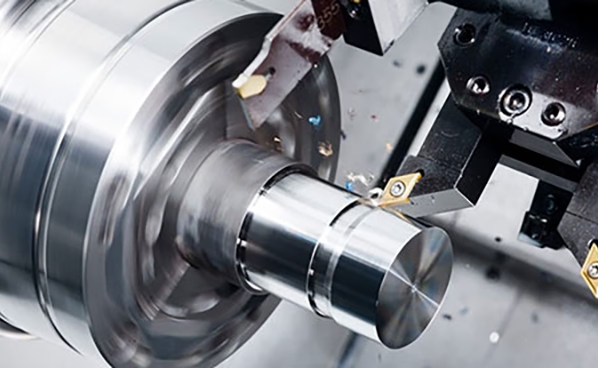
What the nine axes on a 9 axis CNC machine actually are
The name is not a single machine type you can order by name. It is a count of controlled motions on one platform. Three of them are linear: X, Y and Z. The other six are rotary, and where they live matters more than the number itself. On most 9-axis platforms, two rotary axes tilt and rotate the tool or the workpiece head, and additional rotary axes handle things like a second spindle, a sub-spindle, or a bar feeder that indexes the stock.
That difference separates a true 9-axis mill-turn center from a 5-axis mill with a trunnion table. A 5-axis machine gives you two rotary motions, usually A and C. A 9-axis machine may carry a B-axis head, a C-axis table, a second turret, and a sub-spindle that all move under one program. The controller interpolates them together, so the tool tip stays on path while the part is repositioned underneath it.
For a buyer, the practical test is simple. Ask how many axes cut at the same time, and how many just index. A machine that swings a rotary table into place and then locks it is not doing simultaneous 9-axis work. It is doing 3+2 positioning with extra setup flexibility. Both are useful. They do not cost the same, and they do not hold the same tolerance on a contoured surface.
How rotary axes change the cutting mechanics
Adding rotary motion does more than reach the back of a part. It changes the direction of the cutting force and the stiffness of the loop between tool and workpiece. When the tool is short and the rotary axis is directly under the part, the setup is stiff. When the rotary axis is far from the tool, the overhang grows and chatter starts. That is why a 9 axis CNC machine with a long B-axis head is not automatically better than a compact 5-axis trunnion.
The second effect is surface speed. On a contoured surface, a rotary axis keeps the tool normal to the surface and the contact point moving. That spreads wear and holds a steadier chip load. Turn the same part on a 3-axis machine and you either tilt the part by hand between setups or use a ball nose cutter at a shallow angle. The second option leaves a rougher finish and needs more hand polishing.
The third effect is thermal. Six rotary axes mean more servos, more friction, and more heat near the part. On long cuts in aluminium, we see growth in the tenths of a millimetre range if the machine runs hard without a warm-up cycle. A warm-up program of 15 to 30 minutes before the first tight cut is normal practice, not a luxury.
Which parts justify the extra axes
The parts that pay for a 9 axis CNC machine share three traits. They have features on five or more faces, they need those features in one datum, and the material is expensive enough that a scrapped part hurts. A hydraulic manifold with cross-drilled ports on four sides fits. So does an impeller with twisted blades, or a medical bone plate with compound curvature and screw holes at odd angles.
Parts that do not fit are just as easy to name. A flat bracket with holes on two faces. A shaft with a keyway. A housing that needs one bore and a face. On these, a 3-axis or 4-axis machine cuts faster because the setup is simple, the tool is short, and there is no rotary error stack to manage. Sending that work to a 9-axis center adds machine time without adding value.
There is a middle group: parts with one or two angled features on an otherwise simple body. Here a 5-axis machine with a trunnion usually wins. Two rotary axes are enough to reach the angle, the machine is cheaper per hour, and the programming is shorter. The 9-axis platform only pulls ahead when the part needs simultaneous motion on more than two rotaries, or when the cycle also involves turning.
Where the limits show up in real work
Accuracy is the first limit. Each rotary axis adds a small angular error, and the errors stack as the part turns. On a well-kept machine we hold ±0.005 mm on a milled feature and Ra 0.8–1.6 μm on a fine-bored wall. That assumes the part is rigid and the cut is not at full reach. Push the tool to the corner of the work envelope and those numbers widen.
Rigidity is the second limit. A rotary table rated at Ø400 mm carries less load when it is tilted than when it is flat. Heavy parts on an angled axis deflect, and the cutter pulls them further. For a 4,000 mm long part, we often run the first op on a large 3-axis gantry and bring the workpiece to a 9-axis center only for the angled features. That split keeps the heavy roughing off the rotary axes.
Programming and proving are the third limit. Simultaneous motion on six axes needs a post-processor that matches the exact machine build. A generic post will collide. The first article usually takes longer to prove than the same part on a 5-axis machine, and the operator needs to watch the simulation, not just the screen. Budget for that time. It is real, and it does not disappear with a newer controller.
9 axis vs 5 axis vs 3 axis: pick by part, not by spec sheet
Use the row that matches your part geometry, not the machine with the highest axis count.
| Machine | Best for | Typical tolerance | Watch out for |
|---|---|---|---|
| 3 axis | Flat plates, simple pockets, one-face work | ±0.005 mm | Extra setups multiply datum error |
| 4 axis | Shafts, keyways, holes around a diameter | ±0.005 mm | Angled faces still need a second op |
| 5 axis (trunnion) | Impellers, housings, 3+2 angled drilling | ±0.005 mm | Long tools chatter on deep cavities |
| 5 axis (mill-turn) | Turned parts with cross features | ±0.005 mm | Bar capacity limits part diameter |
| 9 axis | Multi-face parts, one datum, hard material | ±0.005 mm | Higher hourly rate, longer prove-out |
The choice in one line
If your part needs features on five or more faces held to one datum, the extra axes earn their keep; if it needs one angled hole on a flat block, a 5-axis machine cuts it for less money and less risk.
Common questions
Is a 9 axis CNC machine the same as a 9-axis machining center?
Usually yes in daily speech, but the counts come from different places. A machining center counts spindle and table motions. A mill-turn center may count a sub-spindle and a bar feeder as axes too.
Ask the builder to list every controlled axis and mark which ones move at the same time. That list settles the question faster than the model name.
Can a 9 axis machine hold tighter tolerance than a 5-axis machine?
Not by itself. Tolerance comes from the machine's geometry, the thermal state, and the rigidity of the setup. A good 5-axis machine holds ±0.005 mm all day.
The 9-axis platform helps when one setup replaces three. Removing two re-clamps often removes more error than the extra rotary axes add.
What materials run well on these machines?
Aluminium grades like 6061 and 7075, stainless such as 316L and 17-4PH, and titanium TC4 (Ti-6Al-4V) are common. The one-setup advantage matters most on titanium and Inconel, where a re-clamp can scrap an expensive part.
Plastics like PEEK and POM also run, but watch clamping force. A tilted rotary table can mark a soft part.
How long does programming take?
A simple 3+2 job might be programmed in a few hours. Simultaneous motion on five or six axes takes longer because the post-processor and the simulation have to be verified against the machine.
Send a STEP file and we return DFM feedback with the quote, usually within 12 hours.
Do I need a 9-axis machine for a prototype?
Rarely. Most prototypes have one or two critical features and can be cut on a 5-axis machine or split across two setups.
If the prototype is also the production geometry and the datum stack is the risk, running it on the final platform makes sense.
How do you inspect a part machined on nine axes?
We check raw material on arrival, monitor dimensions in process, and inspect the finished part before shipment. Reports are available on request.
For multi-face parts, a CMM program built from the same datum as the CAM model catches the errors that matter.
Send the part, get a process recommendation
Upload a STEP file and we will tell you which machine fits, what it costs, and where the tolerance risk sits.
12-hour quote100% inspectionNDA on request
More from the shop floor
We publish setup notes, tooling trials and inspection data from the factory floor.











