
What Is the Most Axis on a CNC Machine?
Practical machines today top out at 11 programmable axes, and most of those are on mill-turn or Swiss-type platforms. This page breaks down what each axis does, where the limit comes from, and how to tell whether you actually need more than five.
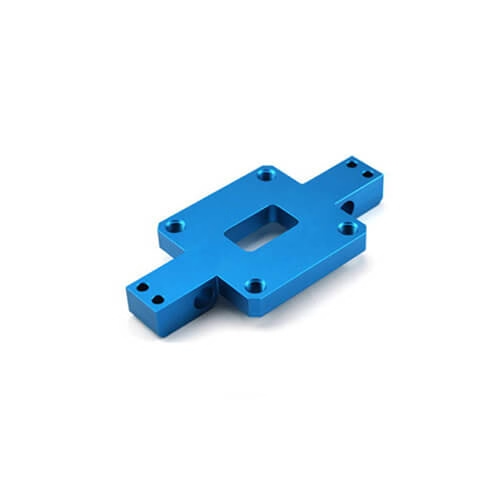
How axes are counted on a CNC machine
Every CNC machine moves a tool relative to a workpiece along controlled directions. The three linear axes are X, Y and Z. X and Y run horizontally, Z runs vertically along the spindle or the part centerline. A 3-axis mill moves the table in X and Y and the spindle in Z, all at the same time, which is enough for flat pockets, drilled holes and simple contours.
Rotation is where the count grows. A, B and C are rotary axes around X, Y and Z. The naming follows the linear axis they rotate about, not the direction the table physically tips. An A axis turns around X, a B axis around Y, a C axis around Z. On a trunnion table you often see A plus C: one tips the part, the other spins it.
Positioning axes are not the same as simultaneous axes. A machine can carry a rotary table that only indexes between cuts, one position at a time. That table is still an axis in the controller, but it does not interpolate with X, Y and Z while the cutter is in the material. When people ask about the most axis on a cnc machine, the honest answer depends on which of these two counts they mean.
Simultaneous axes are the ones that matter for surface quality. If four or five axes move together, the tool tip stays normal to a curved surface through the whole pass. That is what keeps scallop height even on a turbine blade or a sculpted mold cavity. Indexed axes change the setup, not the toolpath.
The most axis on a cnc machine in current production
For milling centers, the practical ceiling is five simultaneous axes. Three linear plus two rotary. Beyond that, you are usually stacking a second spindle or a subspindle onto a lathe platform rather than adding a sixth direction of travel to a mill.
The real high counts show up on mill-turn and Swiss-type machines. A mill-turn center with a B-axis head, a lower turret and a subspindle can carry eight to eleven programmable axes. A Swiss-type sliding-head lathe commonly runs seven to nine, because the guide bushing, the main spindle, the subspindle and the tool turrets each add motion.
So the number you see on a spec sheet is often a machine total, not a simultaneous count. An 11-axis machine may only interpolate five of those axes at once. The rest position, retract or transfer the part. That distinction changes what the machine can cut, and it changes the price.
There is no hard engineering limit at eleven. The limit is thermal stability, controller interpolation speed, and whether anyone can justify the cost. Every added axis adds a stack of positioning error and a longer setup. Past a certain point, extra axes buy flexibility on one part family, not better accuracy.
What the extra rotary axes actually do
The A axis tips the workpiece or the head around X. On a trunnion machine it is the axis that lets a ball cutter reach the underside of a flange without a second setup. Travel is usually ±110° or ±120°, which covers most of a sphere except the pole directly under the clamp.
The B axis rotates around Y. On a swivel-head machine it tilts the spindle itself, so the part stays flat on the table. This matters for heavy parts. Moving a 200 kg casting through an arc is harder than tilting a 15 kW spindle head.
The C axis spins around Z. Combined with A or B it gives continuous 5-axis contouring. This is the pair that produces smooth, blended surfaces on a curved part. Without C, you can still reach the feature, but you often have to stop and re-index, which leaves a witness mark.
On turning platforms, the extra axes are usually a Y axis on the turret, a second spindle, and a bar feeder or subspindle motion. They exist so a part can be cut on both ends without a human touching it. That is a cycle-time argument, not a geometry argument.
When more axes help, and when they do not
More axes help when a feature is unreachable from any single direction. A cross hole that meets a deep internal bore at an angle is a classic case. On a 3-axis machine you would need a custom fixture and two or three setups, and each setup adds stack-up error. On a 5-axis machine the same hole is one operation.
They also help when setup count drives cost more than cycle time. A housing with features on five faces might need five fixtures on a 3-axis mill. If the annual volume is low, the fixture cost never amortizes. Five-axis work absorbs it in the toolpath.
They do not help when the part is prismatic. A flat bracket with holes on two faces is cheaper and faster on a 3-axis machine with a simple vise. Adding rotary axes only adds setup time, tool reach problems, and a longer program to prove out.
Rigidity is the hidden cost. A trunnion table hangs the part out on a rotating cradle. That is less stiff than a part bolted flat to a table. On hard materials or heavy interrupted cuts, a 3-axis setup with a rigid fixture can hold tighter tolerance than a 5-axis setup on the same part. Choose based on the feature, not the brochure.
There is also a programming cost. A simultaneous 5-axis toolpath needs collision checking, post-processor tuning and usually a prove-out cut. For a one-off prototype, that effort can exceed the machining time. For a 10,000-part run, it disappears into the piece price.
How we match axis count to a part at GreatLight
We run 127 high-precision CNC machines across three wholly-owned plants, including 16 simultaneous 5-axis machining centers, 12 four-axis mills, 27 three-axis machines and 16 mill-turn centers. That mix lets us pick the platform that fits the geometry instead of forcing every job onto the newest machine.
The first question is reach, not axis count. If every feature is visible from one direction, a 3-axis machine with a good vise is the fastest and most rigid answer. If a feature sits on a face that cannot be reached without re-clamping, we look at 4-axis or 5-axis.
Tolerance decides the rest. Our standard working tolerance is ±0.005 mm (±0.0002 in), with surface finishes from Ra 1.6–3.2 μm as machined down to Ra 0.2–0.8 μm when a fine finish is specified. A rotary setup that cannot hold that tolerance is the wrong setup, no matter how many axes it has.
Max processing size is 4,000 mm on our largest platform, with common envelopes of 4,000 × 400 × 150 mm, 750 × 1,150 × 550 mm and 600 × 600 × 600 mm. Smaller cells cover 500 × 500 × 450 mm and 500 × 310 × 200 mm, and we use a Ø400 mm rotary table where an indexer is enough.
Materials run from aluminium 6061 and 7075 to 17-4PH stainless, Ti-6Al-4V, Inconel and engineering plastics such as PEEK and POM. The harder the material, the more we favor fewer axes and a stiffer setup. Inconel and titanium punish any flex in a trunnion.
Every part gets a raw material check, in-process monitoring and a final inspection before shipment, with reports on request. Our historical qualification rate is 99.99%. If a drawing needs an axis count we cannot hold, we say so at the quote stage rather than after the first article.
Axis count by machine type
Simultaneous axes are what shape the cut. Total axes include indexing and transfer motions.
| Machine type | Typical total axes | Simultaneous | Best fit |
|---|---|---|---|
| 3-axis vertical mill | 3 | 3 | Prismatic parts, flat faces, drilled holes |
| 3+1 mill with indexer | 4 | 3 | Four-sided work in one setup |
| 4-axis horizontal mill | 4 | 4 | Cylindrical parts, slots, wrap-around features |
| 5-axis trunnion mill | 5 | 5 | Impellers, medical implants, deep cavities |
| 5-axis B-head mill | 5 | 5 | Large parts, 4,000 mm envelope work |
| Mill-turn center | 6 to 9 | 4 to 5 | Shafts with milled flats and cross holes |
| Swiss-type lathe | 7 to 11 | 3 to 5 | Small long parts, medical and connector pins |
The short answer
If your part has features on more than two faces, choose 4 or 5 simultaneous axes and skip the extra fixtures. If your part is prismatic and fits one setup, choose 3 axes and get better rigidity for less money.
Questions engineers ask next
Can a machine have more than 11 axes?
Controllers and mechanics can support more. The practical ceiling sits around 11 on production machines because that is where mill-turn and Swiss platforms stop adding useful motion. Beyond that, builders add a second machine or a robot cell instead of another axis.
Two spindles, two turrets and a bar feeder already produce a long list of axes. Adding a twelfth rarely removes a setup that the eleventh did not already remove.
Does more axes mean better accuracy?
No. Each rotary axis adds a positioning stack: encoder error, backlash, thermal drift and cradle deflection. A well-built 3-axis machine on a rigid fixture often holds tighter tolerance than a 5-axis machine on the same part.
Axis count buys reach and setup reduction. Accuracy comes from the machine build, the fixture and the thermal control, not from the count.
What is the difference between 3+2 and 5-axis?
3+2 uses two rotary axes to position the part, then locks them and cuts with three linear axes. It is sometimes called positional 5-axis. The tool stays at a fixed angle for each pass.
True 5-axis interpolates all five axes at once. The tool angle changes continuously through the cut. That is what produces a blended surface on a curved part, and it is what needs collision-checked toolpaths.
Can you reach a part with a deep cavity on 3 axes?
Sometimes, with a long reach tool. The limit is tool deflection. A tool with a 4:1 length-to-diameter ratio starts to chatter, and finish and tolerance both suffer.
If the cavity is deeper than that, a 5-axis machine with a tilted head keeps the tool short and the setup rigid. The axis count is solving a tool reach problem, not a geometry problem.
How fast can I get parts with a multi-axis setup?
We return a quotation and a free DFM analysis within 12 hours. Production can start within 24 hours, and parts typically ship in 3–5 days. There is no minimum order quantity, so a single prototype and a 10,000-part run go through the same process.
Uploads are treated as confidential, and we sign an NDA on request before drawings are shared.
Which materials are hardest on multi-axis setups?
Titanium, Inconel and hardened tool steel. They cut with high radial force, so any flex in a trunnion or a long tool holder shows up in the surface. We usually reduce axis count and increase fixture stiffness for those jobs.
Aluminium 6061 and 7075, brass and most engineering plastics handle 5-axis contouring without that penalty.
Send the drawing, get an axis recommendation
We review your geometry, tell you the axis count that fits, and quote it with a free DFM analysis within 12 hours.
12-hour quote100% inspectionNo minimum order
More from the shop floor
We publish setup notes, tooling trials and inspection data from the factory floor.











