
What Makes a Greater Than 6 Axis CNC Machine?
A 3-axis mill moves the tool in X, Y and Z. Everything above that is a question of how many directions move at once, and how many of them belong to the part instead of the cutter. This page explains what a greater than 6 axis CNC machine actually adds, when the extra axes pay for themselves, and when a 5-axis center does the same job for less.
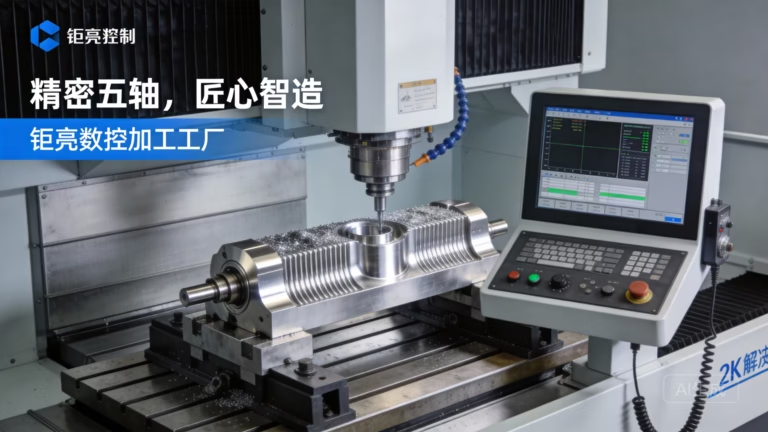
What Counts as a Greater Than 6 Axis CNC Machine
An axis is one programmable direction of relative motion between the tool and the workpiece. A standard 3-axis mill has three linear axes: X, Y and Z. A 5-axis machine adds two rotary axes, usually A and C, so the tool can approach a curved surface from an angle instead of straight down. The count is simple arithmetic, but the meaning is not.
A greater than 6 axis CNC machine adds motion beyond that. The extra axes usually come from two places. The first is a second spindle or subspindle that can hold and rotate the part independently. The second is an additional rotary table or a B-axis head that tilts the tool. Both add degrees of freedom that the controller must coordinate in real time.
That last point matters more than the number. On a 3-axis mill, the programmer plans a path; the machine follows it. On an 8-axis or 9-axis mill-turn center, the controller solves a kinematic chain every few milliseconds so that nine motors arrive at the right position at the same instant. Two of those axes may be moving the part while three are moving the tool.
So the honest definition is not a count of motors. It is whether more than six axes move under simultaneous interpolation control, and whether the controller can hand a part from one spindle to another without stopping the cut. Machines that index an extra axis between operations are not really in this class.
- 1Simultaneous, not indexedAll counted axes must interpolate together, not move one at a time.
- 2Two motion groupsTool-side and part-side axes are coordinated by one controller.
- 3Transfer countsA subspindle that takes over the part adds usable axes.
Where the Extra Axes Come From on the Machine
Most of these machines are mill-turn centers, not mills with extra knobs. A bar feeder pushes stock into the main spindle, which turns it like a lathe. A milling head with B and C rotation cuts flats, slots and pockets on the same part. A lower turret may work the opposite side while the upper head is still cutting.
The subspindle is the piece that changes the workflow. It can pick up the finished end of the part, pull it out of the main spindle, and machine the back face without an operator touching it. On a 9-axis center, that transfer is part of the program, not a manual step. The part is cut off, faced, drilled and dropped into a chute.
Rotary tables add the other half. A trunnion table tilts and rotates the workpiece, which is how aerospace and medical shops reach five faces in one setup. On a larger platform, two rotary tables can serve two spindles at once, so one machine runs two part families in parallel.
None of this is free. Each added axis brings its own servo, encoder, cable run and thermal drift. A 9-axis machine has roughly twice the failure points of a 5-axis one. That is why the number of axes is a capability statement, not a quality statement.
- 1Mill-turn layoutTurning spindle plus milling head with B and C rotation.
- 2SubspindleTakes the part for back-side work with no manual reload.
- 3Dual rotary tablesTwo spindles can run two jobs in parallel on one platform.
The Controller Is the Real Bottleneck
Kinematics is the math that turns a toolpath in part coordinates into motor commands. With three axes it is trigonometry. With nine, each commanded point depends on the position of every other axis, and the solution has to be found fast enough to keep the feed moving. A slow look-ahead forces the machine to dwell, and dwell marks show up on the surface.
Real controllers handle this with look-ahead blocks, typically thousands of them, plus feed-rate planning across corners. The practical effect for a buyer is that two machines with identical iron can perform very differently. Ask for the controller model, the number of look-ahead blocks, and whether the post-processor is proven on your part geometry.
Thermal behavior also lives here. When a subspindle and a milling head run at the same time, the frame heats unevenly. Good controllers compensate with ballscrew cooling and thermal growth models. Without that, a machine that holds ±0.005 mm in the morning can drift past it by the afternoon shift.
Tool setting is the last piece. On a multi-axis machine a small tool-length error rotates into a position error that changes with the tilt angle. Probing routines that measure the tool on the machine, not just offline, keep that error bounded.
- 1Look-ahead depthMore blocks means smoother motion through tight corners.
- 2Thermal compensationBallscrew cooling holds tolerance across a long shift.
- 3In-machine probingCatches tool-length error before it becomes position error.
When the Extra Axes Are Not Worth It
A greater than 6 axis CNC machine earns its keep when a part needs work on faces that cannot be reached without re-clamping, or when the volume is high enough that manual reloads cost more than the machine hour. Bar-fed parts with features on both ends are the classic case. So are housings where a second setup would introduce a position error larger than the tolerance.
Outside that, the math turns against you. Programming a 9-axis cycle takes far longer than a 5-axis one, and the post-processor has to be validated on real stock. Fixture and tooling costs run higher because more of the work happens in one operation. For a 20-piece prototype run of a part that a 5-axis center can reach in two setups, the simpler machine usually wins on both cost and lead time.
Material matters too. Aluminum and brass cut fast enough that multi-axis cycles finish quickly and the machine hour is well spent. Titanium and Inconel cut slowly, so the same cycle can occupy a 9-axis center for hours. In that case, splitting the work across a lathe and a 5-axis mill may free the expensive machine.
There is also a quality angle. Every extra setup is a chance to lose position. If a drawing calls for a bore and a mating face within ±0.005 mm of each other, doing both in one clamping is often the only reliable route. That is a metrology argument, not a speed argument.
- 1Good fitBar-fed parts with features on both ends, high annual volume.
- 2Poor fitLow-volume parts a 5-axis center reaches in two setups.
- 3Slow materialsTitanium and Inconel can tie up an expensive spindle for hours.
How We Program and Prove Out Multi-Axis Work
Multi-axis work starts in simulation, not on the machine. We build the stock model, the fixture and the tool assembly, then run the full cycle in CAM to check for collisions between the subspindle, the turret and the part. A crash on a 9-axis center is expensive in a way that a 3-axis crash is not.
Prove-out uses a sacrificial blank or a soft material first. We check the transfer position between the main spindle and the subspindle with an indicator, then cut a test part and measure the features that depend on the transfer. Only after that does the cycle run on the real material.
For production, we hold ±0.005 mm on critical features and Ra 0.8–1.6 μm on machined surfaces where the drawing calls for it. In-process probing catches drift on long runs, and every part gets a final inspection before shipment, with reports available on request.
Our floor runs 127 high-precision CNC machines, including 16 simultaneous 5-axis machining centers and 16 mill-turn centers, with a maximum processing size of 4,000 mm. That mix lets us route a part to the smallest machine that can finish it in one setup instead of forcing it onto the largest one.
- 1Simulate firstStock, fixture and tool assembly checked for collisions in CAM.
- 2Prove on soft stockVerify transfer position before cutting real material.
- 3Probe and inspectIn-process probing plus 100% inspection before shipment.
Which Machine Fits the Part
Pick the smallest machine that reaches every feature in one setup.
| Machine | Typical axes | Best for | Watch out for |
|---|---|---|---|
| 3-axis mill | 3 | Prismatic parts, flat faces, simple holes | Multiple setups on complex parts |
| 4-axis mill | 4 | Cylindrical parts with milled flats | Reach limits on angled features |
| 5-axis center | 5 | Curved surfaces, deep pockets, one-setup work | Fixture and programming cost |
| Mill-turn center | 7 to 9 | Shafts and housings needing back-side work | Higher setup and tooling cost |
| Dual-spindle mill-turn | 9 to 12 | Bar-fed parts finished in one cycle | Long programming and prove-out time |
The Short Answer
If your part needs back-side features and you run it in volume, a greater than 6 axis CNC machine removes setups and pays back. If it fits on a 5-axis center in two setups at low volume, stay with the 5-axis machine.
Common Questions
Is a 7-axis machine always better than a 5-axis one?
No. More axes mean more programming time, more tooling cost and more places for the machine to drift. A 5-axis center that reaches every feature in two setups is often cheaper per part at low volume.
The extra axes win when a part has features on both ends and the volume justifies a bar-fed cycle.
What does a subspindle actually add?
A subspindle is a second workholding spindle that can take the part from the main spindle and rotate it. That lets the machine cut the back face, bore and chamfer without an operator reloading it.
In practice it removes one or two setups and the position error that comes with them.
Can these machines hold ±0.005 mm?
Yes, on critical features, provided the frame is thermally stable and the tool is probed on the machine. Thermal growth is the usual reason a multi-axis machine drifts out of tolerance during a long shift.
Ballscrew cooling and in-process probing keep that error bounded.
Which materials suit multi-axis cycles best?
Aluminum grades such as 6061 and 7075, brass and stainless cut fast enough that a one-setup cycle finishes quickly. Titanium and Inconel cut slowly and can occupy an expensive spindle for hours.
For those materials, splitting work across a lathe and a 5-axis mill may be the better route.
How long does the first article take?
Quotation and DFM analysis come back within 12 hours, and production can start within 24 hours of approval. Parts typically ship in 3–5 days.
Multi-axis first articles take longer because the transfer position and the post-processor must be proved out before the run starts.
Do you sign an NDA for multi-axis projects?
Yes. Uploads are secure and confidential, and an NDA is available on request. We can review drawings under NDA before quoting.
That applies to prototype quantities as well as production runs.
Send Us the Part That Needs More Than Six Axes
Upload your drawing and we will tell you whether it needs a multi-axis cycle or a simpler machine, with a quote inside 12 hours.
12-hour quote100% inspectionNo minimum order quantity
More Machining Notes
We publish setup notes, tooling trials and inspection data from the factory floor.











